Showing posts with label mothers and daughters. Show all posts

Monday, April 4, 2011

Review: Bitter Melon by Cara Chow

Speech geeks unite!

Debate gets brought up all the time as a geeky competitive high school activity, but I never did it. Because I was caught up in something even geekier: forensics, aka competitive public speaking. So when I saw that Frances joins the speech team in this book, I knew I had to read it, because speech geeks don't get nearly enough love.

Bitter Melon
Frances's life revolves around her mother. Her mother, an immigrant from China, demands utter perfection from her daughter, sending her to an academically challenging high school to ensure Frances will get into a prestigious college with plenty of scholarships to propel her through medical school, after which Frances will be able to take care of her.

The only problem in this scenario - Frances isn't positive that she wants to follow her mother's map for her life. When Frances is accidentally assigned to speech class rather than calculus, at first she figures she'll just sit in the class for a week or two and then transfer to the right one before the deadline. But as the hip and cool teacher recognizes an innate speaking ability in Frances, she ends up sticking around - the first secret she's kept from her mother. Frances knows on the one hand she is being ungrateful - her mother truly has made great sacrifices, working long hours in order to afford Frances' tuition, not to mention clothes, food and rent. But until taking this speech class, Frances has never had the opportunity to consider her own desires, and what might be driving her mother's quest for Frances' excellence. Is her mother truly concerned for Frances' future? Or merely her own?

Frances's mother isn't a nice person. This is probably an understatement. Reading the physical and, especially, the verbal abuse she puts Frances through is absolutely painful. But Chow does an excellent job of slowly revealing the abuse, as Frances's world is slowly opened through her experiences on the speech team. It's not so much that the team magically opens Frances's eyes, but rather as her teacher encourages her hidden talent, Frances begins to understand the power that words can hold.

While Frances and her mother have a very complex relationship that is the core of the novel, most of the other relationships suffer from lack of definition. The friendship between Frances and Theresa especially seems to be one of convenience, as the girls quickly befriend each other after one kind act on Theresa's part, as Frances seems to have resented the girl for years. After that the friendship's up and downs seem to be defined more by what will complicate Frances' life more than anything else. The romantic subplot also takes awhile to get going, and while her crush's personality may not be the most well developed, the details of their relationship were refreshingly authentic - overpowering deodorant, clammy hands, and sweaty outfits all called to mind my early romances more than any idealized romance novel ever could.

As a speech geek, I can totally vouch for the authenticity of the competitive aspects of the book. Frances' competitions superficially differ from how mine were set up, but different states have different rules, and of course she was competing over 10 years before I entered the high school speech scene. But there are some emotional aspects that will always ring true - and every speaker has faced terrible audience members like Frances' nemesis throughout the book! In more ways than one, the scenes of Frances' speech career are a light and necessary break from the oppressiveness of her home life.

Monday, February 7, 2011

Review: Keep Sweet by Michele Dominguez Greene

Found via: 2011 Amelia Bloomer Project

I'm kind of beginning to feel like when it comes to stories of fundamentalist religious societies, all of the stories have been told. This is the third title about FLDS compounds I've read for young adults that has been published in the last three years, and all of the stories share the exact same structure (the other two titles being Sister Wife and The Chosen One)

Keep SweetAlva Jane has never questioned the tenets of living amongst the FLDS faithful in Pineridge. She comes from a long line of women who keep to the Principle - that a man must engage in plural marriage in order to secure his and his family's places in heaven. She is anxiously waiting for her period to start, signalling that she is a woman and ready to marry - hopefully to the young and kind Joseph John, which would also give her the status and privileges associated with being a first wife.

But when an innocent meeting between the two love birds is witnessed, both are fiercely punished, and Alva finds herself married to a cruel man old enough to be her father - a man who viciously beat one of his wives for attempting to escape Pineridge. Does Alva have the strength to defy the will of her husband, her family, and the very tenets of her faith, to find refuge in the world outside of Pineridge?

Well, if you've ever read any other books about young women in FLDS compounds, you already know the answer to that. You probably also know what Alva discovers immediately before she takes off. In an author's note, Greene notes that when she read accounts of women who've escaped FLDS life, their stories were all hauntingly similar, from British Columbia to New Mexico. That similarity is reflected in how many similarities Keep Sweet has to other YA books with similar settings. Obedient daughter who is enamored with a young man is punished for her curiosity by becoming the lowest wife on the totem pole to a much older man. About the only difference between Keep Sweet and other titles is that Alva Jane's parents show little to no remorse for the harsh treatment they heap upon her - they are more concerned with their own standing within the community than their daughter's happiness. This doesn't add much to the characterization of her father because he is so distant for much of the novel, but it does make her mother an interesting, if villainous, character.

On its own, there are few faults to be found with Keep Sweet, aside from an irritating habit in the first few chapters to go on page-long info-dumps about life in Pineridge and her family. If Keep Sweet were the only FLDS novel I'd ever read, I'd probably think it was pretty decent. However, the book doesn't exist in a vacuum, and ends up feeling quite derivative with nothing to separate it from the pack.

Thursday, January 13, 2011

Review: Jumpstart the World by Catherine Ryan Hyde

This one's been on my TBR list for awhile, but it's such a slim book that I put off reading it for awhile after picking it up from the library - short books like this I usually finish up in less than two subway rides, leaving me bored and bookless for part of my commute home. But then I heard some Printz rumblings for this and figured that a lazy Saturday night spent in bed, where I was trying to rest and kick the last bit of my week-long cold, was the perfect time to pick it up.

Jumpstart the WorldWhen Elle's mother picks up a new boyfriend that doesn't want to deal with a teenager in the house, she's set up in her own apartment on the other side of New York City. For most almost-16 year olds, this would be a dream come true, but Elle's just angry that her mother is pushing her aside for the comfort of her newest boyfriend - who, by the way, is taking her mother on a cruise over Elle's 16th birthday. There are only two good things about the new apartment: getting to pick out a new cat (a scared, scarred black cat, the antithesis of everything her mother likes), and her new neighbors - specifically Frank, who may be older and has a girlfriend, but Elle can't help immediately forming a little crush on him.

The new boyfriend also doesn't want to pay for Elle's private school, so she's starting a new school year at a new school, where the only people interested in being friendly are a group of outsiders, most of whom happen to be gay.

When Elle isn't sure she wants to be friends with this group - not that she's homophobic or anything - Frank is the one that listens to her. Frank and his girlfriend invite Elle over for homemade chicken soup, and introduce her to the wonders of photography. Just as Elle begins to acknowledge she's falling for Frank and falling hard, she's shocked to discover that "Frank" hasn't always been Frank - he is, in fact, a transgendered man. The truth turns Elle's world upside down, forcing her to search for the true meanings of friendship and family.

The writing here is spare but thoughtful, and feels very much like we have a direct line to Elle's thoughts. On that level I can totally see why there was Printz buzz for this. On the other hand, there's a stunning lack of character development. Elle, Frank and Elle's new school friend, Wilbur, are the only three that get any sort of depth, but even Frank and Wilbur feel more like stock characters. Here's how bad it was for me: at one point, Elle's cat is sick and needs to be given antibiotics twice a day. At the same time, one of the other characters ends up in the hospital and Elle is spending most of her time there. During this dramatic time, all I could think was that she needed to keep giving the cat antibiotics or it was going to die. I know my great love of cats probably makes me biased, but I really shouldn't have more sympathy for a cat than human characters.

Hyde does do a good job presenting Frank as just another character and never slips into being too didactic about the particulars of trans life. Details of Frank's transition, and of continuing issues as part of his trans identity, are integrated into the story and only those bits that have an impact on what's happening at the moment are included. I note this because the last book I read with a transgendered character was Almost Perfect, which did stop to explain the minutiae of transitioning. However, the presence of a transgendered character is about the only similarity between the two novels (I still highly recommend Almost Perfect - and, of course, so did the Stonewall Award committee!).

Wednesday, December 22, 2010

Review: Dragon Chica by May Lee Chai

Found via: Forever Young Adult

This is definitely a novel with cross over appeal - I'm pretty sure technically it's written as an adult novel, just because of stylistic quirks that aren't part of the YA tradition, but since it covers Nea's young adulthood (we meet her when she's 11 and follow her through the end of high school), it's definitely accessible to teens as well. I could definitely see this being one of those mother/daughter book club picks.

Dragon ChicaIt's the 1980s and Nea, her mother, older sisters, and three younger siblings, are scraping by in Texas. The only Khmer in the community - the only Asians, really - and not knowing if any of their relatives were also able to escape from the Khmer Rouge regime, Nea feels more isolated than the average 11 year old. So when an aunt and uncle write her mother, saying they now live in Nebraska and run a Chinese restaurant there, Nea's mother promptly packs up the family and their few belongings in their beat up car, and drive from Texas to Nebraska.

Nebraska is not the land of dreams as her aunt and uncle promised, however. While Chinese restaurants were prestigious in Cambodia, Nebraskans haven't developed a taste for Asian cuisine yet. The family spends long hours at the restaurant for little pay off, and eventually Nea's sister Sourdi is set up in an arranged marriage with a much older man who her uncle is in debt to. At 16, Sourdi is suddenly put into the role of a grown woman, and Nea loses the one person in the family she feels she can talk to. Nea spends the rest of her teen years feeling increasingly isolated and angry - at the hicks who shout racial slurs at her family, at the family the demands she works when she should be studying, and at the mother who doesn't understand her Americanized daughter.

While this novel covers ages and experiences that are often part of YA novels, it really brought into focus for me some of the stark contrasts between adult and YA. For one thing, YA novels don't usually last very long - I think covering the course of a single school year is the longest period of time I can think of off hand. More often the novel's events will happen in days or maybe weeks. Dragon Chica covers 7 years in under 300 pages. This isn't a criticism, as Chai does an excellent job of picking out the important events over those 7 years, but merely an observation of one of th major differences between YA and adult novels.

Nea's story is painful to read at times, as her family is the victim of some ugly racism. Her family also has some difficulty adjusting to their places in America - her younger siblings are too young to remember their time in Cambodia so they are excused from acting "American," while Sourdi is old enough that she has extensive memories of Cambodia and wishes in many ways to remain true to that heritage. Nea is truly a child of both worlds, with vague memories of Cambodia but an intense desire to fit in as much as possible with her American schoolmates. While parts of Nea's story are surely unique to the Cambodian immigrant experience, large parts of it also seem like they apply to all immigrants, and will be appreciated by anyone with close ties to another country and culture.

Thursday, September 30, 2010

Review: I Now Pronounce You Someone Else by Erin McCahan

I picked this one up because I was intrigued by the part about a girl in high school getting married. It's so rare that I find a YA book that deals with an event I have handled recently (like a wedding, as opposed to the long ago angst of wondering whether so-and-so liked me) that I wanted to see what was up. I then couldn't stop reading when I discovered the book is set not far from my hometown - and in fact, Bronwen's top college pick is my hometown's college!

I Now Pronounce You Someone ElseBronwen Oliver is convinced she's adopted. She and her mother have nothing in common (not even their hair color, though her mom tries to mask it with monthly salon visits to bleach out Bronwen's naturally brunette hair). From an early age she has convinced herself that she is actually Phoebe Lilywhite; she and the real Bronwen Oliver were switched at birth and any day now the Lilywhites will return to re-claim their lost daughter. As she approaches the end of high school this is seeming less and less likely, but Bronwen never stops yearning to find her "real" family.

Enter Jared Sondervan. An old friend of her older brother's (aka Jesus, judging by how much her mother adores him), Jared and Bronwen re-connect during a random coffee run and quickly begin dating, even though she's just finishing her senior year of high school and he's finishing his senior year at Hope College. Not only is Jared a perfect gentlemen, kind, courteous and eager to draw Bronwen out of his shell, but his family is large and loving, caring more about happiness than appearances - everything Bronwen's family is not. So when Jared proposes they should get engaged, Bronwen happily says yes. Suddenly prom isn't the biggest date on her calendar - it's her late August wedding at sunset on the beach at Lake Michigan. But as she and Jared begin planning their lives together, Bronwen finds herself questioning her choices. Maybe before she gets married, she has to really figure out who she is first.

Like I said above, this book is set around my home town, and McCahan has totally nailed the setting, right down to the proliferation of Dutch names (and the inevitable duplication of names, even when people aren't related). I about died when Bronwen and other characters were meeting in the very cafe on Hope's campus that I hung out at as a precocious middle- and high school student taking classes there. It's been years since I really considered the area home, but it was so much fun revisiting through Bronwen's eyes.

My one quibble with Bronwen? I literally ground my teeth together in frustration when she quips that every girl has her dream wedding no matter "how cool she pretends to be." Grr. Not true. I know, I know, one tiny line in a whole book, but that sort of declaration about how "all girls" or "all boys" act is incredibly frustrating for us girls (or boys) who don't share those traits! (See Tuesday's review of This Means War!)

In many ways, this book is the antidote to many of the unrealistic and down right creepy romances that have been flooding the YA market as of late. Jared is a legitimately nice guy - he respects Bronwen's boundaries (and good on Bronwen for having those boundaries and knowing when she had to say stop!) and seems truly interested in learning her likes and dislikes. His and Bronwen's problems don't stem from any inherent personality flaws, rather they're just in two very different places. When you're in a long term relationship, whether marriage or dating or domestic partnership, you do have to start thinking in terms of Us, and that was scary enough for me as a college graduate; I can't imagine having to make decisions like that in high school!

Bronwen's home life is painful to read about. Her mother is just awful, stopping just short of actually being abusive, though it certainly doesn't seem like Bronwen had the healthiest home life. Then again, I knew many parents in that area who shared major traits with her mom, namely the all-encompassing need to always keep up good appearances and never, ever offend or inconvenience someone else.

I totally acknowledge that a lot of my entertainment from this book was the setting and recognizing so much of the area that I grew up in. However, I wasn't so blinded that I couldn't recognize that this is a really solid book, and a great romance for people who like complicated and honest relationships.

Thursday, September 2, 2010

Review: The Snowball Effect by Holly Nicole Hoxter

The first line of the jacket copy on this book made me thing I was in for a quirky-dark family comedy of sorts "18 year old Lainey Pike can tell you everything you need to know about the people in her family just by telling you how they died." Death is serious, of course, but am I the only one who finds that to be a mildly amusing way to introduce the topic?

I've always had a morbid sense of humor.

The Snowball EffectLainey's family is unconventional - she hardly knows her older half-sister, Vallery, as she spent most of her life living with her dad. Her younger brother, Collin, is adopted and has behavioral issues ranging from being on the autism spectrum to ADHD. The three are thrust together to make a new family after their mother kills herself in the basement laundry room.

Lainey is angry and confused. At her mom. At her sister. Even at her long term boyfriend, who is kind and sweet and loving, even with Collin. But the end of high school marks a major life transition, even when half of your family hasn't dropped dead, and Lainey is wondering whether the path she's always had set before her is where she belongs.

Lainey and Vallery are definitely the best developed characters in the book. I kind of got frustrated with how little time was devoted to Collin - he's the whole reason Vallery comes into the story after all. His behavioral and/or developmental issues make communication difficult, but really no one, not even his teachers (who are trained to deal with emotional and developmental difficulties), questions whether his behavior may stem from grief and/or abandonment issues? The boy was adopted as a toddler, so he was in the foster care system for awhile before being adopted, and in short order his adoptive father and mother die violently (motorcycle accident and suicide by hanging). It seemed like sloppy character development, or lack thereof - throw in a character with a disability so the disability can stand in place of a personality.

On the other hand, I loved Lainey's romantic turmoil, between her long-term safe and stable boyfriend, and the rugged, drifter new guy she meets at the 7-11 when she doesn't have the cash for a Slurpee. What's great is Hoxter doesn't give us any easy answers - this isn't the classic love triangle with Lainey pining between the two boys. There's ambiguity here in the relationships and Lainey's feelings. So much YA ends with the lead couple declaring their undying love for each other - and while I don't doubt people feel that way at times, it seems like Lainey's dilemma must be more common.

Thursday, August 5, 2010

Review: Claire de Lune by Christine Johnson

I read Claire de Lune shortly after reading Sisters Red - talk about two totally different werewolf books. Books like Sisters Red are why I can't swear off the werewolf genre, because you never know when something surprising will pop up. Claire de Lune isn't surprising like Sisters Red, but for a paranormal werewolf romance, I've certainly found worse.

Claire de LuneClaire's sixteenth birthday party is going perfectly - except for the weird rash on the back of her hands and ears that is driving her crazy. Luckily Matthew, Claire's crush, hasn't noticed anything weird about her - and even talked to her during her party!

Until word arrives that there's been a werewolf attack nearby. The party shuts down fast as everyone runs for the safety of their homes.

Werewolves are a fact of life - Matthew's dad even works with the Federal Human Protection Agency, and hopes his research into a cure for werewolves will net him a position with Lyconthropy Researchers International. A lot of his research, however, is bunk.

How does Claire know this? On the night of her 16th birthday, her mother reveals a family secret: they are werewolves, and over the next three months Claire will complete her transformation into a fully grown werewolf - that rash was the first symptom of her transformation.

As Claire is initiated into the all-female local pack, the loup-garou find themselves dealing with another major issue: the rogue werewolf attacking innocent humans. As Matthew's father leads the hunt on the human side, Claire's mother is leading the pack's hunt, and Claire is left in the middle. Her mother tells her she's too young to know everything about her werewolf powers, and she is also expected to keep her newfound knowledge totally to herself - certainly she can't tell Matthew, and keeping such a major secret is putting a strain on their budding relationship. Forbidden or not, Claire is sure she can help the pack track down the rogue wolf - and just maybe trust Matthew enough to let him into her inner secrets.

The basics of the story are strong and interesting - I like Johnson's take on the loup-garou legends and the matriarchal pack structure (all werewolves are female in this world), and the mystery of the lone werewolf had me guessing up until the big reveal. Like in The Body Finder, the tension is ratcheted up as we see brief glimpses from the killer wolf's point of view - usually right before she sinks her teeth into the throat of some hapless human.

Less-strong is the storyline between Claire and her best friend Emily. Emily's sole contribution to the novel is giving Claire and excuse to talk awkwardly and very briefly about her growing relationship with Matthew - the girls literally talk about nothing else.

I also didn't like the relationship between Claire and her mother a lot of the time. I hate parent-child relationships where the parent refuses to tell her child something on the basis that the kid isn't old enough. It's exacerbated here because Claire's mother acknowledges there is a lot for Claire to learn, but puts an apparently arbitrary deadline on when she will actually talk to Claire about it. Until then, Claire should just sit back and be quiet, even as the rogue wolf puts everyone she loves in danger.

I also wish more background had been given about the history of the world. Werewolves are a fact of life in this story - but when did that begin? Have werewolves always been part of the human world, never becoming mere myths as they have in ours? Or is like the dragons in Voices of Dragons that appeared after World War II? It looks like this is going to be a trilogy, like so many paranormal stories are these days, with the sequel Nocturne coming out in May next year, and hopefully we'll get more background then.

Since this is a paranormal romance I should probably comment about that, too, huh? The good news is the romance is one of the strong points in the novel. It's nothing groundbreaking, but Claire and Matthew have a fairly normal relationship - as normal as you can have when one partner is secretly a werewolf, at least. It's nice to see this normalcy contrasted with the craziness that Claire's life is quickly becoming.

Wednesday, July 7, 2010

Review: Every Little Thing in the World by Nina de Gramont

Found via: Publisher's Weekly 3/1

When Blogging for Choice day hit earlier this year, I wanted to write a thematically appropriate blog post, looking at YA books where characters have had or considered abortions.

The list was ridiculously short. Thus, no blog post this year.

Discussing this with a friend at the time, we concluded that a big part of the reason there were fewer books "about" abortion was because it's seen as undramatic - with a story of a young girl going through a pregnancy, you have nine months of drama, while abortions are short and quick.

Every Little Thing in the WorldEvery Little Thing in the World has found a brilliant way around this problem: send the girl off into the Canadian wilderness for the first month of her pregnancy!

Sydney's life is a mess. Her parents are divorced and seem bent on making life hell for her - her father lives on a remote farm and eschews as many modern conveniences as is physically possible, while her mother constantly complains about what a burden Sydney is and how Sydney doesn't appreciate any of her sacrifices. So when Sydney discovers she's pregnant after a brief fling, she doesn't know where to turn. And when she and best friend Natalia try to track down said boy, they end up in the middle of a party busted by the police. Before Sydney can gather the guts to tell her parents she's pregnant (and probably wants an abortion), she and Natalia are shipped off for a month long kayaking trip through the Canadian wilderness.

Sydney tries to keep her pregnancy a secret, discussing it only when alone with Natalia, who is dealing with mother-issues of her own. During the month long trip, Sydney goes back and forth on her decision about the pregnancy several times. Thanks to her family issues, Natalia begs Sydney to keep the baby, despite her initial support for Sydney's decision to abort.

Sydney isn't the only camper with secrets, however, and the supporting characters are lively with colorful secrets of their own, including the TV star with a crush on another camper; a "youth at risk" with a shady history; and the flighty, giggly girl who might actually be enjoying this trip more than she's willing to tell anyone. And the counselor who is violently opposed to actually cooking any of the food they brought along, leading to meals of raw bacon and cold baked beans and tuna fish.

Short version of my review: I really, really loved this book. It honestly looks at the realities of having an abortion or become a teen mom. Sydney has a lot of reasons to go either way with her choice, and I really didn't know until the end of the book what she was going to choose. I did know that I would be satisfied with whatever her choice was, because Sydney clearly took the time to weigh the multiple options and would be making an informed decision.

Sydney's relationship with her mother is one of the weak points here - Sydney can get really whiney about how unfair life is and how unreasonable her mother is. And legitimately, her mother sounds pretty unreasonable (is it really a wise choice to tell your child she's a burden to you?), and some amount of whining would be reasonable and expected of a teenager, but she went a little overboard. However, since her mother is only in the first few chapters before Sydney's whisked away to the parent-less camp, we don't have to put up with that for long and can get along with the main story.

There are a lot of supporting characters, some better defined than others, but all interesting and give a great background to the camp experience. Meredith and Brendan, the girl who learns to love camp and the TV star, respectively, were probably my favorites. Mick, who joined the camp as part of a "youth at risk" summer program, has the deepest and most complex back story, but I was never comfortable with him and didn't quite buy how accepting of him Natalia and Sydney grew to be. The counselors are fun, but it's not hard to see how their "hands off" attitude towards a lot of things leads to the dramatic climax of the plot.

I highly recommend this one for anyone who's looking for a book about teen pregnancy that provides a realistic look at the options a young woman has. It's a much needed addition to the teen pregnancy genre!

Wednesday, June 23, 2010

Review: Thief Eyes by Janni Lee Simner

Found via: Publisher's Weekly 4/5

Thief Eyes


I read Simner's Bones of Faerie last December and found it to be a really interesting take on both the fantasy and post-apocalyptic genres. Simner's back again already, dealing once again with fantasy elements, this time tackling Icelandic sagas with a thoroughly modern heroine.

One year after her mother disappeared, Haley has joined her geologist father in Iceland, hoping to retrace her mother's steps and bring her home. What she never expected were those steps to draw her into the magical entanglements of her ancestors and the complicated rules of Icelandic myths!

The magic began with Hallgerd, a woman forced into an unhappy marriage who casts a spell that affects all of her female descendants - including Haley and her mother. In her quest to escape the magical realm and return to the real world, Haley encounters Muninn and Freki - a talking raven and fox, respectively, who offer their help, though always at a price. Also accompanying her is Ari, a handsome Icelandic boy, the son of her father's colleague in Iceland. As the magic sinks deeper into both Haley and Ari, the question is no longer whether they can find Haley's mother, but if they can save themselves from also suffering her fate.

Although this is only the second Simner novel I've read, I'm already detecting a theme in her novels. For one thing, she's got mother abandonment issues, as both this and Bones of Faerie focus on a girl trying to find her mother after a magical intervention (though this time Haley didn't know magic was going to be involved at the beginning).

The novel could be a little frustrating as sometimes Haley's reactions would be very cyclical. Isn't the definition of insanity doing the same thing over and over and expecting a different result? Haley would often make virtually the same mistake multiple times.

I enjoyed the exploration of the Icelandic myths - there are a lot of similarities with Norse mythology which I have a passing familiarity with, but several key differences as well. Simner explains in an author's note that she drew much of the story from Njáls saga, but since the events took place 1000 years ago and weren't written until the 13th century, it's impossible to know what's historical and what's fictional while also leaving plenty of room for Simner to add her own interpretations. She also explains why Freki, traditionally depicted as a wolf, appears as a fox in this story.

Friday, June 18, 2010

Sci-Fi Friday Review: The Line by Teri Hall

Found via: YALit

The LineWhen I feel like I'm running low on new recommended titles, I head over to the YA Lit site which has a pretty comprehensive listing of all of the recently published and upcoming YA titles. That's how I stumbled across The Line, and decided it was a must-read when I saw one of the editorial reviews was from Booklist - and written by Lynn from Bookends (and one of my awesome librarians dating back to when I was in middle school).

Rachel has lived on The Property for as long as she can remember. Her mother does domestic work for the intimidating Ms. Moore, and the three of them have lived quietly away from civilization and next to the Line ever since Rachel's father was presumed dead in the war,

The Line separates the Unified States from Away - a place where horrible creatures and the Others, people who are no longer even human, live thanks to the weapons used in the last war. Not that Rachel has seen any of this, for while the invisible border runs right behind Ms. Moore's orchid greenhouse, Rachel has never seen any signs of life on the other side of the border. Until one day she receives a mysterious message asking for help, smuggled by an Other across the Line she'd thought was impenetrable. The message inspires Rachel to start asking questions about the Unified States, Away, and just why her mother insists on keeping them as far from the rest of civilization as possible.

 Lynn called this "a good choice for introducing young readers to the science-fiction genre" - and I absolutely agree with that assessment. This is in some ways "dystopia light" - a dystopia more on the level of The Giver rather than The Hunger Games. It's clear that the government of the Unified States isn't all sunshine and lollipops, but Rachel is shielded from a lot of the specifics by her mother and also because she's so young she's not as cynical and jaded as someone like Katniss. This is a solid book for middle grade readers, but more experienced dystopian readers won't find much new here.

Wednesday, May 12, 2010

Review: The Dead-Tossed Waves by Carrie Ryan

Consider this post not just another book review, but an important public service announcement: May is Zombie Awareness Month. Please take the time this month to check on your provisions (remember: knives don't need to be reloaded) and review your escape routes and safety zones with your loved ones.

Thank you.

The Dead-Tossed Waves is the sequel/companion novel to Ryan's Forest of Hands and Teeth, which I didn't review but did summarize a few of my thoughts on here after the Post-Apocalyptic Teen Fiction panel last fall. At this point, I really think my problem with Forest of Hands and Teeth was I wasn't paying attention to the genre: I wanted a straight up horror novel but Ryan was writing post-apocalyptic romance. Since I knew what I was going to get this time around, I found The Dead-Tossed Waves to be much more enjoyable.

The protagonist this time around is Mary's daughter, Gabry, safely living in the town of Vista that Mary stumbled upon at the end of the last novel. Gabry is a bit of a coward, there's no other way to put it. While Mary was constantly wondering what was outside of the chain link fence of her home village, Gabry is terrified to climb over the fence that protects Vista. Unfortunately for Gabry, none of the other teenagers in town feel the same way, and during one excursion over the fence into the abandoned amusement park, tragedy strikes as a Breaker (one of the fast zombies we were introduced to in the first novel) attacks, and Gabry is the only one to escape unscathed before the authorities show up, ready to punish all of the surviving teens for blatantly violating Vista's rules.

Gabry is torn on whether to turn herself in, and her indecision only heightens when she discovers her crush, Catcher, may not have died in the attack after all. Venturing out again on her own, she relies on the help of the mysterious Elias to find her way through the ruins and avoid the suspicions of the authorities who are eager to send the batch of troublemakers off to serve in the army of the Protectorate - a virtual death sentence of zombie fighting. But all the rules and good intentions can't keep Vista safe forever, and before long Gabry finds herself in the same position her mother was in so many years ago: wandering aimlessly through a chain link maze, relying on cryptic letters as a guide, with only the faintest hope that safety lies at the end.

While I did enjoy this more than The Forest of Hands and Teeth, that's not to say this novel is perfect. For one thing, once Gabry and her companions are in the chain link path, I really felt like we'd just been transplanted to the reversed quest from the last book. But the first two thirds of the novel I thought were well done - it's a very introspective novel, and Gabry isn't really a noble protagonist, but it's her imperfections that endeared her to me. She's perfectly fine with the status quo (and while Vista's rules are strict, there are reasons behind them so it doesn't really slide into a Panem-style dystopia, so we don't have to dislike Gabry for not making waves) and she's a little bit of a scaredy cat. But really, when the dead have risen, isn't fear a natural reaction? It's the people who say they aren't afraid that scare me!

I also love, love, love Ryan's compromise between fast and slow zombies. And all of the different names zombies go by. In the last novel they were the Unconsecrated, which made sense considering how religious Mary's village was, and Mary continues to call them by that name (even though everyone thinks she's totally weird for doing so). Normal zombies in Vista are called Mudo, which I don't think is ever actually explained but probably stems from the fact most zombies in the area wash up from the ocean and are thus muddy? (Edit: Sami pointed out in the comments that 'Mudo' was actually explained at the end of the first book - it means speechless.) And then there are the Breakers, which are Ryan's answer to new-school fast zombies versus Romero-style slow zombies. Breakers are a biological evolution in zombies, where an infected person will turn into a Breaker if there aren't enough other zombies around, like how frogs will change their sex if the population isn't appropriately balanced. I thought it was awesome and a great explanation for why, even with a functional government and army in place, they haven't been able to wipe out zombies.

I'm not terribly enamored of the cover on this one, but rather than re-hashing that point, I'm going to direct you to Sami's post at Twisted Quill where her rundown covers most of my objections (and the one objection I had that she didn't list I mention in the comments).

Monday, May 10, 2010

Review: Borrowed Names by Jeannine Atkins

Found via: Read Roger

More poetry! But I'm not too bothered I couldn't fit this in to National Poetry Month, as this collection is all about mothers and daughters. Well, three specific pairs of mothers & daughters: Laura Ingalls Wilder and daughter Rose Wilder Lane, Madame C.J. Walker and daughter A'Lelia Walker and Marie Curie and daughter Irene Joiliot-Curie. A perfect post-mother's-day book!

1867 was apparently a banner year, as that is the year the three mothers highlighted in this collection were born. The book is divided into three sections, each focusing on one mother/daughter pair, chronicling the daughter's life as she grows up, watching her mother, learning from her mistakes, and gaining inspiration for her own life. For the daughters are no slouches either: Rose Wilder Lane was a journalist and a biographer before helping her mother turn stories of her childhood into the Little House series; A'Lelia Walker used the fortune she earned as part of her mother's company to support the Harlem Renaissance; and Irene Joliot-Curie joined her mother as a WWI X-Ray technician, saving countless lives, before earning her own Nobel Prize, following in her mother's footsteps by studying radioactivity.

The poetry is well done, as is the biographical content. While I'm no expert on any of these women, Atkins doesn't pull any punches and shows both the ups and downs in these women's lives, including a troubled marriage for Rose and the sexism of the Nobel committee. This bit stuck out for me:
She remembers them taking a train to Sweden
where a woman might earn the Nobel Prize
but would be kept from speaking on the stage

Borrowed Names page 149

It's subtle but spot on, in the way that only poetry can be.

This is the sort of book I would have loved to have available for Ada Lovelace Day. Maybe someone else will pick it up for review next year. While I don't think this would be a replacement for a full biography on any of these women, it's certainly an interesting supplement, and really breathes life into these families in a way a standard biography never can.

Nonfiction Monday
Nonfiction Monday is hosted this week by Picture Book of the Day. Check out other great non-fiction posts going up today!

Women Unbound Challenge

Friday, April 16, 2010

Review: Vintage Veronica by Erica S. Perl

Found via: Publisher's Weekly 3/1

I loooooooooove me some thrift stores. My mom knew she was raising me well when in 8th grade I went into some store at the mall (I think it was Express) and saw a pair of cut off shorts that were selling for some ridiculous price, and I asked why anyone would spend that sort of money when they could buy a pair of jeans for $3 at Goodwill and do it themselves? Almost all of my clothes shopping in high school was done at thrift stores; from my parents' house you can drive in a couple mile long loop and hit about 5 thrift stores without ever having to back track.

So when I ran across Vintage Veronica, which is set in a thrift store, I knew I had to read it. HAD TO.

Veronica picks up a summer job working at the local thrift store/consignment shop. On the first floor is Dollar-a-pound, where shoppers fill bags with clothes from a giant pile, paying a dollar for every pound of goodies they buy. The second level is home to the consignment shop, staffed by the Florons, aka Zoe and Ginger. Veronica works in the part of the store cordoned off and labeled Employees Only! Originally only an assistant, after her flaky boss takes off without warning it's now Veronica's job to decide what goes into the Dollar-a-Pound pile and what gets sent to consignment. Veronica's been cultivating her own unique fashion sense and an eye for bargains since she was a little girl, accompanying her father to flea markets, so this is essentially the perfect job for her. Fun clothes, and no annoying people to bother her.

Until Zoe and Ginger decide they want to be buddies with Veronica. She's hesitant at first - not only are Zoe and Ginger quintessential Mean Girls (they are constantly harassing the staff at Veronica's favorite donut shop next to the store), but Veronica is overweight and is suspicious that anyone would really like her. But Zoe and Ginger seem sincere, and convince Veronica to help them bust the mysterious of the enigmatic Lenny, the stock boy they are convinced is actually the head of some sort of vintage clothing crime ring.

But Veronica isn't cut out to be a super spy. As she's supposed to be spying on Lenny and reporting back to Zoe and Ginger, she quickly finds herself liking Lenny, first as a friend, and then potentially as more. And Lenny seems to like her, too, leaving Veronica to wonder who her true friends really are - the giggly girls who are out to get Lenny, or the shy, quiet boy who cares for sickly lizards and doesn't seem to notice that Veronica is fat.

This book is the definition of a cast of colorful characters. Aside from Veronica, Zoe, Ginger, and Lenny, there's also Bill, the stoner clerk in Dollar-a-Pound who had a thing for Veronica (and maybe still does), and the hoard that lines up in front of the store in order to ambush the pile. The store is also full of cats, which also made me incredibly happy, because I <3 my kitties.

Less colorful was Veronica's mom, who is a totally two-dimensional character. She's super health conscious, teaches yoga, and wears nothing but leotards and other workout gear, a stark contrast to Veronica, she of the reclaimed prom dresses, stubby pigtails, and lemon logs & mocha smoothies. She's so distant she has no idea where her daughter is working during the summer, and we only see her in brief glimpses at the end of the day, usually when Veronica is nuking a Lean Cuisine dinner.

While Veronica is snarky and sassy, she does fall into cliche territory as well sometimes. She's the fat girl that just doesn't have the self-control to stay away from the donut shop. She wears outlandish clothes that aren't all that flattering (though they are eye catching - taffeta dresses in a rainbow of colors worn with bowling shoes, for example). I wish a little more nuance had gone into developing her character.

Wednesday, April 7, 2010

Review: Eyes Like Stars by Lisa Mantchev

Found via: Confessions of a Bibliovore

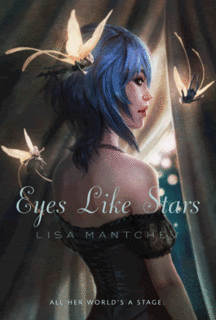
I will confess: 90% of the reason I picked up this book was because of the blue hair on the cover. We all know I have a weakness for colored hair (though blue seems to be the most popular color. I wonder why). Seriously, it's pretty sweet:
Eyes Like Stars by Lisa Mantchev cover


Beatrice Shakespeare Smith (aka Bertie) lives in the Theatre Illuminata, where all the characters from every play ever written reside. She has lived there for 17 years, since she was left at the theatre as an infant, the only non-fictional resident of the theatre. After irritating the powers that be one too many times, Bertie has to find a way to make herself invaluable to the theatre, or she'll be cast out. She proposes to direct a re-staging of Hamlet as set in ancient Egypt, an attempt to create the sort of performance that will fill the house and woo back wealthy donors, restoring the theatre to its former brilliance.

But nothing can be that straightforward, can it? The Stage Manager seems intent on sabotaging Bertie's plans and most of the Hamlet cast is rebelling against tampering with their show. Bertie's only ally in the production is Ophelia, who helps reign in the cast during her brief moments of clarity between suicide attempts. Also making life difficult for Bertie is Ariel (of The Tempest), who desperately wants to escape the theatre entirely, but is bound by the Book - the large tome that collects the first appearance of every character in every play ever written. Ariel thinks that if he can tear his entrance out of the book, he'll be free, and wants Bertie's help in planning his escape.

On Bertie's side are the fairies from A Midsummer Night's Dream and Logan, a pirate from The Little Mermaid, who encourage Bertie through her trials with Hamlet and avoiding Ariel. Ariel seems to think he and Bertie have a bit of a thing going on, but Bertie only has eyes for Logan...and staying in the theatre, of course.

First of all, I have to say I love the Shakespearean characters throughout this story. Ophelia is funny and tragic - any time there's water around she appears to try and kill herself again, but occasionally graces us with moments of lucidity that make it clear she's more than just a crazy, love-lorn girl. The fairies are all hilarious as the squabble amongst themselves and more often than not get Bertie into trouble (though Bertie can be a troublemaker all on her own). It's also great to see a character other than Puck take on the trickster role. The character of Logan stuck out, because he's the only named, non-Shakespearean character that lives in the theatre. When plays are listed, it's like 'Shakespeare, Shakespeare, Shakespeare...The Little Mermaid?!' It seems like a random addition, especially since it's not like there's a definitive stage version of The Little Mermaid. If a pirate character was necessary, why not say he's an extra from Peter Pan, since that was originally a play. Or name drop a few other characters from plays,go back to the Greek tragedies if you're looking for things that are exclusively public domain if necessary, just so Logan doesn't stick out so much.

The logistics of the theatre didn't quite work out for me - at first I thought this theatre was firmly located in the world of imagination (because really? Every character ever written for the stage is here? And can be summoned just by posting a notice on the Call Board?). But then Bertie is originally from the world outside of the theatre, and then real-world patrons show up for performances, which then leads me to question things like how would the playbill credit the performers, if Hamlet is truly played by Hamlet? But if you don't think about it too hard about that point, it's a fun adventure story with lots of humor, and a sequel on the way in May! I won't be rushing out to pick up the sequel on day one, but if I see a lot of positive buzz about it, I'll probably get around to it eventually.

Friday, March 26, 2010

Review: Dirty Little Secrets by C.J. Omololu

Found via: Publisher's Weekly 1/11

I have a huge backlog of books that need to be reviewed, but I keep holding off because it seems like if I blogged them all now I'd have two week's worth of posts about books that I essentially didn't like. Or I liked a ton of the book...but then there was one GLARING THING that makes me unable to actually recommend a book. I certainly don't think I have to give positive reviews all the time, but I also don't want to be a total downer.

So I'm very happy to report that I loved Dirty Little Secrets, was totally unable to put it down, and finished it in just a couple of hours. Seriously, I started it on the train ride home today (at five) and finished by nine - and that includes breaks taken for dinner, websurfing, and talking to my husband.

Lucy's family has a secret. A giant, hulking, dirty secret. Her mom is a compulsive hoarder and has filled the house with piles of newspapers, old clothes, and just plain garbage. Lucy has lived like this for most of her life, and is now 16 and practically counting the days until she can escape from her mother's grip, like her two older siblings have already done.

After spending the night at her best friend's house (Lucy can never allow friends to visit her garbage-filled house), Lucy returns to find her mother dead in the hallway, her inhaler just out of reach and a six-foot pile of National Geographic magazines collapsed on top of her. Lucy spends the next 24 hours desperately trying to make the house presentable before calling for help; she can't stand the thought of her family becoming a freak show on TV with headlines like "Woman Dies Surrounded by Squalor." As she unearths forgotten shopping sprees and school projects she gives us glimpses into life with her slowly deteriorating mother and the heavy toll growing up with a hoarder has taken on Lucy's relationships with peers and her siblings. Lucy's refuge inside the house is increasingly invaded by suddenly nosy neighbors, her annoying older sister, and best friends who are dead set on setting her up with the cutest boy in school. The tension mounts hour by hour as cleaning years of debris seems increasingly hopeless, and Lucy feels her options for protecting her mother's secret are running out.

This book led to some very visceral reactions from me. I'm really glad I'd finished dinner before Lucy found the maggots in the living room (omg, is there anything more disgusting in the world than maggots? Even the word makes me shiver). And it's been awhile since a book made me say "Holy shit" aloud when I reached the climax. Lucy's story is complicated; as she struggles with how to make the house somewhat presentable, you have to ask just what is her motivation? Is she trying to protect her mother? Her family? Or just her reputation at school? Is she more concerned with whether Josh will like her after he knows of her home life than she was with her mother's well being? How justified are Lucy's feelings about her mother, considering the years of verbal and psychological abuse her mother subjected her to? And what made her mother treat her like crap - was it something to do with the illness that caused the hoarding, or would she have been abusive towards Lucy no matter what?

This is a compelling story, but by no means an easy one. Lucy has a lot of struggles, some serious and others frivolous. At first I was totally annoyed by the more frivolous distractions presented by Lucy's best friend and the cute boy, but this is a well crafted novel and eventually their inclusion serves an important point for Lucy's development. I highly recommend this book for anyone looking for a heavy family drama, even though most of the family is actually absent while the book is taking place.

Wednesday, December 9, 2009

Review: The Sweetheart of Prosper County by Jill Alexander

Found Via: BBYA 2010 nominations

I've been reading a lot of heavy, serious books lately. Like Into the Wild Nerd Yonder, The Sweetheart of Prosper County provided some lightheartedness to break up the downer books - though this one does have a serious story at its core.

After being made fun of by the school bully at her small Texas town's No Jesus Christmas parade, Austin Gray decides that she needs to be elected as the Sweetheart of Prosper County. If she gets to wear a pretty dress and ride in the parade, no one will be able to make fun of her! Of course, in order to win the crown, she has to join the Future Farmers of America club, and raise a prize-winning farm animal. Enthusiastically supported by her best friend Maribel, and just slightly less so by her overprotective mother, Austin throws herself head first into raising a prize rooster, named Charles Dickens.

When she's not carefully attending to Charles Dickens, Austin is also carefully learning how to grow up and assert her independence under her mother's tight reign. She's been extremely protective of Austin ever since Austin's father died in a car accident one rainy Christmas Eve. Naturally Austin misses her father terribly, but she doesn't understand why his death means she has so fewer freedoms than her peers. And being kept under strict rules isn't exactly conducive to going out with Josh, the cutest boy in the FFA!

I felt there were some uneven spots in this book - the men and boys are a little underdeveloped (I never figured out why the bully was so damn MEAN to Austin - sure she's an easy target since she won't stand up for herself, but he really takes it too far), and the animal-raising plot seems resolved too early so for chapters at a time there's no mention of Charles Dickens, who is so essential to the first half of the book. However, those uneven spots don't take away from the delightful charms of Austin and her relationships with her friend Maribel and her mother. Austin and Maribel are delightfully close, even though the rural town has more than its fair share of racist rednecks who aren't afraid to throw slurs at Maribel. Austin even takes part in Maribel's quinceanera.

It's also always nice to see a functional mother/daughter relationship. Yes, Austin's mother is a bit overprotective, which Austin sometimes resents, but the two of them are also affectionate and there's obviously a deep bond there. They aren't perfect, but they don't hate each other.

Another plus: the book's subtle but ever-present portrayal of religion. A lot of YA books totally gloss over religion - if it's mentioned, the character is either fervently anti-religious, or the whole book is religiously themed. The Sweetheart of Prosper County isn't a religious book, but there are plenty of references to Austin's religion sprinkled throughout the text, mostly through her strategy of "praying the problem:" instead of asking god for a specific outcome, you just pray about what's going on and trust that it will be resolved. Also the quinceanera takes place in Maribel's catholic church, which is very different from anything Austin had experienced before. Though I'm not religious myself, it's nice to see religion acknowledged as part of a character's life.

Thread plug: Yesterday I put out a request for books with explicitly female characters - I'd still love to hear from you and your thoughts in the comments!

Tuesday, December 8, 2009

Review: Goth Girl Rising by Barry Lyga

Found via: NYC Teen Author Fest

I first heard about this title back in March, when Barry Lyga read bits and pieces of the beginning of the book at the NYC Teen Author Fest. I have half a dozen other books that need to be reviewed, but Goth Girl Rising is jumping to the head of the line because it is awesome.

Goth Girl Rising is the sequel to The Adventures of Fan Boy and Goth Girl, picking up Kyra's story about six months after the end of that book. Kyra has been in a mental hospital for the last six months, covering the entire summer and the beginning of the next school year. It's now November and Kyra is struggling to get back to her old life.

Kyra's top problem is she feels like she was abandoned while she was in the hospital. Her two best friends claim they sent her TONS of e-mails over the summer, but Kyra didn't receive one. But most hurtful is that Fanboy himself seemed to forget about her - no e-mails, no calls, no texts.

Kyra returns to a school where the social hierarchy appears to have been turned upside down while she was away. When she left, Fanboy was easily manipulated, lonely little geek, harboring secret fantasies about a senior girl and translating those into his epic comic book Schemata. Now Fanboy is the toast of the school, after doing some editing on Schemata and publishing it in monthly installments in the school's literary magazine. The way Kyra sees it, first Fanboy forgot her, then he went and got all popular by sharing his masterpiece with the plebes; now Kyra wants revenge on him.

Life isn't any easier at home for Kyra, where she and her dad continue to butt heads over pretty much everything, from Kyra's attitude at school to the way she dresses. Like most 16 year old girls, Kyra is changing and trying to find her place in the world, with her history, though, she just feels she has it harder than anyone else.

The main reason I loved, loved, LOVED this book and tore through it in one day is that in so many ways Kyra is exactly like I was in high school. A lot of the big things are different, sure - my mom didn't die, I never tried to kill myself, when someone hurt me I didn't set out to destroy his life, and my boobs were nowhere near a D cup (though I still disliked their existence) - but so many of Kyra's smaller moments were just like how I was in high school it was a little scary. Kyra's feminism and mine had a lot in common at that stage - lots of anger, convinced that all guys were stupid and out only for sex. Both of those are still mostly true, but my views are a bit more refined by now. I also loved the moment when Kyra is experimenting with her look and, just to try something different, undoes a few buttons on her shirt to show some cleavage and rolls up the waistband of her skirt to make it a little sexier. Despite how much she hates women who use their appearance to gain control, Kyra recognizes that she, too, could pull off the look - and she might even kind of like it! Kyra spends a lot of time trying to be comfortable in her own skin, which is something I think we can all relate to.

I do think the most exciting part, however, was Kyra's explicit musings on feminism. I thought about this a lot last year with The Disreputable History of Frankie Landau-Banks. It's not so uncommon anymore to read YA books with feminist themes, but how often do characters explicitly identify as feminist? During the spring's teen author fest, I went out of my way to make sure to thank E. Lockhart for making that a positive part of Frankie's character. Since then, I can't recall too many other characters that expressly say "I'm a feminist." Does anyone out there know of any others?

If you haven't read The Adventures of Fanboy and Goth Girl, you need to go out and find yourself a copy immediately - this really isn't a sequel that works well without knowing what went on in the first book. After you read that, Goth Girl Rising should definitely be next on your list.

Tuesday, December 1, 2009

Review: Blue Plate Special by Michelle D. Kwasney

Found via BBYA 2010 nominations

Note to self: when going on a weekend outing with your mother, don't take along a book about girls who have less-than-stellar relationships with their mothers! Sure, it might make you appreciate your own mother more, but what a downer!

Madeline, Desiree and Ariel are three very different young women growing up in three very different times. Madeline is quiet and overweight in 1977, the defacto head of the family since her father is gone and her mother prefers to spend the welfare checks on alcohol. Desiree, getting ready to graduate from high school in 1993, tells her story through poetry (and I didn't hate it!), as she tries to avoid her mother and her mother's skeezy boyfriend, finding her only refuge in her high school sweetheart. Ariel, the contemporary girl in 2009, has a workaholic for a mother and is throwing herself at Shane, her new boyfriend that wants her to spend all of her time with him - and only him.

Like I hinted at above, this book is a bit melancholy, but ultimately thoroughly enjoyable.

I always find it supremely satisfying when I reach the end of a book and can sit back and appreciate just how finely crafted the book is. There are complex books out there that can feel like they're being complex just for the sake of complexity; there are others that are exciting and breathtaking but don't necessarily feel like they were crafted. It took me a little bit to really feel immersed in Blue Plate Special, probably because the chapters alternate between three different young women in three different decades, but at the end you can't help but appreciate how deftly Kwasney has woven their stories together.

Monday, November 30, 2009

Double Review: Shine, Coconut Moon by Neesha Meminger and Love is the Higher Law by David Levithan

Found via: BBYA 2010 nominations

Oh man, it's been a crazy week out here. The weekend before Thanksgiving I was in Chicago with my mom, and then I spent Thanksgiving weekend with my in-laws in Florida, meaning there was lots of traveling, and LOTS of reading, but little time to blog! Thankfully, my reading list made my blogging a little easier for me by happening to have thematically similar books, like these two stories of how 9/11 affected high school students.

In Shine, Coconut Moon, Sam is an Indian-American teenager living in a relatively diverse community in New Jersey. For most of her life, she's put the emphasis on the "American" in her heritage, as her mother has kept her away from her very traditional Sikh grandparents. Instead, Sam spends most of her time with her best friend, Molly, and wondering when she'll lose her virginity to her boyfriend, Mike.

The weekend after 9/11, Sam is surprised to find a man in a turban at her front door. He says he's her uncle Sandeep, her mother's brother, and after his tumultuous divorce he wants to be part of Sam's and her mother's lives again. Sam is eager to get to know her uncle, and pressures him to teach her everything about her Sikh heritage, despite her mother's reservations and outright objections to Sam having anything to do with Sikh culture. As she grows more aware of her cultural heritage, she realizes just how different she is in some ways from her friends and community - but also learns to recognize what is truly important in life.

Love is the Higher Law takes place in New York City in the immediate after math of 9/11. The narrative jumps between three characters - Claire and Peter, who attend high school together, and Jaspar, the college guy Peter had scheduled a date with for the evening of 9/11. Alternating chapters explore the three characters and what it's like for them to live in post-9/11 New York City: Jaspar was sleeping late and actually missed the early TV coverage - and his parents were temporarily stranded in South Korea, where they'd been visiting Jaspar's grandmother; Claire spent 9/11 in her brother's elementary school, keeping him and his classmates calm while waiting for their mother to find them; Peter was skipping school to buy a new CD when an employee tells him the news. In the days, weeks and months after, each of them tries to understand how they fit into this new world they've been thrust in to.

I realized with a start about half way through Love is the Higher Law that for the first time in several years, I was reading a book about my peers. As an adult reading YA lit, I'm used to reading about characters who are about 10 years younger than I am, and in both of these books the protagonists are in the 17-19 years old age range - but back on September 11th, 2001, I was just a couple of months shy of my 17th birthday myself. I kind of found myself wondering what the characters were doing "now," in their mid-twenties, almost a decade later. It also made me wonder how today's crop of teenagers react to these books, since they were in elementary school in 2001.

Shine, Coconut Moon also had moments of familiarity for me - I remember reading this article in my hometown paper shortly after 9/11, about a Sikh family posting signs explaining their religion in the windows of their store, in order to prevent any attacks against them.

Shine, Coconut Moon and Love is the Higher Law are both excellent titles showing the wide variety of ways teenagers reacted after 9/11.

Friday, November 20, 2009

Review: After by Amy Efaw

Found via: BBYA 2010 Nominations

I had a bit of a hard time getting into this book, and a few pages in I realized exactly why: it's written in the third-person. I've been reading so much first-person stories lately, both in fiction and in memoirs, that trying to get into a third-person narrative threw me a bit!

Devon is a star soccer player and dedicated student with dreams of becoming everything her mother is not. Her mom is a bit flighty, very flirty, and had Devon when she was only 16.

But now Devon, 15, finds herself on charged with attempted murder - of her own baby. Devon never realized - or maybe never admitted? - that she was pregnant, and when faced with the birth wrapped the baby in a garbage back and threw it into a trashcan behind her apartment. She's placed in a juvenile detention facility, with strict instructions from her court-appointed lawyer to be cooperative, until the hearing which will decide whether Devon's case remains in the juvenile system - or if the attempted murder on her baby was a crime so heinous only the adult justice system, with its sentence of life in prison, can handle her.

This novel completed my week of depressing reads - I was so desperate for something happy that I picked up a picture book reviewed by Lynn and Cindy for Nonfiction Monday at the library Monday night! But I absolutely don't regret picking this one up - Efaw, who spent time observing girls in the real life version of the detention center the novel is set in, has created a dark and disturbing narrative, filled with intriguing characters. I loved Devon's lawyer, and while some of the girls in the detention center seemed a little cookie-cutter at first, most of them get fleshed out, at least a little, by the novel's end.
Related Posts with Thumbnails