Showing posts with label theatre. Show all posts

Monday, April 18, 2011

Pink by Lili Wilkinson

I was super excited for this book - Australia, theater, and, most importantly, a bisexual protagonist! And in fact, there are lots of small things to love here, but I was never quite sold on our protagonist.

PinkAva has always been a dutiful daughter - going with the flow at her public high school, eschewing pink (and most other colors) from her utilitarian wardrobe, and spending lots of time with her radical anarchist girlfriend. Did I mention that Ava's parents are anti-establishment types? But Ava yearns for some normalcy in her life - demanding academics, pink argyle sweaters, and maybe even a boyfriend or two. So she convinces her parents that she should start attending a rigorous private school, a place where no one knows the old Ava and she can make herself over without anyone from her old life commenting on the change.

While her new look immediately ingratiates Ava with the popular "pastels" of the school, that doesn't make her new life easy. Joining the stage crew of the school musical (after an epic crash and burn at the actual auditions) in order to be close to the cutest boy on campus, Ava finds the "Screws" are the school's social lepers - and decides that she's now qualified to give them a social leg up even while she's precariously balancing her new social status, and hiding her new self from her old girlfriend and family. Most troubling to Ava is balancing her emotions - she still feels close to her girlfriend Chloe, but she undeniably finds the lead guy in the musical hot, and then there's the cute and helpful leader of the Screws who makes her feel all sorts of confused. Which Ava is the real Ava? And will she ever become comfortable with herself?

For me, Ava herself was the biggest problem of the story, in that she doesn't seem to actually grow in any meaningful way. The best illustration of this for me was when she tried to play matchmaker among the Screws, and it fails miserably, in part because Ava makes a lot of assumptions about the people whose hearts she's toying with. But in the end, Ava pulls the exact same stunt...only because it's a platonic set up everyone's okay with it? Also I have to say that while I love having a character proudly call herself a feminist, Ava has some extremely retrograde and ill-informed feminist thoughts. Which would be okay if she'd come up with them independently but considering her parents are professors and should be on the cutting edge of gender studies, it doesn't make sense that Ava would be so incredibly wrong sometimes (and really, asking the kid of Asian descent where he's "really" from? Wow, not okay. And that's pointed out in the text, but is again illustrative of just how out of touch with progressive and feminist thought Ava is).

BUT, it is encouraging to see a story with a bisexual protagonist - not that Ava uses the label for herself, but it's probably the closest label that fits. She makes it very clear that her relationship with Chloe is real and important and certainly not just a phase, and while it's a little preachy I did feel it was important to include some acknowledgement of the legitimacy of that relationship to make it clear that Ava wasn't just a lesbian until the "right guy" came along to straighten her out.

Also, science fiction geeks will have a lot of fun with Ava's stage crew friends, as they are huge nerds. In a delightful way. Lots of discussions of Star Trek and Lord of the Rings and zombies and...just general geekery. Gotta love that.

Friday, January 7, 2011

Review: The Jumbee by Pamela Keyes

Found via: Forever Young Adult

Phantom of the Opera is far from my favorite musical - even among Andrew Lloyd Webber shows it doesn't rank very high (my favorite is totally Cats and I feel no shame for this. Well, not much). Even so, I think as a theatre geek I'm contractually obligated to at least pay attention to a book that re-tells the story of the classic musical (and, of course, novel). The Jumbee takes the basic premise of Phantom, but instead of 19th century Paris opera, it's contemporary Caribbean high school theater. Keyes deftly weaves the themes of the original into the new story, with just enough twists to keep even those of us who know Phantom guessing.

The JumbeeFollowing the tragic death of her father, famed Shakespearean actor Alan Legard, Esti and her mother relocate from Oregon to her father's enclave on the island of Cariba. Both women are hoping that a change of scenery will help them move on; Esti in particular is hoping to rekindle her passion for acting by getting the lead in the prestigious high school's production of Romeo & Juliet.

Cariba is an island steeped deeply in tradition and superstition. When a student dies within days of Esti moving to the island, tongues start to wag. When Esti begins rehearsing in the dark theater, alone, rumors begin that she's communicating with a jumbee - a ghost who is often malevolent. When Esti begins hearing a voice in the dark with her, she's not sure what to think, either. The voice - Alan - claims he was a student of her father's. But why did her father never mention this brilliantly talented student with the sexy voice? And if he's truly there, why does he always insist that the lights must remain on? Esti isn't particularly superstitious, but if there's anywhere ghost stories could be true, it would be on the island of Cariba.

Just as Esti is sure she's falling in love with the mysterious Alan, her childhood friend and resident playboy, Rafe, returns to the island from LA. Rafe and Esti immediately resume their friendship, with the possibility of something more always bubbling beneath the surface, but Esti is torn between the two boys. One with whom she has a lifetime of history, the other who has reawakened her passion for the stage. With her other relationships and responsibilities faltering, Esti must discover who Alan truly is, and make a fateful choice.

There are plenty of obvious parallels here between The Jumbee and Phantom of the Opera: the love triangle, a mysterious teacher, a diva who gets every coveted role even when a more talented ingenue appears. However, that doesn't necessarily make the novel predictable. For example, even though I know Erik turns out to be a real man rather than a ghost, Alan's corporealness (or lack thereof) goes a long time without being explicitly confirmed or denied.

Because it's not clear who - or what - Alan is, there are some parts of his and Esti's relationship that made me uncomfortable, but could plausibly be explained by jumbee magic - or just an extremely accomplished manipulator. They don't have a healthy relationship at times, but it's not quite Bella/Edward levels of creepiness.

Speaking of creepy, Keyes does a fabulous job of creating the atmosphere of the fictional Cariba. The school has a sordid past as a plantation with a particularly sadistic slave owner, giving rise to the stories of the jumbees and their various hauntings. The island is in equal parts a lush tropical paradise and the setting of a horror film.

Keyes also integrates the Shakespeare into the text well. Enough happens off stage that the scenes that show the rehearsals or performances for Romeo & Juliet don't feel boring or overdone.

The story is thoroughly enjoyable with some great scenes and set pieces, but the actual writing felt awkward and clunky at times, which holds me back from recommending this whole heartedly. Fans of Phantom should enjoy it, and the unique setting and diverse cast are also major bonus points, but the actual writing style kept me at a bit of a distance.

In other news: Yesterday was the official start of the 2011 Comment Challenge hosted by MotherReader. The challenge lasts for 3 weeks and the goal is to leave 100 comments on other book blogs in order to encourage the habit of commenting. I did this last year and had a blast "meeting" new people and finding new blogs. Welcome new readers who found me through the challenge, and I encourage everyone else to join in the fun!

Monday, August 30, 2010

Nonfiction Monday Review: I Am an Emotional Creature by Eve Ensler

Found via: Amelia Bloomer Project

I debated whether this should be a Nonfiction Monday post or not. It's poetry/monologues, but they are all drawn from interviews and writings of real teenage girls. There are no fictional characters or plot - it's a collection of writings about the real experiences of girls and young women, that have been polished by Ensler. Since Amazon includes it in two nonfiction categories and one fiction category (literature and fiction > Drama), and the Library of Congress headings don't include fiction, I figured it could count for Nonfiction Monday.

I Am an Emotional Creature: The Secret Life of Girls Around the WorldEve Ensler's The Vagina Monologues was a watershed moment for women. A play that spoke frankly about the most shamed part of our bodies. While there are parts of it that are definitely applicable to women of all ages, it's generally not the sort of text you hand to a middle or high school girl. But where can these girls to turn for validation of their experiences? Ensler has filled that void with I Am an Emotional Creature. Inspired by girls all over the world, from US suburbs to eastern European brothels, African villages to middle eastern cities, the poems and monologues interspersed with "girl facts" about our bodies and our treatment around the world (child labor, sex trafficking, etc) give voice to a variety of female experiences. There's the girls at a sleepover playing "would you rather," girls experiencing first love and their "first time," and girls who were sold into slavery - or ran away from home to escape that fate.

The actor in me relished these poems and monologues, as they beg to be performed. Many of the poems are obviously drawn from the experiences of multiple girls and I am sure would be best understood if the various lines were said by different girls to build a story.

Randomly, one selection from The Vagina Monologues is included - "My Short Skirt." It's an excellent poem and definitely worthy of inclusion considering how young women are often shamed for their fashion choices, it was just slightly distracting for me as I was reading the poem and thinking "I've heard this before..." (Freshman year of college I performed in The Vagina Monologues. Unfortunately I didn't do "My Short Skirt." I got to put on my best British accent and perform "The Vagina Workshop")

This should be considered mandatory reading for every teenage girl - even teenage boys would benefit from some of these (like the aforementioned "Short Skirt"). While much of the book is about body image and sexuality, there are lots of other topics too - like child labor, from the girl who works in a Chinese factory assembling Barbies, and dating violence, like in the letter to Rihanna penned by a girl in her own abusive relationship but hasn't left, like Rihanna did. It's an excellent assortment of points of view, arranged well so you aren't overwhelmed by dark and depressing themes before a more lighthearted piece pops up.


Nonfiction Monday
Nonfiction Monday is hosted this week by the Book Nosher. Be sure to check out all the other great nonfiction books highlighted today!


Women Unbound Challenge

Thursday, August 19, 2010

Review: Illyria by Elizabeth Hand

Illyria won the World Fantasy Award for best novella back in 2008, when it was published in the UK. Now, I have nothing to do with the World Fantasy Award (which is probably a good thing considering my general apathy for the genre), but looking at some of the other winners, this one doesn't quite seem to fit.

IllyriaMadeline and Rogan think of themselves as two halves of the same soul. Children of identical twins who share a birthday themselves, they are inseparable as children - an intense friendship that grows into an intense love as they enter their teen years.
Multiple generations of their large family all live on the same block, all descended from a great stage actress, though Madeline and Rogan are the only ones who have retained a love of theatre and performing, encouraged by their great aunt who appreciates the art of theatre, though doesn't seem to perform herself.

When cast as the stars of Twelfth Night in a school production (Madeline as Viola, Rogan as Feste), Madeline and Rogan must begin to confront their separate talents and where they might lead them, even as their relationship grows in intensity in the face of adversity.

Notice how in that description there isn't much that would really fall into a "fantasy" story? It's more like what one of my college professors called magical realism. This is a rather straightforward story about two extraordinarily close cousins who face some adversity because of their peculiar talents and relationship. The fantasy/magical element comes from an apparently enchanted miniature theatre they find embedded in the walls of the attic, where the lovers escape for their illicit trysts.

While published as a YA novel, the only resemblance this has to most YA is the ages of the protagonists - but in some ways I never felt like I was reading about teenagers because Madeline is telling this story as a middle aged adult. I had only a tenuous connection with her during the high school phase, but I totally lost it once she skipped ahead to briefly show her life as an adult, and how her and Rogan's decisions from back in their high school days had panned out as adults. 

The romance between Madeline and Rogan is heady and impulsive - and yes, they are cousins, but really, we're still grossed out by that these days? Their familial relationship isn't fetishized - rather Madeline sees them as two halves of one whole, and it's the most natural thing in the world for them to come together. Maybe if someone in the extended family modeled a healthy relationship, or tried to speak to the kids frankly and without judgment, things would have turned out differently, but as-is, the romance was the least-problematic aspect for me.

Monday, May 17, 2010

Review: Will Grayson, Will Grayson by John Green & David Levithan

Today is the International Day Against Homophobia and Transphobia. Unlike other "international" action days, judging by their website this truly is an international event, with leaders in the EU recognizing today, rather than being an American-based project that welcomes participation from overseas. Yeah internationalism! I figured there was no better way to promote a day defending against hatred than highlighting a book that is about love in all of its forms.

Will Grayson has been best friends since 5th grade with Tiny Cooper - who is either the world's largest gay man or the gayest man in the world who is large (the name is ironic). While Will would prefer nothing more than to blend into the woodwork (his two life rules are 1. don't care and 2. shut up), with Tiny around that is effectively impossible. Tiny falls in love approximately once an hour, is determined that Will should be in love too, and is writing an epic musical about his life: Tiny Dancer: the Tiny Cooper Story.

On the other side of Chicago lives another will grayson, who writes all in lower case as a sign of his existential angst (or an easy way to tell the alternating Wills apart if you're cynical). will is gay, though about as closeted as Tiny is out. He has only one friend in real life, the extremely fragile and manipulative Maura, but online an epic romance is blossoming with a boy named Isaac. will's life looks like it may finally be looking up when he and Isaac decide to meet in Chicago.

Once in Chicago, will doesn't find the boy he was looking for - instead running into his namesake, Will Grayson, and being absorbed into the orbit of Tiny Cooper whether he wants to be or not. What follows is an adventure almost as epic as Tiny Dancer about the meaning of life, friendship, and love, platonic and romantic and everything in between.

First of all, I demand that the libretto of Tiny Dancer be released in full. I don't care whether it's only released as an e-book or maybe Green & Levithan could write it for charity a la JK Rowling and her Hogwarts school books, but Tiny Dancer is clearly a masterpiece that deserves its day in the sun. Also I have to thank Green & Levithan for giving me a book that so clearly shows what it's like to be in theatre without making me sit through Shakespeare.

Tiny Cooper is seriously a revelation as a character. Rarely do we meet someone who is so...in love with life but also has deeper layers that are revealed as the story goes on. At first it looks like Tiny is going to be on big (sorry) stereotype, jolly and partying and breaking out into song at the drop of a hat, but it's clear even before we get to see Tiny Dancer that there's a lot more to Tiny than being fabulous. Part of me wants to see a book about him, but in a way Will Grayson, Will Grayson already is, as he's such a major catalyst in the lives of everyone around him - and it's clear they affect him as well (a true sign that someone is more than just a caricature).

While on the one hand having will grayson write all in lower case seems like a cheap and easy way to differentiate the two Wills, the way the two boys talk and think is really what makes the alternating chapters work. Just a few sentences into the first will grayson chapter made me feel like all the air had been sucked out of the room (or subway car, as it were). Will Grayson seems to love life in comparison to will. will can get a bit "woe is me" dramatic at times, but so can Will, and if you can't be melodramatic at 16, when can you be?

As I said above, this is a novel that is about love. There are hookups and breakups throughout the story, and those are certainly a type of love, but really this story is about the type of love that binds people together, whether you want to be or not. After you've been through a lifetime of ups and downs (or even if it only feels like it's been a lifetime), you develop a bond with another person that can't be broken easily. I couldn't help but grin when Will would declare that he loves Tiny (in a totally platonic sense) because we don't see people (especially boys) talk about their friends and family in such a way very often. I've said this is why I love the show Glee, because every time Kurt's dad shows up we're guaranteed at least one "I love you" that you don't really see anywhere else - on what other TV show do you have a father and son who will hug each other and cry and talk explicitly about their feelings? Will and will and Tiny never get quite to that point, but there is a lot of open talk about love, which is absolutely the message the world needs to hear.

GLBT Challenge

Tuesday, April 27, 2010

Review: City of Cannibals by Ricki Thompson

Found via: Publisher's Weekly 1/18

I'll admit, I picked this one up thinking it was going to be some creepy science fiction-y thing (potentially where cannibals=zombies). Spoiler alert: this is not the case. In fact, it's kind of the opposite - historical fiction. But despite the lack of zombies, it's still an enjoyable read.

Dell lives an isolated like in the hills with her father, brother and aunt. They eke out a meager existence with the help of "the Brown Boy" who drops off goods for the family on a monthly basis. With her mother long dead, Dell's father abuses and berates her, apparently for the crime of reminding him too much of her mother. But she stays with her family out of fear of the cannibals she has been told live in the city below. But after one episode of cruelty too many, Dell finally strikes out on her own, determined to find the Brown Boy who she is sure will protect her.

The city Dell lives above is London, which isn't populated by cannibals, but is filled with more people, stink, and filth than Dell has ever imagined. With the help of a few friendly folks, Dell finds places to sleep, earns a few coins for food, and finds the Brown Boy. She also learns that her family was once well known in the city - until her mother's tragic death forced her father to take the family into the hills.

The setting is an interesting one - it's 1536, right when King Henry VIII was breaking his ties with the Catholic church. The Brown Boy Dell is searching for is actually a novice monk, which periodically brings the church schism to the forefront, as the monks refuse to pledge their loyalty to the king and would rather risk death than turn their backs on their religion. So the danger in this story is on two levels - the inherent danger of being all alone in unfamiliar territory on one, and then the institutional danger of a society in upheaval.

There's naturally a love story element to this book, but I wasn't that fond of it. Ronaldo the monk seems a bit too quick to drop his vows to the church, specifically that chastity one, if you know what I mean. And then there's an infuriating period where Dell is convinced she's led Ronaldo to sin. It takes two to tango, sweetie, and while Dell is the pursuer in the beginning of the relationship, by the time it turns physical that's all Ronaldo's idea. Of course, this just proves that sexual double standards are at least older than steam.

But that's really a minor quibble with an overall interesting work. I enjoy reading historical fiction that's set somewhere or sometime different than a lot of other books. The only other historical fiction I know of set during Henry VIII's reign is The Other Boleyn Girl, and while the time period is roughly the same, they might as well take place in two different world's since City of Cannibals is never near the intrigues of the court. (Also, City of Cannibals appears to be more historically accurate)

Wednesday, April 7, 2010

Review: Eyes Like Stars by Lisa Mantchev

Found via: Confessions of a Bibliovore

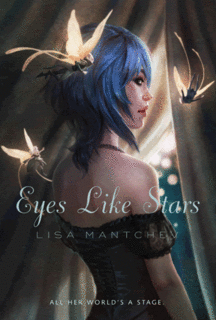
I will confess: 90% of the reason I picked up this book was because of the blue hair on the cover. We all know I have a weakness for colored hair (though blue seems to be the most popular color. I wonder why). Seriously, it's pretty sweet:
Eyes Like Stars by Lisa Mantchev cover


Beatrice Shakespeare Smith (aka Bertie) lives in the Theatre Illuminata, where all the characters from every play ever written reside. She has lived there for 17 years, since she was left at the theatre as an infant, the only non-fictional resident of the theatre. After irritating the powers that be one too many times, Bertie has to find a way to make herself invaluable to the theatre, or she'll be cast out. She proposes to direct a re-staging of Hamlet as set in ancient Egypt, an attempt to create the sort of performance that will fill the house and woo back wealthy donors, restoring the theatre to its former brilliance.

But nothing can be that straightforward, can it? The Stage Manager seems intent on sabotaging Bertie's plans and most of the Hamlet cast is rebelling against tampering with their show. Bertie's only ally in the production is Ophelia, who helps reign in the cast during her brief moments of clarity between suicide attempts. Also making life difficult for Bertie is Ariel (of The Tempest), who desperately wants to escape the theatre entirely, but is bound by the Book - the large tome that collects the first appearance of every character in every play ever written. Ariel thinks that if he can tear his entrance out of the book, he'll be free, and wants Bertie's help in planning his escape.

On Bertie's side are the fairies from A Midsummer Night's Dream and Logan, a pirate from The Little Mermaid, who encourage Bertie through her trials with Hamlet and avoiding Ariel. Ariel seems to think he and Bertie have a bit of a thing going on, but Bertie only has eyes for Logan...and staying in the theatre, of course.

First of all, I have to say I love the Shakespearean characters throughout this story. Ophelia is funny and tragic - any time there's water around she appears to try and kill herself again, but occasionally graces us with moments of lucidity that make it clear she's more than just a crazy, love-lorn girl. The fairies are all hilarious as the squabble amongst themselves and more often than not get Bertie into trouble (though Bertie can be a troublemaker all on her own). It's also great to see a character other than Puck take on the trickster role. The character of Logan stuck out, because he's the only named, non-Shakespearean character that lives in the theatre. When plays are listed, it's like 'Shakespeare, Shakespeare, Shakespeare...The Little Mermaid?!' It seems like a random addition, especially since it's not like there's a definitive stage version of The Little Mermaid. If a pirate character was necessary, why not say he's an extra from Peter Pan, since that was originally a play. Or name drop a few other characters from plays,go back to the Greek tragedies if you're looking for things that are exclusively public domain if necessary, just so Logan doesn't stick out so much.

The logistics of the theatre didn't quite work out for me - at first I thought this theatre was firmly located in the world of imagination (because really? Every character ever written for the stage is here? And can be summoned just by posting a notice on the Call Board?). But then Bertie is originally from the world outside of the theatre, and then real-world patrons show up for performances, which then leads me to question things like how would the playbill credit the performers, if Hamlet is truly played by Hamlet? But if you don't think about it too hard about that point, it's a fun adventure story with lots of humor, and a sequel on the way in May! I won't be rushing out to pick up the sequel on day one, but if I see a lot of positive buzz about it, I'll probably get around to it eventually.

Friday, April 2, 2010

Review: Total Tragedy of a Girl Named Hamlet by Erin Dionne

Found Via: Publisher's Weekly 1/25

Y'know, for someone that doesn't like Shakespeare all that much, I end up reading a lot of books where he or his work features prominently. I think it's because it's about the only way I get to read stories about theater - since Shakespeare's all public domain, the author can quote at liberty and the stories are well enough known that you don't have to summarize the story. Also, I do happen to very much like A Midsummer Night's Dream, so even though the main character here is named for a very different play, Midsummer plays a prominent role.

Hamlet wants nothing more than to be normal - which is really hard to do when your parents are Shakespeare scholars who insist on dressing and speaking in Elizabethan style and her younger sister is such a super genius that at the tender age of 7 she'll be starting 8th grade with Hamlet. And then, of course, there's that name. At least younger sister Desdemona ended up with something feminine.

So Hamlet's life is tough enough before it's announced that Shakespeare will be the focus of an interdisciplinary study in history and English this year. In history they'll construct replicas of the Globe theatre (conveniently, one of her dad's hobbies) and in English they'll be performing scenes from A Midsummer Night's Dream, where it's discovered that Hamlet is a superb Shakespearean performer and is assigned the role of Puck against her will.

Adding to Hamlet's horror are her two nemeses who quickly befriend Desdemona, who can't see that the older girls are just using her for her brain. Hamlet's crush hardly seems to know she exists, and her best male friend is apparently harboring a major crush on her, which is weird. And somebody keeps leaving origami pigs in her locker, which is weirder. Eighth grade is definitely turning out to be a total tragedy.

At first I was a little put off by just how weird Hamlet's life can be sometimes. I've had some college professors that were hugely into their subjects, but nobody was dressing up in period garb and then showing up at their daughters' school unannounced. But then I decided to read this as an all-out farce, and everything fits much better.

The parental obsession with Shakespeare aside, I did like Hamlet's family relationships, even though they're often dysfunctional. Hamlet often feels like she's ignored and standing in the shadow of her genius little sister. Her parents ask Hamlet to make sacrifices to accomodate Desi's schedule, and when things get broken at home it's automatically assumed that Hamlet (or one of her friends) must have done it, because Desi's too perfect. Lots of siblings will be able to relate to that!

The romance is well handled as well. Hamlet has a major crush, but that doesn't overshadow the rest of her life. The secret admirer is fun, and the best friend crush is horrendously and delightfully awkward.

Friday, July 31, 2009

Review: Wondrous Strange by Lesley Livingston

I've lived in New York City for just under a year now and there are still huge swathes of the city I've yet to explore. So on the nice weekends this summer (of which there have been disappointingly few) I'm trying to go out and see new places - especially if I can connect them to a book I'm reading!

I picked up Wondrous Strange because the annotation on the BBYA nominations page mentions A Midsummer Night's Dream. Now, despite being a huuuuuuuuuuuuuuuuuuuuuuuuuuuuge drama geek, I've never been a big fan of Shakespeare. In college I took a 2 week study abroad course on the bard because I had to take a Shakespeare class and 2 weeks in London sounded a hell of a lot better than a semester in a stuffy classroom. However, Midsummer was my first introduction to Shakespeare, way back in 5th grade when I got to be a fairy in the high school's production (being the daughter of their costumer definitely had its perks!). Then, right when the play was about to open, the cartoon Gargoyles started a Midsummer-themed arc featuring Oberon, Titania and Puck prominently.

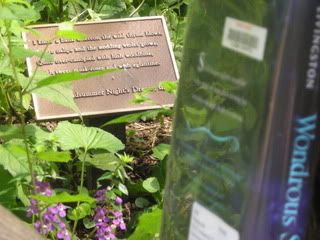
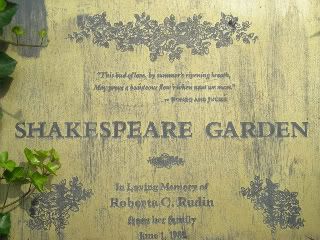
So even though there is nothing else about Wondrous Strange that would normally appeal to me, I knew I had to pick it up. And as long as I was reading something Shakespearean-esque, why not check out the Shakespeare Garden in Central Park?


(Inscription reads: This bud of love, by summer's ripening breath,/May prove a beauteous flow'r when next we meet)

From what I've read the garden is best viewed in springtime when all of the flowers are in bloom. I had to settle for greenery. Lots and lots of greenery.

I did, however, find a plaque and some plants from Midsummer. Here's my attempt at fitting the book and the plaque into the same photo:


"I know a bank whereon the wild thyme blows/where oxlips and the nodding violet grows/Quite over-canopied with lush woodbine/With sweet musk-roses and with Eglantine" A Midsummer Night's Dream, ii, 1

Mission accomplished, I found a nice grassy shaded area, broke out a picnic lunch, and settled in to read Wondrous Strange, and was very proud of myself that the book all but opens in the very part of Central Park I was sitting in!

Kelley, at 17, has moved to New York City to pursue her dream of acting, and has caught her lucky break when the tempermental star of A Midsummer Night's Dream storms off the stage, forcing stagehand and understudy Kelley to step into the role of the fairy queen Titania. It's Autumn in New York, just days before Halloween - an eerie time in the city. Kelley, already stressed from being pushed suddenly into the spotlight, is further unnerved when she attracts the attention of a mysterious good looking stranger in the park. And then she finds a horse in the reservoir that proceeds to follow her home and take up residence in her apartment's tiny bathtub.

Kelley has unwittingly been wandering through Central Park when the barrier between the human and fairy worlds is at its weakest. The mysterious stranger is Sonny Flannery, one of Auberon's guards of the gate. Sonny is instantly attracted to Kelley, not only for her spunk and good looks - but rather there's an almost otherworldly element to her that Sonny can't get out of his mind - even when he's supposed to be guarding the human world from Queen Mab's minions.

It feels to me like if you've read one girl-meets-fairies story you've probably read them all - it's not a genre that holds my attention particularly well, but the slight Shakespearean element adds a little bit of depth to the story. Only a little bit, because it's not like the story itself mimics Midsummer, rather characters like Auberon (Oberon) and Puck are inserted where, really, any generic fairy king/trickster could have been.

The inclusion of some Midsummer characters did get me thinking, though - Oberon shows up in lots of places in literature - but I can't think of anything outside of the Gargoyles cartoon that features Titania (who personally I've always found more awesome - the only person with the guts to stand up to Oberon. And he could only get her back using magic!). Anyone know of a book where Titania gets to be the star?

Saturday, February 7, 2009

Review: My Most Excellent Year: A Novel of Love, Mary Poppins and Fenway Park by Steve Kluger

It was definitely the subtitle that got me to read this book. Love, Mary Poppins and baseball (and not just baseball, but the poor Red Sox)? I had to know what it was about.

The story of TC's, Augie's and Ale's freshman year of high school is told mainly through diary entries, but also IMs, private chatrooms, text messages and e-mails. It's a sprawling story, chronicling more than a year in their lives, which makes summarizing this hard, but let's give it a shot.

TC and Augie have been best friends and brothers since elementary school when, shortly after TC's mother died, Augie was the only kid willing to talk to him. Since then they've done everything together, from sleepovers to family vacations. Augie puts up with TC's obsession with baseball, while TC tries to follow Augie's passion for musicals (turns out that Augie is gay and everyone but him knows it).

Ale, meanwhile, is the daughter of US diplomats - though she's more likely to start an international incident than follow in the family business. After her father retires from his position as ambassador, the family moves to Brookline, Massachusetts at the beginning of Ale's freshman year. TC is immediately smitten with Ale - who initially is determined to discourage TC's attention. She does, however, strike up a friendship with Augie when it comes time to produce the freshman talent show (Augie is director, Ale is producer). And of course where Augie goes, TC follows.

While TC is trying to woo Ale, he is also finishing up his baseball season where he has picked up a six-year-old deaf fan who tells TC when to swing at pitches. The boy, Hucky, is an orphan who has been bounced from foster home to foster home and has trust issues, but TC is as determined to bring this kid out of his shell as he is to get a date with Ale.

As Augie directs the freshman talent show, he not only befriends and mentors Ale, but also Andy - soccer player, swimmer, football fan and totally cute. Augie finds himself falling head over heels for the boy before he even realizes that it is a boy he is lusting after. Luckily, Andy feels the same way about Augie.

Ale takes dancing and singing classes, trying to keep her parents in the dark about her new-found hobbies. When not practicing or driving TC crazy, she pursues various social justice issues, from getting some of the more execrable songs cut from Kiss Me, Kate to building a baseball field at a memorial for the US Japanese internment camps of WWII (TC is helping with that one).

Yeah, like I said, there's a lot going on here, but most of it really works out. Sometimes I wondered about the convention of including e-mails and letters sent by parents and teachers - would the kids really have access to these to include them in a school paper? But other items, like Augie's mother's play reviews (a woman after my own heart - we're in agreement that Henry Higgins may be the worst character written for the stage EVER) add another fun level to the story. Also, sometimes it seems that Kluger got his electronic formats mixed up - when the kids were sending e-mails back and forth they would cut each other off. Which you definitely can't do in e-mail, and can't even do in most IM programs now (back in the day when I used ICQ there was a chat version that let you see what the other person was saying as they typed it, so theoretically you could cut someone off in that)

I do have to say I caught the book in a (relatively) big continuity problem. The book explicitly states that their freshman year was 2003. Yet Ale implies that Augie only discovered the musical Chicago in December of that year. Trust me, any musical fan worth his or her salt saw the movie version of Chicago back in 2001.

The relationship between Hucky and TC feels perhaps the most authentic in the book, followed closely by Ale and TC. The lengths TC goes to to make Hucky's life better are heartwarming. And the development of Ale's and TC's relationship definitely feels real.

And now, because this is a running theme for me, commentary on the gay characters: on the one hand, Augie and Andy are treated like any other couple. Augie's parents don't care (I don't believe we ever heard what Andy's parents thought), TC says "Duh" when Augie comes out over IM, and in their private e-mails Augie's dad wonders if "this generation" has made coming out superfluous. On the other hand, Augie is one big stereotype. He addresses a "Diva of the Week" in his diary, writing to Liza Minelli or Judy Garland (TC addresses his mom in his diary, and Ale spends most of her time writing to Jackie Kennedy, when really Eleanor Roosevelt seems like a first lady after Ale's own heart). Yes, he can also kick a soccer ball around, but after he starts going out with Andy it seems most of the sports drop out of his life. So points for treating a gay character like everyone else, but I would love to see a gay boy who is, I don't know, a big academic geek or something. They all seem to be either queens who love mince around singing show tunes or, in an effort to buck that stereotype, athletes. Here, Augie tries to be both of those (with more emphasis on the show tunes), but still comes off as a stereotype.

And yet, while Augie is quite stereotypical in some regards, I did appreciate the glimpses at his and Andy's relationship. In some ways it's not as well-rounded as TC's and Ale's, but that's partly because with Augie and Andy we only get Augie's diary on the relationship, while both TC and Ale contribute their own halves to the story.

So while on one level I can find lots of things to nitpick about this story, overall it comes across very well and was extremely enjoyable.

Wednesday, January 21, 2009

Review: Suite Scarlett by Maureen Johnson

I love books about New York City, my new home. And after spending most of my life on stage, I love books about theatre as well. Combine these two with Maureen Johnson's flair for quirky characters and fun dialog and you have what may be the perfect book for me (just missing the end of the world theme that has been so common in my reading as of late!)

The Martin family has lived in and run the Hopewell Hotel since the 1920s. By now, it's certainly seen better days (some of which are detailed in the guide book excerpts sprinkled throughout the book) - by Scarlett's fifteenth birthday, all of the staff has been let go and while she's excited to be given responsibility over the prestigious Empire Suite (as every Martin takes over the housekeeping and guest maintenance duties for a specific room on the fifteenth birthday), the hotel now sits empty more often than it's full. Still, Scarlett is expected to spend the summer cleaning towels and manning the front desk while her friends have exciting adventures around the world.

Enter Amy Amberson, a former New York City starlet who has returned to the City to find her roots (or her voice, or release her chakras...she seems to have lots of reasons for returning!), and of course she wants to stay in the Empire Suite. A woman who knows what she wants (at least at the moment) and how to get it, Mrs. Amberson immediately conscripts Scarlett as her personal assistant for the summer, constantly sending Scarlett on errands for everything from books on how to write to ensuring Mrs. Amberson has an endless supply of organic tea.

But one new guest isn't going to save the hotel, and the Martin family faces crisis after crisis. Responsible older sister Lola suddenly finds herself jobless after spending too much time trying to keep up with her rich boyfriend. The oldest member of the Martin clan, Spencer, is at the end of a year off from school, so now he either has to find a paying acting gig or accept a scholarship to culinary school (hardly the life of his dreams!). A show comes up at the last minute - a parking garage-staged production of Hamlet - but when the show starts facing problems it's up to Scarlett and Mrs. Amberson to save the day. Scarlett not only has to balance her new job as Mrs. Amberson's gopher, but a budding, confusing, and knee-weakening romance with southern charmer Eric, one of Spencer's fellow cast members. And Marlene, the youngest Martin, is a childhood cancer survivor who needs to be the center of attention (unless it's Scarlett's attention - the two sisters have a tempestuous relationship).

Johnson has perfectly captured so much in this book, from the craziness of the theatre to the difficulties a family faces when one of its members has special needs. Marlene's portrayal - and Scarlett's reactions to her - was spot on.

One thing totally outside of the story that I found interesting on a personal level was Johnson's acknowledgments. Over the past year or two I've started paying more attention to the acknowledgments and author's notes - I used to only read them if they were in historical fiction and gave some insight into the historical accuracy or research of the novel. Now that I'm paying closer attention I'm finding more and more of my favorite books all reference the same group of authors - usually Scott Westerfeld, Justine Larbelestier and Holly Black. It's just interesting to me how some of my favorite writers all seem to like each other as well!
Related Posts with Thumbnails