Showing posts with label trilogy. Show all posts

Wednesday, June 1, 2011

Review: The Dark and Hollow Places by Carrie Ryan

Back when I first read The Forest of Hands and Teeth, I was sorely disappointed by how much of a romance the story was. I wanted zombie action, not romantic angst. Now, I realize this is my fault for not thoroughly checking up on the book before buying it, but it made me hesitate before reading The Dead-Tossed Waves. Perhaps it was a stronger book, or perhaps I just knew what I was in for, but I ended up enjoying that much more. Still, the memory of The Forest of Hands and Teeth lurked and I waited awhile before picking up The Dark and Hollow Places - would it be more like Forest or Waves? And was I really in the mood for any sort of romance story anyway?

The Dark and Hollow Places (Forest of Hands and Teeth, Book 3)
 Annah is alone in the Dark City. A place that promised safety after she and Elias were lost in the Forest of Hands and Teeth, the forest where they abandoned her sister. And now Elias has apparently abandoned her, as he should have returned from his tour with the Recruiters months ago.

If he's still alive.

Just as Annah has convinced herself that the City is no longer the place for her, as she is about to literally cross the bridge that will take her out of the City, an apparent miracle happens: her sister is here! And she's brought a mysterious boy with her, a boy the Recruiters want desperately, and who the Unconsecrated ignore like he's one of their own: Catcher.

As an unforgiving Horde bears down upon the City Annah was once so ready to abandon, Annah must look inside herself to understand what it means to have family and friends, and to what lengths its acceptable to go to keep safe what - and who - is precious to you.

One thing I've found very interesting as this trio of novels has progressed, is the way the settings have changed. When a series is exploring the end of the world, the usual progression is to go from largely populated areas to smaller, as the population is decimated. Here the progression is the opposite, as The Forest of Hands and Teeth was set initially in a very small village and then saw the village attacked by the Unconsecrated, leaving just our handful of protagonist to wander the dangerous Forest. The Dead-Tossed Waves brought us to Vista, a small town with knowledge that they aren't the last people on Earth, as there are the Recruiters working to keep the population safe and wandering bands of religious fanatics that see the zombies as something akin to holy icons. The Dark and Hollow Places gives us our biggest setting yet - the burnt out husk of a once thriving city (and Ryan leaves just enough clues that savvy readers will figure out what city it is well before Annah does). The actual scope of these stories has remained the same; there's no sprawling cast of characters to keep track of and the zombies are merely a dramatic backdrop against which romantic melodramas play out.

So how does this story compare to Forest and Waves? In terms of my personal enjoyment, I think it'd be in the middle of the three books. Of the three protagonists Ryan has given us (and as an aside, I love that this is a series that gives multiple view points, rather than contriving a way for Mary from  Forest to have all of these experiences herself), Gabry is my favorite. She's just so normal. She's totally fine with the status quo in Vista and doesn't feel the need to wander that Mary did. Annah doesn't have much of a status quo to either support or rebel against, and ends up feeling like a very reactionary character for me, after her first big independent decision to leave the City is immediately reversed.

Friday, October 8, 2010

Sci Fi Friday Review: Behemoth by Scott Westerfeld

It's no secret to long-time readers of this blog that I have a thing for Scott Westerfeld's writing. I wrote my senior thesis on the Uglies series, for goodness' sake! So it's probably no surprise, given my history with Westerfeld's work and my feelings about last year's Leviathan, that I enjoyed Behemoth. Just wanted to get that out of the way in case the curiosity was killing you.

Behemoth (Leviathan)When we last left the crew of the British airship Leviathan, they had just picked up several Austrian passengers, including the son of the recently-assassinated Archduke Franz Ferdinand, Alek - not that any of the British crew know that. Alek's lone friend among the crew is a young airman Dylan, who is actually a young woman, Deryn, disguising herself so she can serve in the air force - not that anyone knows about that. The airship is carrying some precious cargo and distinguished guests, including the granddaughter of Charles Darwin, who has some very special eggs she wants delivered to the ruler of the Ottoman Empire before a great war can break out among the European nations in response to the murder of Alek's parents.

The Ottoman Empire is at a crossroads when the Leviathan docks. They are technically neutral in the burgeoning conflict, but are being courted by both German and British forces for an alliance. And all is not well within the Empire, as the current sultan has only been in power for a few years and already militants are planning a coup to replace the monarchy with a democratic government. Alek and Deryn know that technically they are on opposite sides in this war - Clanker and Darwinist, royalty and commoner - but discover they will have to work together, along with an eclectic mix of allies, if they ever hope to achieve their mutual goal: stop a world war from beginning.

If you haven't read Leviathan yet, you absolutely need to read it before reading Behemoth. The story picks up mere days after the end of Leviathan, and the action starts within just a few pages, leaving precious little time to catch the reader up on what happened in the last book. I really liked the fact that Westerfeld just goes with the assumption that the reader already knows the back story, because that means each and every page can be devoted to developing what happens next.

This is one wild ride both similar to and very different from Leviathan. In the last book, we followed Alek wandering in the wilderness towards safety with his body guards, and Deryn spent much of her story alone among the crew out of need to protect her secret. In Behemoth, less physical ground is covered, as the story stays focused on Istanbul, and the story becomes more of a political thriller as Alek and Deryn become involved in the resistance movement - which introduces my favorite character, the feisty revolutionary Lilit, who has dreams of bringing women's liberation to Istanbul. She also has a huge crush on one of our dashing heroes. Lilit is a young woman destined for greatness and could probably support a whole novel of her own!

As expected, there are more great beasties and machines this time around. The Ottoman Empire is a Clanker nation, but they're more in touch with nature than the Germans or Austrians, as their mechanics are based on animals. My favorite was probably the spider-like machine that worked the great library. On the Darwinist side, we finally get to see what was in those eggs that were so carefully guarded in Leviathan and, of course, there's the title beastie, the Behemoth. It's awesome, in every sense of the word.

Because I feel like it's becoming my trademark, I do have to comment for a moment on the romance element of the book. Deryn is beginning to develop "feelings" for Alek. Maybe this just annoyed me because I read it shortly after The Education of Bet and A Golden Web, two other novels about young women dressing up as men, but I'm getting quite tired of girls putting all of their other goals at risk because of some boy that literally thinks they're just one of the guys. Deryn keeps a handle on herself better than the protagonists of the other two books, and it's really just a small bit of this otherwise giant story, but it still rankled me a bit. I am certain Goliath won't go the way of Mockingjay in terms of focus on relationships, but I can't deny there's a little bit of worry in the back of my head. Hopefully, averting World War I will remain the focus.

Rot & Ruin Giveaway Reminder: I'm going to draw the winner for the Rot & Ruin giveaway at 12 pm Eastern time today! If you still want a chance to win, enter here!

Reviewed from ARC picked up at ALA 2010.

Friday, October 1, 2010

Sci-Fi Friday Review + Giveaway: Rot & Ruin by Jonathan Maberry

Yeah, you read that subject right! To kick off October right, I'm jumping in with a PERSONALIZED, SIGNED copy of Jonathan Maberry's new YA zombie novel Rot & Ruin! Read through my review to find the details at the bottom.

Rot & RuinSet 14 years after the dead first began to rise, Benny Imura is 15 and has to choose his career quickly, before the town cuts his ration allowance in half. Benny looks into pretty much every half-decent job in town (and even a couple that are less-than-decent), all hoping to avoid the inevitable: joining the family business and becoming his brother's apprentice. What does his brother do?

Kill zombies.

Benny and his older brother Tom have a complicated relationship - as in Benny does little more than tolerate his older brother, who is totally uncool in comparison to the bad-ass zombie bounty hunters that tell tall tales filled with daring and adventure to entertain the kids. But when Benny runs out of other job options, he reluctantly begins training to join his brother in the field - and learns that there's a lot more to zombie hunting than just whacking zoms.

When Jonathan was talking about the novel at Sunday's Books of Wonder event, he noted that zombie novels are never about the zombies - the zombies are metaphors and catalysts for change. I think rarely has that fact come through as clearly as it does in Rot & Ruin. This is not a book about zombies. This isn't even really a book about zombie hunters. It's a book about brothers, about family, and about what it means to be human. There's lots of philosophy in this book - not the heavy sort that put me to sleep in college, but this is definitely a book that asks readers to think.

That's not to say there isn't any zombie killing action in the story. In fact, there's quite a bit, and Benny is often in the thick of it, even though he's not a trained bounty hunter yet, which adds to the drama - often he's armed with nothing more than a bokken. 


Placing the story within one generation or so of the onset of the zombies was an excellent idea. It's far enough that people realistically have some knowledge of the zombies (what will make a person return, how to kill them, what attracts them), but it still makes sense for some of the history to have to be explained to someone like Benny who was barely a toddler when the outbreak again. While some scenes were heavy on the exposition as older brother Tom explains the ways of the world to Benny, the reason for the exposition never felt forced; it just could have been trimmed a little. Also, Tom spends a bit too much time congratulating Benny for asking great questions; there certainly could have been a little more showing rather than telling.


I also have to give a major shout out for the multi-cultural cast. Tom and Benny are Japanese-American - which explains the affinity for Japanese weaponry (Tom uses a katana when fighting with a blade - remember, blades are quieter and don't need reloading!). A quick rundown of the heritages of other characters is given at one point as well - a doctor born in India, another man from Oaxaca, and Vietnamese and Chinese characters as well. While the zombies are a more-or-less uniform shade of gray, the living characters are vibrant and represent the real diversity found in the contemporary United States.


I know a book, especially a zombie book, is resonating with me when I can't wait to finish it so I can go work on my own novel. I've been toiling for ages on my own zombie novel, and I find my biggest inspiration to get back to writing is to read another great book. In this case, I'm not inspired because I think I have a superior take on zombies - rather I'm just excited about some day adding my own bit of input into this rich genre, and I get excited by what other people are adding along the way.


While you're waiting for the next book in the trilogy to come out (Dust & Decay), I highly recommend you check out Jonathan's website. There's a great interview up right now with Carrie Ryan (The Forest of Hands and Teeth and The Dead Tossed Waves) and Alden Bell (The Reapers are the Angels - which I hadn't heard of before! Amazon doesn't list it as a YA novel, but the protagonist is 15, so you can be sure I'm trying to get my hands on it now) giving their thoughts on all things zombie.


GIVEAWAY


This is the part you're waiting for, right?


After my Fall releases post last week, I got a lovely e-mail from Jonathan offering up a signed copy of Rot & Ruin for giveaway here on the blog! After responding that yes, I would love to host a giveaway, he upped the ante on his offer: not only will the book be signed, but he'll personalize the book for the winner! So instead of just his signature, the book will be signed just for you!


The contest is going to run for one week - I'll announce the winner on Friday, October 8th.


How to enter? Leave a comment in this entry with your e-mail address. And just to make this fun, answer the same question I posed to Jonathan and the other panelists last Sunday: do you prefer fast zombies or slow? 


The winner will be chosen randomly - as in my last giveaway the question is just to make the entries more interesting - and I'll send Jonathan the winner's e-mail address so the two of you can work out signing and shipping details. 

Friday, September 24, 2010

Sci Fi Friday Review: Monsters of Men by Patrick Ness

Back when I went to ALA, I knew I was going to meet up with Lynn & Cindy at some point, but probably not until Saturday or Sunday. Yet when I got to the convention hall on Friday evening to register, I saw them across the lobby and snuck up on them like the sneaky person I am. And good thing too - while they were off to do important committee stuff, they clued me in that Candlewick had a few ARCs left of Monsters of Men and I should make that my first stop if I wanted to get my hands on this book before September. I then impressed them when we met up again on Sunday to report that I'd already finished the book!

Monsters of Men: Chaos Walking: Book Three
Monsters of Men is the conclusion to the Chaos Walking trilogy, all of which have had slightly unwieldy names (The Knife of Never Letting Go and The Ask and the Answer). When we last left Todd and Viola, they were facing the prospect of all out war, with Mayor President Prentiss' army of men and Mistress Coyle's resistance/terrorist cell of women and cast off men ready to kill each other, if the massive army of rebelling Spackle don't kill all of the humans first. Oh, and Viola's people, her fellow colonists, have reached the planet. Monsters of Men drops us right back into the action, with the adults and the Spackle known as 1017 all itching for war. Todd and Viola are once again caught in the middle, and now 1017 is added to the narrative mix, struggling with many of the same issues as the humans - he wants revenge, and is even willing to go against the nominal leader of his people, The Sky, in his quest. Will cooler heads ever prevail?

First of all, I love how Ness writes the animals in these books. There's Manchee, of course, and his lovable enthusiasm, but Angarath was tugging at my heartstrings throughout the entire book. It's great because these animals retain their essential animal-ness, just now it's easier for them to communicate with the humans around them. It's totally a dream come true for someone like me who would love to know what her cat is thinking (I just gave my cats some catnip, so I'm pretty sure their thoughts right now are I'M SO HIGH, but that's just a guess).

I have to say, I was on the edge of my seat for most of the book, but it was written in such a way that I felt a little manipulated. Every few chapters a new emergency arises or someone blows something up, which is pretty much the sole way the plot moves forward for much of the book. Around page 350 I found myself sighing with each new emergency - and at Mistress Coyle and Mayor Prentiss as they constantly bickered, backstabbed, and manipulated their proteges to get Viola and Todd to follow in their footsteps. After reading Mockingjay, I found myself comparing the two books - Ness moves the plot forward by blowing something up, Collins moves Mockingjay forward by having Katniss suffer a traumatic injury. Both are effective in small doses, but repeatedly in one novel is just...repetitive. The pace picked up again in the last 100 pages or so, but part of that may have been me realizing I was so close to the end and desperate to find out what the payoff would be for the series.

Writing the conclusion to a trilogy has to be super stressful for an author. Undoubtedly, it will be impossible to please everybody (as we saw with Mockingjay last month). While I had a few minor problems with Monsters of Men, it is overall a very satisfying conclusion to this story.

Reviewed from ARC picked up at ALA.


BTW: Last night I attended the awesome Zombies Vs. Unicorns debate! Check back here after 1 PM Eastern to see my re-cap of the event!

Thursday, August 5, 2010

Review: Claire de Lune by Christine Johnson

I read Claire de Lune shortly after reading Sisters Red - talk about two totally different werewolf books. Books like Sisters Red are why I can't swear off the werewolf genre, because you never know when something surprising will pop up. Claire de Lune isn't surprising like Sisters Red, but for a paranormal werewolf romance, I've certainly found worse.

Claire de LuneClaire's sixteenth birthday party is going perfectly - except for the weird rash on the back of her hands and ears that is driving her crazy. Luckily Matthew, Claire's crush, hasn't noticed anything weird about her - and even talked to her during her party!

Until word arrives that there's been a werewolf attack nearby. The party shuts down fast as everyone runs for the safety of their homes.

Werewolves are a fact of life - Matthew's dad even works with the Federal Human Protection Agency, and hopes his research into a cure for werewolves will net him a position with Lyconthropy Researchers International. A lot of his research, however, is bunk.

How does Claire know this? On the night of her 16th birthday, her mother reveals a family secret: they are werewolves, and over the next three months Claire will complete her transformation into a fully grown werewolf - that rash was the first symptom of her transformation.

As Claire is initiated into the all-female local pack, the loup-garou find themselves dealing with another major issue: the rogue werewolf attacking innocent humans. As Matthew's father leads the hunt on the human side, Claire's mother is leading the pack's hunt, and Claire is left in the middle. Her mother tells her she's too young to know everything about her werewolf powers, and she is also expected to keep her newfound knowledge totally to herself - certainly she can't tell Matthew, and keeping such a major secret is putting a strain on their budding relationship. Forbidden or not, Claire is sure she can help the pack track down the rogue wolf - and just maybe trust Matthew enough to let him into her inner secrets.

The basics of the story are strong and interesting - I like Johnson's take on the loup-garou legends and the matriarchal pack structure (all werewolves are female in this world), and the mystery of the lone werewolf had me guessing up until the big reveal. Like in The Body Finder, the tension is ratcheted up as we see brief glimpses from the killer wolf's point of view - usually right before she sinks her teeth into the throat of some hapless human.

Less-strong is the storyline between Claire and her best friend Emily. Emily's sole contribution to the novel is giving Claire and excuse to talk awkwardly and very briefly about her growing relationship with Matthew - the girls literally talk about nothing else.

I also didn't like the relationship between Claire and her mother a lot of the time. I hate parent-child relationships where the parent refuses to tell her child something on the basis that the kid isn't old enough. It's exacerbated here because Claire's mother acknowledges there is a lot for Claire to learn, but puts an apparently arbitrary deadline on when she will actually talk to Claire about it. Until then, Claire should just sit back and be quiet, even as the rogue wolf puts everyone she loves in danger.

I also wish more background had been given about the history of the world. Werewolves are a fact of life in this story - but when did that begin? Have werewolves always been part of the human world, never becoming mere myths as they have in ours? Or is like the dragons in Voices of Dragons that appeared after World War II? It looks like this is going to be a trilogy, like so many paranormal stories are these days, with the sequel Nocturne coming out in May next year, and hopefully we'll get more background then.

Since this is a paranormal romance I should probably comment about that, too, huh? The good news is the romance is one of the strong points in the novel. It's nothing groundbreaking, but Claire and Matthew have a fairly normal relationship - as normal as you can have when one partner is secretly a werewolf, at least. It's nice to see this normalcy contrasted with the craziness that Claire's life is quickly becoming.

Wednesday, April 21, 2010

Review: This World We Live In by Susan Beth Pfeffer

I read this one the same day that the volcano started wreaking havoc with travelers around the world. It was a total coincidence, I swear!

Such is just one of the disasters that has happened in Susan Beth Pfeffer's trilogy that started with Life as We Knew It and continued in The Dead and the Gone (both of which were among my favorite books read in 2008). To re-cap briefly: an asteroid hit the moon, knocking it out of its standard orbit and moving it much closer to Earth. Cue instant environmental chaos: tidal waves wipe out coastal cities (in The Dead and the Gone I learned that my neighborhood in Queens would have most likely been wiped out immediately), earthquakes strike and the darn volcanoes start going off constantly. Millions die instantly, and who knows how many thousands more die as electricity, heat, and food are in short supply. Global warming is no longer an issue - with all of the ash in the atmosphere a new ice age settles across the globe, where in the middle of summer in Pennsylvania they're happy for days of a warm 60 degrees Fahrenheit. The first book is told through Miranda's diary entries in Pennsylvania; the second book covers roughly the same period of time, but follows Alex and his two sisters in New York City. This World We Live In is set a year after the asteroid's impact and we're back following Miranda through her diary entries.

A sense of civilization has returned for Miranda, her mom, and her two brothers. They're still getting canned food from city hall. They're getting electricity for a few hours every day, and spring is on the way, which will hopefully mean warmer days. But the quartet expands rapidly, first as her oldest brother brings a girl home along with a big haul of fish, and then as Miranda's dad returns, with his wife and new baby, and three friends from a refugee camp: Charlie and Alex and his little sister Julie, two of the stars of The Dead and the Gone.

It's tough going from a family of four to a group of 11 almost over night. Food rations are increasingly scarce and privacy - already rare when it was just Miranda, her mom and her brothers - is a thing of the past. To make it all the more frustrating, Miranda and Alex can't seem to stand each other. He's quiet and stand-offish, intent on taking Julie to a convent despite her wishes to the contrary. He doesn't want to take Miranda's advice on anything - he doesn't seem to want to be around people at all. But in this new world they live in, Alex and Miranda can't afford to be at each other's throats constantly and learn to first like, and then perhaps even love each other, even as the future is as uncertain as ever, and tragedy lurks around every corner.

I've said before that diary-style stories can really throw me off, but for some reason I had absolutely no problem with the diary entries here. I don't know if this is because Pfeffer has some magic tricks up her sleeve, or if I was just so excited to get back into this devastated world she's created. In books like the Carbon Diaries series, the natural disasters build gradually over time, but here the change is immediate and devastating and reading about the short- and long-term survival of Miranda and her family is just gripping.

The last two books were necessarily light on the romance since the main characters interacted with few people outside of their families (no Flowers in the Attic storylines here!), but the romance got turned up to 11 in this one, first with Matt and then Miranda and Alex falling head over heels in love almost immediately upon laying eyes upon someone of the opposite sex. While I found it totally believable (it's the end of the world, of course you're going to go looking for connections where you can find them!), I was kind of waiting for the adults to butt in and try to get the kids to act rationally. For example, Miranda's mother can be extremely short tempered and clearly treats Miranda differently than her brothers post-asteroid (this was touched on more in The Dead and the Gone than Life as We Knew It, but the streets are dangerous places for girls alone, and as we've seen in post-earthquake Haiti, natural disasters make areas doubly unsafe for women and girls) yet she never has a real problem with Miranda melodramatically declaring her love for Alex. I got annoyed with the two of them talking about their deep and spiritual love; I found it hard to believe Miranda's practical and short-tempered mother having much of a stomach for it, either.

But really? That's my only critique. Even when she's being whiny or melodramatic, I love reading about Miranda and I'm sad this is the conclusion of the trilogy. Pfeffer has created an intensely compelling world, and even if the Earth didn't seem to be in the middle of heightened seismic activity, I would still love reading this. I think this is another early add to my best of 2010 list.

Wednesday, April 7, 2010

Review: Eyes Like Stars by Lisa Mantchev

Found via: Confessions of a Bibliovore

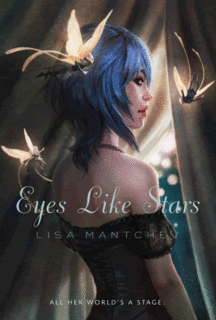
I will confess: 90% of the reason I picked up this book was because of the blue hair on the cover. We all know I have a weakness for colored hair (though blue seems to be the most popular color. I wonder why). Seriously, it's pretty sweet:
Eyes Like Stars by Lisa Mantchev cover


Beatrice Shakespeare Smith (aka Bertie) lives in the Theatre Illuminata, where all the characters from every play ever written reside. She has lived there for 17 years, since she was left at the theatre as an infant, the only non-fictional resident of the theatre. After irritating the powers that be one too many times, Bertie has to find a way to make herself invaluable to the theatre, or she'll be cast out. She proposes to direct a re-staging of Hamlet as set in ancient Egypt, an attempt to create the sort of performance that will fill the house and woo back wealthy donors, restoring the theatre to its former brilliance.

But nothing can be that straightforward, can it? The Stage Manager seems intent on sabotaging Bertie's plans and most of the Hamlet cast is rebelling against tampering with their show. Bertie's only ally in the production is Ophelia, who helps reign in the cast during her brief moments of clarity between suicide attempts. Also making life difficult for Bertie is Ariel (of The Tempest), who desperately wants to escape the theatre entirely, but is bound by the Book - the large tome that collects the first appearance of every character in every play ever written. Ariel thinks that if he can tear his entrance out of the book, he'll be free, and wants Bertie's help in planning his escape.

On Bertie's side are the fairies from A Midsummer Night's Dream and Logan, a pirate from The Little Mermaid, who encourage Bertie through her trials with Hamlet and avoiding Ariel. Ariel seems to think he and Bertie have a bit of a thing going on, but Bertie only has eyes for Logan...and staying in the theatre, of course.

First of all, I have to say I love the Shakespearean characters throughout this story. Ophelia is funny and tragic - any time there's water around she appears to try and kill herself again, but occasionally graces us with moments of lucidity that make it clear she's more than just a crazy, love-lorn girl. The fairies are all hilarious as the squabble amongst themselves and more often than not get Bertie into trouble (though Bertie can be a troublemaker all on her own). It's also great to see a character other than Puck take on the trickster role. The character of Logan stuck out, because he's the only named, non-Shakespearean character that lives in the theatre. When plays are listed, it's like 'Shakespeare, Shakespeare, Shakespeare...The Little Mermaid?!' It seems like a random addition, especially since it's not like there's a definitive stage version of The Little Mermaid. If a pirate character was necessary, why not say he's an extra from Peter Pan, since that was originally a play. Or name drop a few other characters from plays,go back to the Greek tragedies if you're looking for things that are exclusively public domain if necessary, just so Logan doesn't stick out so much.

The logistics of the theatre didn't quite work out for me - at first I thought this theatre was firmly located in the world of imagination (because really? Every character ever written for the stage is here? And can be summoned just by posting a notice on the Call Board?). But then Bertie is originally from the world outside of the theatre, and then real-world patrons show up for performances, which then leads me to question things like how would the playbill credit the performers, if Hamlet is truly played by Hamlet? But if you don't think about it too hard about that point, it's a fun adventure story with lots of humor, and a sequel on the way in May! I won't be rushing out to pick up the sequel on day one, but if I see a lot of positive buzz about it, I'll probably get around to it eventually.

Thursday, March 25, 2010

Review: Clone Codes by Patricia C., Frederick and John McKissack

Found via: Publisher's Weekly 1/18

I've been waiting a couple of months for this one to come in, so as soon as I got it, it jumped pretty high up in the ol' to be read pile. It has a great concept with a lot of potential it just never quite lives up to.

It's 2170 and humanity has nearly perfected the science of cloning. Clones are officially classified as not human and are governed by a strict set of rules that further establish their place in the world. Leanna is 13 and firmly believes in the hierarchy that places humans as "Firsts" and clones as "Seconds" - until she learns her mother is an extremist and/or abolitionist (depending on your point of view) with the Liberty Bell movement, and is subsequently arrested for treason.

Leanna is forced to run in order to evade the government forces, though she doesn't understand why the government is so interested in her. She's just a regular girl, isn't she?

Luckily Leanna's mother had planned ahead in case she was caught and has set up an elaborate safety network to help hide Leanna from the government. Leanna is determined to do what's right, and do everything she can to save her mother in the process, while learning more than she probably ever wanted to know about history, equality, and what makes us human.

Like I said above, I really wanted to like this one - but I almost put it down 10 pages in because the Publisher's Weekly reviewer and I have vastly different definitions of "preachy." Even for a middle grade book, the narrative felt overly simplified and like the authors were talking down to their audience. And then there's The Message, which boils down to Slavery Is Bad. Is that really a lesson that needs to be hammered home in this way in the 21st century? Maybe if the parallel were to a more insidious form of slavery like sex trafficking or child labor, but the explicit parallel is to pre-American-Civil-War slavery (Leanna is a run away slave in a virtual simulation at the start of the book, and she mentions Harriet Tubman several times as she grows from thinking of clones as tools to clones as people).

I almost gave up again at the end, when it seemed the authors totally messed up the workings of the Supreme Court. I don't pretend to be a legal expert, but generally cases only reach the Supreme Court through an appeal, and they don't call in witnesses in criminal cases (Wikipedia seems to back me up here). I find it unlikely that if the number of justices didn't change in 160 years, they would change the fundamentals of the the court's operations. Also a lawyer cites the Dred Scott Decision as precedent for treating clones as property, and despite the whole dystopian-like world the McKissack's built up, I just didn't see how the country would go back to thinking that was a good court case. Why'd I keep on pressing through? Because it was a slow day on the subway and it was either read this or stare off into space. I'll take reading every time.

Science fiction for teens is a subject near and dear to my heart - I wrote my senior thesis in college on science fiction and young adult literature, using Uglies as my case study. Science fiction has always been my preferred literary/TV/film genre. So to see it manhandled like this was disappointing, because the story is fundamentally sound, and there's some great action and character building for Leanna. But the tone and over-emphasis of the message kind of killed it for me. Looking for some great SF for the middle grade reader in your life? Check out the Golden Duck awards, which recognize excellence in children's/middle grade/YA science fiction. They also have a Good Books page which wins bonus points with me for being filled with Animorphs books for grades 5-6. Leave your middle grade science fiction recommendations in the comments!

Monday, March 1, 2010

Review: The Maze Runner by James Dashner

Found via: B&N Post-Apocalyptic Teen Fiction Panel

I heard about this one back in the day, but put off picking it up. Now that I've read it (and read it fairly quickly), I've been delaying writing my review, because I feel like I have a major bone to pick with the characterization of the lone girl in the story - but I've been having trouble articulating my feelings about her. More on that after the summary:

Thomas enters the Glade in the Box. He doesn't remember where he came from, or even his last name. He knows he is Thomas, and he knows the basics of how the world works, but all of the details of his life have apparently been erased.

He emerges from the Box into the Glade and a group of teenage boys, most of whom don't seem too keen on giving Thomas too many answers on where he is or why he's there. And just when Thomas is supposed to start his grand tour of the Glade, a wrench is thrown into the works.

A girl shows up.

Thomas gets a crash course in the rules of the Glade: two years ago a group of boys was dumped into the Glade, which seems to be in the center of a giant, ever-changing maze. Since that first group, one new boy has joined them on the same day every month. The girl, Theresa, shows up one day after Thomas and is, clearly, the wrong gender. She also comes bearing an ominous message: she is the last teen to be delivered to the Glade. Clearly, everything is about to change.

Thomas is a boy of action - he doesn't like sitting around and obeying the rules of the Glade. The rules are there for a reason, as is explained to him many times: when dozens of nervous and scared boys are forced to live together for years, the rules bring order, and order is the only thing that keeps them sane. The rules include assigned jobs for every boy - and one particularly prestigious, and dangerous, job is that of the runners. The runners are the boys who spend every day running frantically through the Maze, trying to map the corridors and find an exit, even though the walls move every night. The runners have to be fast, because the maze is populated by Grievers - horrifying creatures, part machine and part flesh, that will kill anyone who gets in their way - or at least sting them with a poison that causes the boy to see flashes of terrifying memories of life before the Glade.

After Thomas and Theresa's arrivals, life in the Glade changes quickly. Thomas and Theresa discover they have some sort of connection to each other from Before, and life in the Glad becomes progressively more dangerous until one thing becomes clear: the Gladers need to find that way to escape, or one by one they are all going to die.

Let me get some of the good points out of the way before I launch into my thoughts on Theresa: there are lots of interesting characters in the Glade, and the world is definitely very interesting. There's all sorts of slang in the book, which judging from other reviews has thrown people, but isolated communities are naturally going to create their own slang (two years is more than long enough) and the general meaning of the slang I felt was pretty obvious (it's used in place of traditional curse words. Even if you don't know what "klunker" actually means, context lets you know it's some sort of expletive most of the time).

I was torn between being annoyed with the Gladers a lot, and accepting their portrayals as realistic. Thomas has lots of questions, naturally, upon waking up - and absolutely no one will answer them. This is a recurring theme - if Thomas (and we as the readers) have a question, there's going to be a lot of hesitation and arguing before the answer is given to us. Likewise, every single idea Thomas has is immediately shot down because of course the Gladers have already tried it. It makes the Gladers rather unsympathetic initially. On the other hand, if Thomas really did come in and save the day on his second day in the Glade, I would have questioned the intelligence of the rest of the Gladers that a boy figured out in two days what they couldn't in two years. Generally I think the constant belittling of Thomas just went overboard.

And now. Theresa. I think part of the reason I avoided this book for so long is that I have an aversion to guys-only stories - a habit carried over from middle school and high school when I was protesting the forced-reading of so many stories by and about Dead White Guys so I focused my reading on female-centric stories. I've broadened my reading horizons a lot since then, but I still hesitate before picking up a book that I know features only a token female character. I figured I'd give The Maze Runner a chance finally because I liked The Knife of Never Letting Go so much, and that after all is sold as a story about an entire planet with no women until Viola shows up. But Theresa is no Viola, and Thomas is no Todd. For one thing, Viola is given character development, while Theresa is in a coma or otherwise separated from the action for most of the story, which makes her more of a plot device than an actual character. Despite it being so strange for a girl to show up in the Glade, we don't get to see any actual repercussions from that because Theresa rarely interacts with anyone. I hope her presence is setting something up for the sequel that will explain her importance, but as a character (or even as a plot device) she doesn't work at all in The Maze Runner. Ultimately I was left wondering why Thomas on his own couldn't have served the purpose Theresa ended up doing (aside from future dramatic and romantic possibilities in the sequel. Oh man, was Theresa included just to prove these guys weren't gay? That's a terribly depressing thought - because several guys do go out of their way to mention or ask about how hot Theresa is).

As another contribution to the ever-growing list of YA dystopian fiction, The Maze Runner is a solid attempt. A weird and creepy world was definitely created - and we only get the smallest glimpses of what life may be like outside of the Maze. I'm mildly curious to see where this trilogy goes, but I'll probably wait to hear other people's opinions on it before jumping in myself.

Has anyone else read this one? I looked around for other reviews, but I couldn't find any commentary on Theresa. I would love to know if I'm the only one that has a hangup about her.

Monday, February 22, 2010

Review: Incarceron by Catherine Fisher

Found via: Read Roger, Jan/Feb Horn Book Starred Reviews

Incarceron is the perfect fantasy story for me: it has a lot of the trappings of fantasy (pseudo-medieval clothing and social system and mystical characters), but it's also set firmly in the future, which means in my mind I can call it science fiction and be totally accurate.

This is how I justified reading The Dragonriders of Pern when I was in high school - so maybe this line of reasoning doesn't have the world's greatest track record (I kid, Pern fans).

Incarceron follows two stories that are eventually interconnected: Finn, a prisoner inside the horrid world of Incarceron, considered to be a starseer by his fellow inmates; and Claudia, the daughter of the warden of Incarceron, betrothed to marry the Queen's son, and chafing under the rules of Protocol. That Protocol is how we get a fantasy setting in a science fiction world: for reasons that are mostly unexplained, it was decided decades (centuries?) ago that humanity would revert to living in medieval style, with kings and queens and serfs and servants and castles and thatched roofs.

Though everyone in Incarceron knows no one has entered or left the prison since it was built, Finn has visions of life outside and believes he once lived outside of the prison. He collects a motley band of fellow inmates who believe him, and are willing to follow him and the mysterious key he has scavenged, a key that matches the mysterious mark on his arm.

Outside of Incarceron, Claudia is determined to learn its secrets, for even though her father is the warden he has never spoken of the prison to her. She doesn't even know where it's located. When she snoops in her father's office one day, she discovers a key to Incarceron - and is startled to discover it is also a way to communicate with inmates inside. Specifically, the inmate holding the matching key: Finn.

As Claudia's arranged marriage is quickly approaching, she spends much of her free time talking with Finn, trying to help him find a way out, and is startled to discover Incarceron isn't the Utopia she'd always been told it would be - that even though it was populated by criminals from before the introduction of Protocol, with proper food and education they would have created a paradise within the prison. As she speaks with Finn, Claudia becomes convinced that he's not just an ordinary prisoner - that in fact he may be a member of the royal family who died under mysterious circumstances several years back. If she can just get him out of the prison and prove who he is, she can avoid her marriage and overthrow the Queen.

Incarceron has all the marks of another great dystopian series (like so many books today, it's the start of a trilogy). There are lots of mysteries left to uncover in the second and third books. At the same time, there are a few hiccups here - a lot of the basic world building goes unexplained, most notably the Sapients. It's pretty clear that they aren't normal humans, and that they are somewhat respected as scholars (both in and out of Incarceron) - but we have absolutely no explanation of anything else about them. No physical description, nor explanation of how another sentient species is living with humans. While I'm fine with some things being left to be explored later in the series, since Sapients play large roles in Claudia's and Finn's lives, I would have liked to have more explanation of who they are.

The lack of background aside, however, this is a great addition to the explosion of dystopian YA we've seen over the last few years, and I'm definitely eagerly awaiting the next installment!

Monday, December 28, 2009

Review: Prophecy of the Sisters by Michelle Zink

Found via: BBYA 2010 nominations

Hope everyone's been having a happy holiday season so far! Christmas week was off to a rough start for me last week, knocking me off my feet with a cold that left me too tired to read. That's just cruel, right?

But I'm back on my feet, and I have a light week at work, so reviews are back!

Lia and Alice Milthorpe's family has been touched by tragedy far too often. Their mother died of mysterious circumstances years ago and as the novel opens the girls and their little brother are burying their father. Lia's anxiety is hightened by the small symbol that has appeared on her wrist since her father's death, and the bizarre book containing a dangerous-sounding prophecy that the boy she likes found in her father's library.

Intrigued by the prophecy and trying to understand what it means, Lia discovers that the prophecy that speaks of two sisters, one who shall be the guardian of Earth and the other who is the gate that shall let the devil back onto earth, is actually about her and Alice, and they are merely the latest in a long line of twins (including their mother and the aunt who now serves as their guardian) to be bound to the prophecy.

Terrified of her place in the prophecy, and the ends her sister will go to in order to ensure the prophecy comes true, Lia sets out to learn all she can, and hopefully put an end to the prophecy once and for all.

Zink has created a very moody atmosphere for her story, which works great as a background. Unfortunately, the characters didn't grab and hold me - Alice feels far too two-dimensional and Lia, our narrator, is only a bit more interesting. While Lia has an epic task in front of her, far too many pieces seem to fall into place easily for her, hampering any real feeling of drama.

This is the first book in a trilogy (because what fantasy stories don't come as trilogies these days?), but I think this may be one trilogy that I'm going to sit out.

Wednesday, November 11, 2009

Review: Crashed by Robin Wasserman

I read, and moderately enjoyed, Robin Wasserman's Skinned last year, about a girl who suffers a horrific car accident and wakes up to find her parents have downloaded her brain into a cybernetic body. It wasn't the best book of the year, but it was a fine example of YA dystopian lit. So when Crashed came up this year, I knew I had to read it - even if it wasn't at the top of my "to be read" stack.

After reading Crashed I actually had to go back and read Skinned and then re-read Crashed. For one, there were just enough details I didn't remember from the first book that weren't re-capped adequately in the sequel, so I was totally lost half the time. Secondly, I was trying to figure out why Lia just rubbed me the wrong way.

Crashed follows Lia after she ran away from home at the end of Skinned. She's now living with a small group of other Mechs and helps out in the group by helping to recruit new Mechs to their philosophy: since they clearly aren't human anymore, why cling to the trappings and limitations of their old human lives? The Mechs, led by Jude, live a hedonistic lifestyle: there are a few independently wealthy Mechs with enough credit that no one has to work, they don't go to school, since they don't feel emotions or physical sensations the way humans do they subject themselves to extreme activities just to feel again, and since they'll live forever they find monogamy to be monotonous.

In Skinned we saw the first inklings that there were groups of people who were adamantly opposed to the existence of the Mechs. In Crashed, those groups are back in full force and growing larger and more powerful every day, succeeding in placing new restrictions on the lives and activities of the Mechs. A confrontation is approaching between the two sides, and Lia finds herself conflicted: just how much is she willing to tow the party line? How far is she willing to go to defend the rights of Mechs?

One theme that was introduced in Skinned and is really brought to the forefront in Crashed is class, which brings me back to Thursday's post on class in YA lit. Before the download, Lia was definitely in the upper class of the dystopian society America has devolved into. She doesn't have to live in a city or a Corp town, and totally buys into the bullshit reasons that people live in those less-than-desirable places (people in cities are stupid and lazy; if they'd just work harder they'd be working decent jobs and out of those hell holes!). In Skinned we briefly see a city at night, and Lia's friend Auden often tries to open her eyes to the realities of their society. In Crashed we see more of the cities, as well as a corp town, and learn more of what life was like for Jude, Riley and Ani - three of the first Mechs, culled from "volunteers" in the city.

Jude especially seems to revel in telling Lia what a spoiled and clueless girl she is, since she has grown up sheltered outside of the cities. He and the others don't waste an opportunity to let Lia know that she doesn't "really" know how the world works and she's just naive and/or a stuck up rich bitch to think the way she does. And it is painfully obvious that Lia doesn't get what life is like in the cities, but on the other hand I felt the book was really cramming it down my throat, "poor people aren't poor because they want to be! The Man keeps people down!" We got the point the first dozen times; now do we really need to keep calling Lia stupid because she doesn't think something is fair (or right)? I commented over at Adventures of Cecelia Bedelia that I couldn't figure out if Lia irritated me because she's legitimately irritating, or if I was reacting to and sympathizing with the other characters' irritation. I still haven't figured out which it was - all I can pinpoint now is that these books get under my skin, but not in a good way.

Friday, November 6, 2009

Review: The Ask and the Answer by Patrick Ness

In middle and high school, as I became painfully aware of the fact that my school-assigned readings were dominated by male authors and male characters, I unofficially set out to read books that revolved around female characters. I never said "Oh, I won't read that book, it's about guys," but given a choice between two books, I would always choose the one about a girl. Back in May of this year I first read The Knife of Never Letting Go, and I remember being a little hesitant; why would I want to read a book set on a world where there were no women?!

Thank goodness I got over that hesitation, because The Knife of Never Letting Go is an amazing book, and Viola's awesomeness, combined with the terrible secrets of Prentisstown, make up for the lack of women.

The Ask and the Answer was high on my "Most anticipated books of 2009" list (right up there with Catching Fire). The Knife of Never Letting Go ends on a cliff hanger, and The Ask and the Answer picks up shortly after we were left hanging.

Haven, where Todd and Viola were sure they were going to be able to find refuge from Mayor Prentiss' relentless army, and find a way to contact the settler ships Viola had come from, has been transformed into New Prentisstown. Haven's mayor has been deposed and is held as a political prisoner, while Mayor Prentiss has installed himself as President Prentiss and is intent on reinstating order in New Prentisstown - there are curfews, men and women are separated...and the Mayor begins to limit who can have Haven's famed Cure for the Noise that plagues the men of the New World.

As Viola is recuperating from the wounds she sustained at the end of The Knife of Never Letting Go, she is sent to a house of healing - Haven has always had female Healers versus male Doctors, ostensibly so patients could choose whether they wanted to hear their doctors thoughts, but since men and women must now be kept separate female patients go to the Healers and male patients go to the Doctors. Surrounded by women - women who aren't too keen on Mayor Prentiss' new isolating policies - Viola learns some important history lessons about the New World, about the early days of colonization and the devastating Spackle War. Among those who fought in the Spackle War were a group of guerrilla warriors, mostly women who called themselves the Answer, who took up arms when they felt the male-led army wasn't doing a good enough job. Now that a new male threat has appeared, it looks like the Answer is going to have to return.

Todd is kept as far from Viola as possible - Mayor Prentiss will neither confirm nor deny that she is alive. Todd begins to fear the worst - that even if she isn't dead, she doesn't want to be with him anymore. Todd initially resists the Mayor's new rules - but as the terrorists of the Answer begin to make themselves known (and he wonders whether Viola is among them), some of the Mayor's policies make sense. He is just trying to protect them from the terrorists, isn't he?

The Ask and the Answer has some absolutely heart wrenching moments, as Todd and Viola are forced to choose sides in the conflict over New Prentisstown. As the Mayor tightens his grip on the women of New Prentisstown, I found myself comparing it to The Handmaid's Tale: In The Handmaid's Tale, we only get brief flashbacks to the events that led up to the total oppression of women; here in The Ask and the Answer, we actually get to see some of those steps taken: women and men separated, women only allowed out at certain times of the day and then only in small, tightly controlled groups - and even worse, grotesque measures that I won't spoil because you really need to read it for yourself to feel how TERRIBLE it is. Women are kept apart "for their own safety," yet it's widely known that the soldiers assigned to guard the women sneak into the women's homes and dormitories at night.

Todd and Viola do a lot of growing up in this book - it's wonderful and heartbreaking at the same time to see them forced into the frontlines of the Mayor's war. And my stomach dropped when it came to this book's cliffhanger ending - how long do I have to wait until book 3?!

Tuesday, October 6, 2009

Review: Leviathan by Scott Westerfeld

ARC picked up at BEA

My main reason for getting into BEA back in May was the release of the Catching Fire ARC. A nice bonus was picking up Leviathan, written by my hero Scott Westerfeld. I've written more about my love affair with Mr. Westerfeld's work here.

Leviathan has gone through quite a bit of cosmetic changes since I got my ARC. Mine has the original cover, which was nice and all, but I really love the actual cover.

But a change in covers isn't quite enough to get me to go out and buy a new copy of the book - however, the new endpapers might get me to change my mind. Check out Scott's blog for an awesome .jpg (it's now my desktop background at work) and background information on allegorical maps and an explanation of the imagery in Leviathan's map.

But what about the actual story, you're asking? It is, in a word, awesome.

Set in an alternate WWI-era Europe, Leviathan follows two teenagers: Deryn is a Scottish girl who dresses up as a boy (and goes by the name Dylan) in order to join Britain's air service. Alek is the son of Archduke Ferdinand. Yeah, that Archduke Ferdinand.

But because this is steampunk, this isn't just a piece of historical fiction: in this version of WWI, the British have learned how to genetically engineer animals (these are the Darwinists, as here it was Charles Darwin who discovered DNA and paved the way for such engineering), while Germany, Austria-Hungary and the Ottoman Empire rely upon great mechanical war machines that do in some ways emulate the animal fabrications of the British. In our history, machines have usually moved on wheels, but in Leviathan's world, the machines (clankers - any more explanation necessary?) move about on sets of legs.

Deryn and Alek have parallel adventures through Europe for most of the book: Deryn is serving on the great airship Leviathan, which is transporting precious cargo to Russia, while Alek is on the run for his life from the people who would have him assassinated.

Leviathan has a lot of the hallmarks of a great Scott Westerfeld book: the action scenes are epic, there are long journeys through the wilderness (not unlike Tally's quest to find the Smoke back in Uglies), and great, distinct characters. Of course Deryn is a very strong female character (because Westerfeld doesn't seem to know how to write any other kind!), and I really appreciated how in the author's note at the end of the book it's noted that, in reality, much of the past was a terrible time to be a woman. But that's part of the fun of steampunk, that you can take a setting that was less-than-ideal in many ways and create something new. (For more on alternate histories, including some thoughts by Scott Westerfeld on this very subject, check out this video from BEA where Scott Westerfeld speaks, along with Holly Black and Cassie Claire).

Saturday, May 30, 2009

Review: Catching Fire by Suzanne Collins

When I heard earlier this year that the galley for Catching Fire, the sequel to Hunger Games, one of my favorite books of last year, was going to be at Book Expo America, I cursed my current employer. Since we already have a showroom in New York, and BEA was going to be in New York, we decided to just have all of our clients come into the showroom. Which meant there wasn't going to be a way for me to sneak out onto the floor to score myself a copy of the book. ~sigh~

But eventually word got out that little ol' Angela really, really wanted to get on the floor at BEA. So strings were pulled, and by the end of the day yesterday I had a pass to get onto the floor. So I woke up ridiculously early for a Saturday to make sure I would be at the Javits Convention Center right around 9:00 when the floor opened.

I ended up getting there around 9:30 (stupid E train running local through Queens. You're supposed to be express!) - and already there was a huge line at the Scholastic booth for the galley, which was being given away at 10! I was a little nervous about whether I would make it to the front of the line before they ran out of books, but it turns out I didn't need to worry - there were plenty of books to spare by the time I made it to the front of the line.

Now I must confess, I seriously considered finding some out of the way spot right then and there and starting to read. But when I was getting in line I happened to bump into a friend who was working at the show and had actually volunteered to pick up the galley for me, so instead I decided to be social and went with her to see Scott Westerfeld, Holly Black and Cassandra Clare talk about steampunk and building alternate worlds. Then we had to go pick up the Leviathan galley, but that's a post for another day.

It was a gorgeous day in New York, so I decided to take my new galleys and check out the new lounge chairs in Times Square. Naturally I started with Catching Fire.

While my copy of the galley didn't specifically request I avoid discussing the twists and turns of the novel, I'm still going to avoid a detailed plot summary for a couple of reasons. Mostly because I'm still trying to wrap my brain around a lot of the plot.

But let me assure you, this novel will in no way disappoint fans of The Hunger Games. Suzanne Collins is an extremely deft writer - I noticed this as I re-read Hunger Games twice over the last three days. Both Hunger Games and Catching Fire are extremely tightly woven stories - if Collins mentions something early on in the book, you can bet it will play a part in the story later on. Of course, now that I was on to her, I was feeling rather smug going into Catching Fire, sure I'd be able to predict the plot based on Collins' effective foreshadowing. Boy was I wrong - while I often caught what was going to be important later on, there was absolutely no way of predicting just HOW that plot point was going to be implemented.

Like Hunger Games, I was an extremely vocal reader during Catching Fire (so much so that I eventually decided I needed to leave Times Square and read in the solitude of my apartment). I may even have been more so this time, thanks to the deeper emotional investment we have this time around. We've watched Katniss survive insurmountable odds once - to see her thrown back into the fire after the president's reaction to her stunt at the end of the Hunger Games is almost too much.

And of course, we're left with another fucking cliff hanger. There seems to be a consensus here: as awesome as it is to get to read this galley, it's going to make the wait for the third book even longer - especially if, as this Publisher's Weekly article says, they don't do a galley for the third book!
Related Posts with Thumbnails