Showing posts with label thriller/suspense. Show all posts

Monday, January 17, 2011

Review: Trash by Andy Mulligan

This one has been getting lots of love from the start - and while it wasn't awarded any serious hardware at the recent ALA awards, Trash does have the honor of being one of the top ten books chosen by the Best Fiction for Young Adults committee, a great honor in itself!

TrashRafael, Gardo and Jun-Jun, aka Rat, are trash boys. Living among the dump site Behala, the boys spend their days climbing mountains of trash, sorting out what can be re-sold, earning meager pay that is hardly enough to support themselves and their extended families. Most of what they find is shtupp, until one day Rafael pulls a leather bag out of the refuse - a leather bag with an ID card, and over 1,000 pesos inside. It's more money than Rafael has seen in his life - this sort of money represents hope for his family.

But before Rafael can get too comfortable with his newfound luck, the police come to Behala, saying they're looking for a leather bag. Instinctively, Rafael hides his treasure, and with Gardo and Jun-Jun's help, begin their own investigation into the man on the ID card and former owner of the cash. Their search will bring them face to face with some of the darkest secrets of their country, with the ones whom power has corrupted. But the boys hold out hope, that they can solve the mystery, and perhaps bring about some small amount of justice.

The theme of trash comes up in so many ways in this book - there's the actual trash mountains the boys climb every day, and it's where they find the money that jump starts their adventure. But it's also how people treat the boys - as if just because they're poor these boys are worthless. It's also a term that comes to mind to describe the corrupt politicians and other people in power.

The narration jumps between the three boys, with the occasional chapter told by other supporting characters, like the man who runs the Mission School in Behala who befriended Rat. It's never totally clarified who the story is being told to, or how long after the events the story is being relayed. This would be an excellent book to use when writing teachers are talking about audience and first person narration, because these boys are very aware that they are telling a story.

Mulligan does an excellent job describing th downtrodden settings and fast-paced action. He cultivates an excellent sense of danger as the boys are on the run. There's a bone chilling scene where Rafael is taken in for questioning by the police that had my heart in my throat the entire time.

There's a lot of awesomeness going on here. While this one personally wouldn't have made it onto my personal best read in 2010 list (and won't be going on my 2011 list), I can still see why it's garnered a lot of praise, and highly recommend it.

Friday, October 15, 2010

Sci Fi Friday Review: Feed by Mira Grant

Sometimes I debate what titles I should include in my Sci Fi Friday reviews. Should I expand it to Sci Fi/Fantasy? (No, because I generally dislike fantasy and don't want it interfering with my science-y goodness) What about horror? Or superhero graphic novels? While Feed falls firmly into the horror genre, what with all the zombies running around, there are also some awesome bits of science and tech, allowing me to make it a Sci Fi Friday contribution without hesitation.

Which is a good thing because there's been a dearth of SF in my life lately

Feed (Newsflesh, Book 1)It's been twenty years since the dead have risen. Mutated from the cures for humankind's greatest illnesses, the virus lies dormant in every human being, ready to reanimate the corpse to become one of the walking dead with the incessant need to feast on human flesh.

Siblings Georgia and Shaun, along with their friend Buffy, are mid-level bloggers ready to make it to the big time when they're selected to be part of the press team for presidential candidate Peter Ryman. Dedicated first and foremost to reporting the news, the bloggers unwittingly become part of the news when a series of suspicious zombie attacks start following Ryman. A cut fence here, an infected horse there, and it begins to become very obvious these aren't accidents - someone is using the zombie virus as a biological weapon.

Technically this is an adult novel, but I'm confident it will have plenty of teen crossover appeal. Georgie and Shaun are in their twenties (no definitive age is given that I saw), and they also still live at home, under the imposing shadows of their famous-blogger parents. There's been some talk over the past year about a potential new marketing category called "new adult" and I think Feed could easily be classified there.

Grant has included lots of funny details for readers to pick up on. While it's explained that Georgia was born at a time when the most popular girls' names were Georgia, Georgette and Barbra as George Romero was recognized as a sort of patron saint of the zombie apocalypse, it's up to zombie fans to guess where Shaun's name comes from - Shaun of the Dead anyone? (And for the uninitiated, Barbra was the woman in Night of the Living Dead) Bloggers have also organized themselves into a couple of factions - broadly the Newsies, the Fictionals and the Irwins, who like to go out in the field and poke zombies with sticks (they also give out an annual award called the Stevies, solidifying the tribute to the late, great Steve Irwin). Each faction has sub-factions - for example in the Newsies, the people who deliver the news with a healthy dose of opinion are called Stewarts. I loved these little glimpses into Grant's world building, and make it clear she probably has lots of details planned out for this trilogy.

As a blogger, and as someone who probably gets 90% of her news from various blogs (and the other 10% still from internet sources like the New York Times online or streaming Rachel Maddow's show), I absolutely loved following a group of citizen journalists on the campaign trail. Of the trio, Georgia and Buffy were definitely my favorites, but Shaun and Georgia have a great rapport as well.

While I loved the blending of genres in this book (new adult, zombie horror, journalistic thriller), and Grant has clearly done some great work with her world building, the overall setting just never worked for me. It's been twenty years since the zombies first rose, which really isn't much time at all, and there's already a fully functioning government? It felt like the zombies were never that much of a threat if the whole world didn't collapse, and now that the government is functioning so well the zombies are only terrifying on a personal level (like if you're like Shaun and enjoy poking zombies with sticks) and no longer on a widespread level. There are so many weapons and defense tactics and decontamination safety protocols in place, that society really isn't in danger of ever collapsing, which for me is half the fun of zombie stories. Humanity can try to rebuild, but it shouldn't be as good as it was before, unless a much longer period of time has passed.

I know this review is getting long but I have to praise Grant on one other thing - this has one of the best surprises I've ever read in a novel. If nothing else, strictly from a writing standpoint it's fascinating to see it done, and her technique for accomplishing it. It's a huge spoiler so I can't go into detail, but as a writer myself it was interesting to see an author do what I'd long thought was impossible.

Feed is the first book in a new trilogy, but there's no severe cliffhanger ending here and feels like a complete story in itself. I recommend picking this one up, though personally I don't know if I'll be back for more - the fully functional society really irritated me on some levels.

Tuesday, July 27, 2010

Review: Stolen by Lucy Christopher

Found via: Publisher's Weekly 4/12

I think I'm just a contrarian, whether I mean to be or not. It's been a few weeks since I read this and didn't make any notes on it, so now I'm looking at the original Publisher's Weekly review (it's starred even!) that made me get this book, and I an't figure out what drew me to it in the first place, since I found it to be a rather underwhelming read.

StolenGemma isn't happy with her parents - but that doesn't mean she ever wanted to be drugged and kidnapped from the Bangkok airport in the middle of a trip with her parents and whisked away to the Australian outback by a guy who's been stalking her for 6 years.

Ty first saw Gemma in the park in London when she was ten years old, and has spent his life since then preparing to bring her to the beautiful outback. He's convinced her parents don't actually love her, certainly not the way he loves her, and he's sure she'll come to love the wild outback the same way he has.

Lucy recounts her life in captivity in a diary or letter addressed to Ty, detailing her frustrations, anxieties, and even the occasional moment of exhilaration so far from civilization, even as she desperately want to return home.

While the story itself is solid, I felt the pacing was way off throughout the story, as Gemma's captivity only lasts a couple of months, and we never see the complications in Gemma's emotions that she claims to feel at the end. She's diagnosed with Stockholm syndrome, but while she's in captivity Gemma feels no ambivalence, let alone affection, for Ty. Not to mention her escape from captivity feels like a big deus ex machina, coming out of nowhere even after she and Ty have negotiated terms for bringing her back to civilization. I would much rather have followed the story for six months, which would have allowed Gemma more time with her captor with the promise of release and thus more opportunities for complicated emotions to arise.

Ty was a creepy yet oddly sanitized villain and I never felt I really understood his motivations for kidnapping Gemma in the first place. I say sanitized because let's face it, how many real life kidnappings of teenage girls lack physical or sexual violence. Ty maintains he's a gentleman (despite taking a girl against her will) and even shows embarrassment when he has to see Gemma in a state of undress (she messes herself up a couple of times, requiring changes of clothes or even nudity in order to heal from things like extreme sunburn and dehydration).

There are a few brilliant moments of writing. Gemma's interactions with the camel Ty captures and tries to domesticate are heartbreaking, as she confides in the camel how they're both captives and Ty will try to break both of them. It's an absolutely tragic and apt parallel.

Friday, July 23, 2010

Sci-Fi Friday Review: For The Win by Cory Doctorow

Found via: Publisher's Weekly 4/19

This image is a derivative work of Gamepad.svg...Image via Wikipedia
Gaming is a Big Deal in my family. As a kid, I loved our Intellivision II, until we finally upgraded to a Super Nintendo (still my favorite gaming system). In high school and college, I matured to playing table top role playing games (if you want to hear a story of the Worst Decision Ever made - like, the sort of decision that gets people killed in horror movies - ask about the first time I went gaming with my new college friends. Note: offer does not apply to my mother - I don't want to give the woman a heart attack). Through the man who's now my husband, I discovered MMORPGs - games like World of Warcraft and Second Life (not that he plays either of those - Star Wars Galaxies and City of Heroes dominate in our apartment). So when I heard Cory Doctorow, author of Little Brother, one of my tops reads of 2008), was combining MMOs with the sort of social justice stuff I also love, I was all over it.

For the WinSet in the not-too-distant future, For the Win follows several gamers from around the world, all of whom are employed in different ways in gold farming. They work in sweat shop conditions, mostly in India and China, playing for hours every day in order to collect gold and other in-game valuables that can then be sold for real-world money to first world players too lazy or inept to collect the treasures for themselves. The conditions are deplorable, but a step up from the dangerous factory work these children and young adults would otherwise be forced into.

A young woman who goes by the name Big Sister Nor recognizes that the conditions these gamers work under are dangerous and abusive - slave wages, dark and crowded work environments, and threats to family members are all part of the gold farmers' lives. Nor is determined to unionize these workers across the world, gaining the support of real world unions to help protect local gamer unions. But Nor isn't only working against the systems in the game (as gold farming is clearly against the Terms of Service in any game) - after all, she's taking on whole governments when she tries to organize workers in China, and even the small-time bosses in India don't take kindly to children demanding better treatment. It will take the resources and determination of dozens, even hundreds, of players around the world, to give the new system even a hope for survival.

Doctorow clearly knows his stuff, both when it comes to games and to Marxism. Unfortunately, this didn't always come out in the best way. More than once I had flashbacks to college discussions about the benefits of Marxism and unions and the details of various economic theories as characters sounded just like my professors - or worse, the text books. I was glad some of these topics were being explained, as a lot of readers will lack a working knowledge of at least one subject integral to the story, but the way the information was presented was too heavy-handed.

Editing was also a huge problem for this book. Shortly before I read this, Cindy and Lynn at Bookends posted about "bloated 500+ page books," asking where they'd come from. For the Win definitely could have been much shorter - and needed an editor to go through at least one time with a fine-toothed comb, as this had far more than the average number of typos and several repetitive phrases, including repeated definitions of PvP (made more awkward because alternatives like PvE and role playing servers were never mentioned) and warnings of Terms of Service so dense they retained the right to kick you off at any time for any reason (or no reason at all).

There were also way too many characters in play, few of whom got any real development. The cast is as diverse and multi-cultural as you can get, but the lone white American boy was the closest to getting an actual character arc. Also, while I appreciated the attempt at cultural diversity, a lot of the characters from all around the world felt and sounded essentially the same, making the different countries little more than window dressing and not actually an integral part of the characters' backgrounds. It's almost as though the only reason this wasn't just set in America with a generic cast is because you'd have to go a little farther in the future before we'd really believe the military would come in and kill people over a union trying to organize, but we know that happens in China right now.

So while I found the initial idea to be intriguing, unfortunately it fell apart in the execution for me. However, if you're like me and find your curiosity piqued no matter how many critical reviews you see, know that Doctorow not only talks the talk, but walks the walk when it comes to copyright issues, and the novel is available for free download in multiple e-formats, from plain text to Kindle.
Enhanced by Zemanta

Monday, June 7, 2010

Review: The Body Finder by Kimberly Derting

Oh, suuuuuuuuuuure. Mere days after I say I'm not doing paranormal romance anymore, I pick up a book that ends up being just that - and I like it. I just can't win, can I?

In my defense, I didn't see The Body Finder advertised as a paranormal romance - I wasn't looking to set myself up for disappointment or anything. Okay, now that I look at the cover I see the blurb says "You'll be drawn in by the love story," but I wasn't looking at the blurb! I thought this was a more straightforward paranormal mystery, but ends up being a delightful mix of paranormal, mystery and romance.

Ever since she was a little girl, Violet Ambrose has had the ability to sense the bodies of murder victims. Usually it's just dead squirrels and rats - there's a sound or scent or taste that draws her to the body, and a matching one attached to whoever or whatever killed it.

Now a junior in high school, Violet is mildly bothered by her "talent," but is able to mostly ignore it - until a day out at the lake, when an oily sheen on the water catches her attention. When she goes to investigate, she's horrified to find the body of a dead girl.

Soon more girls start disappearing, and the community begins to panic. Violet knows that she's the only one who might be able to track down the killer, hoping to find him in a public place where the echoes of the dead girls are clinging to him.

Her best friend Jay, suddenly hot after a summer growth spurt, is fiercely protective of Violet and thinks her plan is a terrible idea - but knowing she's determined, he promises to stick by her to help keep her safe. Violet chafes under his watchful eye, as she's determined to not ruin their friendship by mixing it up with romance. But Jay sure isn't making that vow easy. Even as she's falling harder and harder for Jay, Violet knows she's getting closer and closer to finding the killer. But the question is, will she be able to find him before he finds her?

This book immediately throws you into the deep end of creepy. The prologue shows Violet finding her first human body - at the tender age of 8! And then just two chapters later, we get a glimpse at the REAL creepy strength of the book - glimpses into the killer's mind. He shows up periodically throughout the book, showing us what's happening on the other side of the coin. I always got jumpy during his short chapters - because while it's creepy to follow Violet as she's tracking an imprint, it's even creepier to be following the killer as he's tracking his next victim. So Derting gets HUGE points there, and I hope she keeps writing mystery thrillers!!!

Other great point: love, love, LOVE that Violet has a group of girlfriends which makes this book easily pass the Bechdel Test. We actually see the girls out having a good time, shopping for shoes and then later on at the Homecoming dance. Sometimes we're told that girls are friends, but we never see them actually doing anything together. Here there was no problem. So more bonus points!

For once, I didn't mind the romance. Jay isn't a creepy stalker boyfriend. Sometimes he's comes across as a little possessive, but usually Violet shoots back at him, standing up for herself. Violet is rarely the damsel in distress for long - and sometimes Jay is the dude in distress. All in all, very equitable.

My only minor quibble, and this probably comes from my background as a science fiction rather than a fantasy fan, is I either wanted an explanation for why Violet could find bodies or I wanted it completely handwaved as a mystery. There's a brief mention or two of her grandmother having a similar ability - but that's it. I'd rather have had a full explanation, or just ask us to go with it, no questions asked.

Okay, I guess there are actually two minor quibbles - it seemed weird that Violet considered animals killed as prey for other animals "murder." She makes it clear that she can only feel the echoes of people or animals that have been murdered - she can't find someone that died of natural causes. But the food chain is murder? That felt a little off. I mentioned this to my husband, who suggested that saying Violet could sense those who'd died violently would have been a better description, but it's intimated later that Violet can tell if a doctor or nurse has essentially committed euthanasia by administering too much pain medication or sedatives. So there doesn't seem to be an easy way to define exactly what bodies Violet senses, but "murder" doesn't feel like the right term to me.

But seriously - that's it. My only nitpicks. I really enjoyed this one - so much so that I considered staying on the train past my stop since I reached home EXACTLY when Violet had found the killer. I was really hungry so I didn't do that, but I practically ran home (yes, in the oppressive NYC humidity we're suffering right now), grabbed a snack, then sat on the couch to read the last bit. Definitely a "couldn't put it down" book!

Thursday, June 3, 2010

Review: Split by Stefan Petrucha

As mentioned yesterday, two very different books titled Split were released in March. While I originally thought I could make a double review out of them, they turned out to be so different I decided to go with a back-to-back approach, so here's the science fiction version of Split.

When Wade's mother dies, he finds himself conflicted with how to move on with his life. Should he re-dedicate himself to his studies and stay on the straight and narrow? Or is life without a mother hardly worth living, so he should drop out and drift?

Fast forward three years later, and in the style of Sliding Doors we get to see the outcomes of both decisions. One Wade has dropped out of school, run away from home where his father has fallen off the wagon, and is now living above the coffee shop called The Rat where he plays music to pay rent and entertains his friend Ant and exasperated girlfriend Denby. He also likes to do small-time cons to entertain himself, which is how he ends up with a stolen diamond studded car - originally Ant was supposed to deliver it to the fence, but through a convoluted series of events, it ends up in Wade's hands.

The other Wade is a straight A student, still living with his dad and encouraging him to attend AA meetings so he stays on the wagon. He's still best friends with Ant - called Anthony here - and has proposed to Denby, though she hasn't agreed to the engagement yet. Instead of working cons, this Wade has thrown himself into writing a computer program to prove that the town's particle accelerator could destroy the world. When Wade shows the results of the computer program to the higher-ups at the accelerator, he discovers that not everyone is as eager to protect the world as he is; they're concerned with destroying the livelihoods of many of the town's citizens (and their own paychecks, of course) if the particle accelerator is shut down. We the readers get to see exactly what happens to the town without the particle accelerator - end of the world fears shut down the accelerator shortly after it was started in the other Wade's world, leading to widespread unemployment and economic depression.

Each Wade has strange dreams, seeing himself as the other Wade. As both of their lives are tumbling out of control, by chance they end up at their mother's grave - and by accidentally exchanging the car and the flash drive with the computer program on it, the two Wade's end up exchanging lives. Finding themselves in a world that is totally different, yet utterly familiar, each version of Wade has to find a way to save himself from the other's problems.

Maybe it's because I was reading this the day after I watched the big Lost finale, but the early chapters were giving me traumatic flashbacks, as each Wade was having flashes of himself in his other life. Definitely reminded me of the flash-sideways we were seeing through season 6, when the characters would get flashes of their island lives. Thankfully the trope was abandoned after a few chapters, because not only didn't I need the Lost thoughts, but it was actually kind of annoying to see the events of the last chapter immediately re-capped.

This is not an in-depth science fiction novel for the hard-core enthusiast. Both Wade's are rather shallowly drawn, and there's such an emphasis on action that it's hard to keep track of either Wade's motivation. I'm still not sure if straitlaced Wade was hoping to find the particle accelerator was dangerous or not. I also would have loved some sort of explanation of why there are two different Wade's - does Petrucha subscribe to the multiverse theory? Or maybe it was caused by the particle accelerator experiments? And why were they able to change places?

The supporting cast is no more well developed than the Wades. Both Wades' attitudes towards the girlfriend, Denby, was extremely annoying. She seemed to exist solely to reflect the two Wades' attitudes towards life. At least Ant/Anthony got to actually take part in both adventures - Denby was just there as an example of how controlling Straightedge Wade was and how careless or manipulative Slacker Wade could be.

If you're looking strictly for a SF-tinged action/adventure story, this is for you - but if you want something with well-rounded characters and development, you'd best look elsewhere.

Thursday, May 13, 2010

Double Review: The Dark Days of Hamburger Halpin by Josh Berk and All Unquiet Things by Anna Jarzab by

Hamburger Halpin found via Publisher's Weekly 1/18
All Unquiet Things found via Tea Cozy

On the surface it looks like I'm stretching for this Double Review pairing, but hear me out! While The Dark Days of Hamburger Halpin is a dark comedy and All Unquiet Things is a noir-ish murder mystery, at the center of both stories is the murder of a young classmate. How each novel handles that murder, and tracking down the killer, however, couldn't be more different.

In The Dark Days of Hamburger Halpin, the Will "Hamburger" Halping has decided it's time to ditch "deaf school" and join mainstream classes at the local high school. He's fairly adept at reading lips, but being new, disabled, and overweight all combine to work against Will when it comes to making friends. His only social prospect is perpetual dweeb Devon Smiley. Will does his best to ignore Devon, despite the latter's eager attempts at communication, including learning to finger spell and sign some basic phrases so Will doesn't have to read his lips all the time. The two join forces and forge a friendship in the aftermath of a tragic accident at a coal mine during a school trip where a popular classmate died. Or was it an accident? Will and Devon take it upon themselves, roping in Ebony, Devon's friend from his deaf school days (and who just narrowly avoids falling into the "sassy black friend", to solve the crime, relying on Will's & Ebony's lip reading abilities to surreptitiously gather information. Their investigation takes them through all the rungs of the high school social ladder, uncovering secrets and petty gossip the popular kids would rather remain quiet, until the startling reveal of whodunnit.

All Unquiet Things also has a murder at its center: Carly, Neily's ex-girlfriend and Audrey's cousin. Months after Carly's murder, Neily has come to terms with her death (as well as you can when someone you love has been brutally murdered) - until Audrey shows up in school again after an extended absence, saying that her father - Carly's uncle - wasn't guilty, and she wants Neily's help to uncover the true suspect. Through alternating sections, we see the investigation unfold through Neily's and Audrey's perspectives as the two start sticking their noses where they don't belong, tangling with teenage drug dealers and stalkers, while trying to uncover the motive and the guilty party that snatched Carly from their lives all too soon.

I enjoyed Hamburger Halpin for about 99% of the book - until the murderer and motive was revealed. My dislike of the conclusion was only heightened after reading All Unquiet Things which took a very similar tactic and treated it with seriousness and respect. I'm trying to be circumspect here so as not to spoil the ending for either book, but the murderer and motivation in Hamburger Halpin feels totally out of place in a comedic book. I'm all for dark comedy, but the conclusion comes out of nowhere and the very serious motivation is treated like an afterthought that just totally ruined the end.

All Unquiet Things, on the other hand, builds the mystery slowly over the course of the book, with multiple suspects investigated, so that when the big reveal is finally made it feels like we've really been on the investigation with Neily and Audrey. The final few scenes at the climax are tremendously tense and were everything a person could ask for in a dramatic murder mystery.

In Hamburger Halpin's favor, I did enjoy reading about a deaf protagonist, even if I felt the communication difficulties were overcome rather quickly. Until Devon procures smartphones for text messaging for both of them, a lot of communication is done via notebook paper. Have you ever tried to carry on a conversation by writing everything down? It drives you crazy (I did this in high school during the Day of Silence). Also I thought it was a little convenient that Will rarely missed important words while lip reading. Luckily, Will is a fun character, so I didn't mind spending so much of the book inside of his head with just his observations to carry the story until he and Devon become friends.

Has anyone else read either title? What did you think of the big reveals?

Tuesday, May 11, 2010

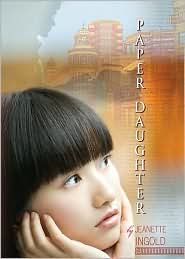
Review: Paper Daughter by Jeanette Ingold

Found via: Reading in Color

I picked this one up because I was interested in the journalism aspect of the story; it's simply coincidence that I'm posting my review during Asian-Pacific American Heritage Month.

In the aftermath of her father's death in a hit-and-run accident, Maggie Chen is helping her mother sort through his things when she starts uncovering startling inconsistencies. His old prep school and fraternity claim they've never heard of him. His notebooks have cryptic messages scribbled in the margins. An aspiring journalist, taking after her father, Maggie vows to delve deeper into the mystery. What she doesn't expect is to stumble upon a major criminal story in the course of her work as a newspaper intern that might just connect to her father's mysteries. But is it simply that her father was onto the same story? Or was the man lying about more than just his origins?

But this isn't just the story of Maggie and her father - this is also the story of Fai-yi Li, a 19th century Chinese immigrant whose story also plays a role in Maggie's life. As his story slowly unfolds, Maggie digs deeper into her father's past, until the stories intersect.

I like to think that I'm fairly well versed in history, but then I stumble across stories like this and I realize just how much there is that I don't know. I know that Chinese immigrants weren't treated well in the 19th century (because Americans really didn't treat any immigrants well at that point), but I didn't know about the Chinese Exclusion Act, which suspended legal Chinese immigration into the US for decades. The Act gave rise to "Paper Sons," Chinese immigrants who were allowed into the country because a Chinese-American citizen would claim the immigrant as a son (or daughter). Want more information on Asian immigration in this era? My friend Ay-leen the Peacemaker not only has a badass name, but runs the awesome steampunk project Beyond Victoriana and this past week's post was all about Asians in the Americas. (While the general focus of Beyond Victoriana is multi-cultural steampunk, many of Ay-leen's essays provide historical background for non-western cultures in the Victorian-ish era that are fascinating even outside of a steampunk context, hence the link this week)

I found the historical chapters to be a bit of a drag, and once Maggie starts researching the history of Chinese immigrants in Seattle the characters can get a little preachy - it's clear that Ingold did a lot of research and I'm sure it was insanely difficult for her to decide what there was room for in the story and what wasn't. The information she does include is fascinating, but I feel it doesn't roll out smoothly. But the journalistic thriller aspect of the story, as Maggie helps track down leads both about corruption in city hall and her father's secretive past, is fast paced and well done.

This is also an interesting novel on the immigrant experience, in part because that isn't the focus of the story. Many, many stories featuring non-white protagonists are about how the character doesn't fit in to mainstream America society and how different she or he is, but Maggie tells a fellow intern at one point that she doesn't necessarily think of herself as "ethnic" - she is aware of and proud of her Chinese heritage, but her family has been in the US basically "forever" so her primary identity is American. It is through the historical chapters with Fai-yi Li that we see what immigration was like for the Chinese on the Pacific coast.

On a closing note, continuing with my goal to not only shame publishers that white wash covers but to applaud those who accurately portray people of color, Harcourt wins for giving us an unambiguous Chinese model on the cover:

Monday, March 1, 2010

Review: The Maze Runner by James Dashner

Found via: B&N Post-Apocalyptic Teen Fiction Panel

I heard about this one back in the day, but put off picking it up. Now that I've read it (and read it fairly quickly), I've been delaying writing my review, because I feel like I have a major bone to pick with the characterization of the lone girl in the story - but I've been having trouble articulating my feelings about her. More on that after the summary:

Thomas enters the Glade in the Box. He doesn't remember where he came from, or even his last name. He knows he is Thomas, and he knows the basics of how the world works, but all of the details of his life have apparently been erased.

He emerges from the Box into the Glade and a group of teenage boys, most of whom don't seem too keen on giving Thomas too many answers on where he is or why he's there. And just when Thomas is supposed to start his grand tour of the Glade, a wrench is thrown into the works.

A girl shows up.

Thomas gets a crash course in the rules of the Glade: two years ago a group of boys was dumped into the Glade, which seems to be in the center of a giant, ever-changing maze. Since that first group, one new boy has joined them on the same day every month. The girl, Theresa, shows up one day after Thomas and is, clearly, the wrong gender. She also comes bearing an ominous message: she is the last teen to be delivered to the Glade. Clearly, everything is about to change.

Thomas is a boy of action - he doesn't like sitting around and obeying the rules of the Glade. The rules are there for a reason, as is explained to him many times: when dozens of nervous and scared boys are forced to live together for years, the rules bring order, and order is the only thing that keeps them sane. The rules include assigned jobs for every boy - and one particularly prestigious, and dangerous, job is that of the runners. The runners are the boys who spend every day running frantically through the Maze, trying to map the corridors and find an exit, even though the walls move every night. The runners have to be fast, because the maze is populated by Grievers - horrifying creatures, part machine and part flesh, that will kill anyone who gets in their way - or at least sting them with a poison that causes the boy to see flashes of terrifying memories of life before the Glade.

After Thomas and Theresa's arrivals, life in the Glade changes quickly. Thomas and Theresa discover they have some sort of connection to each other from Before, and life in the Glad becomes progressively more dangerous until one thing becomes clear: the Gladers need to find that way to escape, or one by one they are all going to die.

Let me get some of the good points out of the way before I launch into my thoughts on Theresa: there are lots of interesting characters in the Glade, and the world is definitely very interesting. There's all sorts of slang in the book, which judging from other reviews has thrown people, but isolated communities are naturally going to create their own slang (two years is more than long enough) and the general meaning of the slang I felt was pretty obvious (it's used in place of traditional curse words. Even if you don't know what "klunker" actually means, context lets you know it's some sort of expletive most of the time).

I was torn between being annoyed with the Gladers a lot, and accepting their portrayals as realistic. Thomas has lots of questions, naturally, upon waking up - and absolutely no one will answer them. This is a recurring theme - if Thomas (and we as the readers) have a question, there's going to be a lot of hesitation and arguing before the answer is given to us. Likewise, every single idea Thomas has is immediately shot down because of course the Gladers have already tried it. It makes the Gladers rather unsympathetic initially. On the other hand, if Thomas really did come in and save the day on his second day in the Glade, I would have questioned the intelligence of the rest of the Gladers that a boy figured out in two days what they couldn't in two years. Generally I think the constant belittling of Thomas just went overboard.

And now. Theresa. I think part of the reason I avoided this book for so long is that I have an aversion to guys-only stories - a habit carried over from middle school and high school when I was protesting the forced-reading of so many stories by and about Dead White Guys so I focused my reading on female-centric stories. I've broadened my reading horizons a lot since then, but I still hesitate before picking up a book that I know features only a token female character. I figured I'd give The Maze Runner a chance finally because I liked The Knife of Never Letting Go so much, and that after all is sold as a story about an entire planet with no women until Viola shows up. But Theresa is no Viola, and Thomas is no Todd. For one thing, Viola is given character development, while Theresa is in a coma or otherwise separated from the action for most of the story, which makes her more of a plot device than an actual character. Despite it being so strange for a girl to show up in the Glade, we don't get to see any actual repercussions from that because Theresa rarely interacts with anyone. I hope her presence is setting something up for the sequel that will explain her importance, but as a character (or even as a plot device) she doesn't work at all in The Maze Runner. Ultimately I was left wondering why Thomas on his own couldn't have served the purpose Theresa ended up doing (aside from future dramatic and romantic possibilities in the sequel. Oh man, was Theresa included just to prove these guys weren't gay? That's a terribly depressing thought - because several guys do go out of their way to mention or ask about how hot Theresa is).

As another contribution to the ever-growing list of YA dystopian fiction, The Maze Runner is a solid attempt. A weird and creepy world was definitely created - and we only get the smallest glimpses of what life may be like outside of the Maze. I'm mildly curious to see where this trilogy goes, but I'll probably wait to hear other people's opinions on it before jumping in myself.

Has anyone else read this one? I looked around for other reviews, but I couldn't find any commentary on Theresa. I would love to know if I'm the only one that has a hangup about her.

Wednesday, February 3, 2010

Review: The Comet's Curse by Dom Testa

Found via: Jen Robinson's Book Page

I've read several reviews on this one...and of course the one review that I want to link to now is the one I never saved! Argh. How frustrating.

Also frustrating: How myself and that one unfindable reviewer seem to be the only ones not enamored with The Comet's Curse.

In the not-too-distant future, the comet Bhaktul passes near enough to Earth that its tail passes through our atmosphere. However, instead of being just another fascinating astronomical event, it turns out that Bhaktul was carrying microscopic particles in its tail that are fatal to humans over the age of 18.

As adults around the world start to die in droves, Dr. Zimmerman is one of the few who realizes that instead of wasting time trying to develop a cure before all the adults die, his energy should be focused on saving at least a sliver of the human race. And so the Galahad project is born - choosing 251 teenagers to be sent on a 5 year space flight to begin colonizing another planet.

The teenagers are the best and the brightest 15 and 16 year olds from around the world, and the best of the best make up the Council that will govern the ship and the crew. Guiding the Council and helping to maintain the ship is Roc, the ship's smart-alec computer system.

But on Earth, not everyone is happy with Dr. Zimmerman's plans. Whether they disagree with his methods of choosing a crew, or his focus on space, they write letters and protest and use everything within their means to foil the launch. Nothing seems to succeed - that is, until a few days after the Galahad has launched, and there are mysterious sightings and incidents of vandalism throughout the ship. Just when the Galahad crew thought they were safe, it seems a new problem has followed them on board.

I've mentioned before that I really like stories where all of the adults are gone. I'm sure a psychologist would have a field day with that, but there you have it. However, The Comet's Curse left way too many questions and leaps in logic for me to really remain interested. It seemed like all of the adults were just giving up on Earth as soon as the Bhaktul virus/plague/epidemic began - negating the fact that all of these children and teenagers still had several years to live before the virus would even start affecting them. This isn't like other stories where when you turn 18 you immediately sicken and die - Dr. Zimmerman lasts more than two years before even starts to fall ill. Plus I really doubt imminent death is the factor that's going to convince teenagers to stop having babies.

Also never explained: why 251 teenagers? That seems like a really small number for repopulating a civilization. In Battlestar Galactica they were concerned about repopulating and they had more than 100 times more people than the Galahad carried!

This is supposed to be the beginning of a six part series, but I really don't see how the drama is going to hold up for six books. This book is told half through flashbacks from the development of the Galahad project - but those flashbacks cover the entire development, so there's nothing else to add there. After the crew dispatches the danger presented in this particular book, it seems like there are only so many more options for drama and they would get old well before book 6.

On a positive note? This isn't a future where America saves the world. The crew is definitely multi-cultural, and the Chinese-born second in command is even featured on the cover. Unfortunately many of the characters felt thin, and the romances that Testa is setting up have all the heft of a soap opera (really: one guy observes the girl he likes hugging another guy in a moment of triumph and immediately decides that she really must like that guy. Never mind no one knew this guy was in close enough proximity to hug as well, or the fact that they were celebrating not being dead - if I'd just averted a disaster, I'd be hugging whoever was closest too, whether I liked them, or liked them, or not).

If you're a fan of the "all adults are gone/dying" genre, you might want to give this one a try, if just to satisfy your own curiosity. It's a short read so it wouldn't require too much of an investment. If you're not already a fan of the genre, however, there are plenty of other titles you should seek out first!

Thursday, December 10, 2009

Review: Candor by Pam Bachorz

Found via: BBYA 2010 nominations

When I'm traveling, I like to bring along books that match where I'm going whenever possible. So when I was traveling over Thanksgiving to celebrate the holidays with my in-laws in Florida, I brought along Candor, set in a perfect community in Florida. Hm, maybe when I'm going to spend time with my in-laws I shouldn't bring along books that encourage distrust of adults!

Oscar Banks lives with his father in Candor, Florida, the community that his father established as the perfect place, especially for parents to bring their troubled teenagers. Only Oscar knows why the kids become so docile upon moving to Candor - his father has set up an elaborate sound system throughout the town that is constantly pumping subliminal messages into everyone's unsuspecting minds.

Rebelling against his father the only way he can and not be sent to the extreme re-education room, Oscar runs a sort of underground railroad where the richest kids in town can buy passage out of Candor (and Oscar in return has an endless supply of contraband - porn, DVDs and M&Ms are just a few of the things that are outlawed in Candor that Oscar hoards). Oscar's secret? He knows how to create his own subliminal messages, which can counteract the ones his father has set up.

And then Nia arrives. Beautiful and rebellious, Oscar can't stand the thought of her being changed into the perfect Candor citizen. He creates a special batch of messages for Nia to keep her from falling under the spell - but never tells her about it. At the same time Nia arrives, one of Oscar's clients who was supposed to escape is caught at the last minute. Oscar's usual balancing act has become much more precarious - there's now someone else in town who knows what he's up to, who could spill the beans at any moment. At the same time he has to encourage Nia to be herself, but pretend that she's like the other Candor kids - without revealing the secret of the messages. All without his strict, controlling father ever suspecting that the rebellion is being run from inside his son's bedroom.

Candor has all the elements of the quintessential YA novel - untrustworthy parents, conspiracy theories, a beautiful stranger, and a smarter than average protagonist. But with all of these elements, I still felt the book fell a little short in some ways. Big things went unexplained, like why exactly someone goes crazy if they leave Candor but don't bring along a set of subliminal messages. I also never understood why Oscar felt it was so important that Nia not know about the subliminal messages, either the ones his father set up or the new ones he gave Nia. It felt like it was an artificial reason, set up so there would be conflict between Oscar and Nia if/when she did find out. Finally, why on earth did Oscar's dad create Candor in the first place? I can see the appeal of creating a perfect community, but there's never an explanation for why he targeted rich families with problem teenagers. Oscar points out a very real problem with his father's business model: since you die if you leave Candor, no one can ever move away permanently (college-bound students have a special CD pack they take with them, but they always come back to Candor), meaning eventually the town's land will be completely used up, with no new families (and thus no new income for his father) until people start dying off. Unless his father's plan is actually to keep expanding Candor until he's taken over the US, it doesn't seem like a feasible plan.

There are some fun elements, however. I enjoyed Oscar's increasing paranoia throughout the book, trying to figure out what new messages his father was implanting in the populace, knowing when to play along with the messages and when to actively rebel. The story is exciting, despite the occasional holes in the logic, and tightly paced, making this a definite page turner.

Thursday, July 30, 2009

Review: If the Witness Lied by Caroline B. Cooney

Caroline B. Cooney has been writing YA suspense books for ages. Books like The Face on the Milk Carton helped define the genre in its early years and many of her books are (probably rightfully) considered classics. I know in middle school I absolutely devoured the Janie quartet (which starts with The Face on the Milk Carton) - I absolutely couldn't get enough of that poor girl's story.

So picking up Cooney's latest book, If the Witness Lied was in a way like visiting an old friend. The narrative just immediately felt like it was one of her books, even though it's been years since I've read any of them. The characters are all rather upstanding but have some crucial flaw/secret/weight on their shoulders, danger pops up immediately within the first few pages of the book, and its a tightly plotted suspense novel that I read through quickly (started it this morning on the train, read a bit during lunch and then again on the train home, and finished the last quarter of the book in about half an hour at home).

The story follows the four Fountain children - Madison, Jack, "Smithy" and Tris - who within the last three years have witnessed both their mother's and their father's deaths. Their mother died from cancer shortly after giving birth to Tris - she refused chemotherapy during her pregnancy to bring him into the world. A year before the start of the novel, their father died as well - apparently in an accident caused by Tris, earning the family a lengthy stay in the media spotlight thanks to the gristly story of a toddler who caused the deaths of two parents.

In the year since their father's death, the children have split up: Madison lives with her god parents, Smithy ran away to boarding school, while Jack nobly stuck it out and lived at home with Tris and Aunt Cheryl, their mother's stepsister who ingratiated herself into their lives shortly after their mother's death. Aunt Cheryl clearly feels no great love for the children - more than once she's suggested Tris or Jack belong in foster care and has never tried to get Madison or Smithy to move back home. Instead she is obsessed with "fixing up" the house - she's one of those women who watches nothing but home redecorating shows on TV all day. Aunt Cheryl is the witness referred to in the title, as she was the only one to witness the accident that killed the kids' father, thus it was she who placed the blame on Tris.

The day after what would have been their father's birthday, Aunt Cheryl reveals that she has arranged for a reality TV crew to document the family. Jack sees this as "selling" Tristan to TV - again. Coincidentally, the two sisters also feel a pull to come home, uniting the Fountains against the intruding enemy of Aunt Cheryl and Reality TV.

As much as Cooney was a pioneer of YA lit, in some ways this book really felt like it belonged to another era of YA literature. I kept comparing the four siblings to The Boxcar Children - the littlest brother is charming and winning, the oldest brother is the solid, responsible one and the two sisters are pretty much incompetent. Sure they can whip up toast in an effort to feel useful and keep everyone's spirits up, but when it comes to planning and action, they leave it all to Jack (even though he's two years younger than the oldest sister). Perhaps the sisters wouldn't have irked me so much if all the other women in the novel weren't also incompetent and/or evil: we're told right away that Aunt Cheryl is a beastly aunt who apparently wants to remove every little memento of the children's dead parents (she was only a step-sister to their mom, and came into the family when the mom was already an adult), and the neighbor girl is also reliant upon Jack for making plans (and is the only pseudo-motherly influence little Tris has ever known).

All of the adults are largely absent throughout the novel, and when they do appear they are ineffective cardboard cutouts. There's also a bit of preachiness - literally in the form of reflections on religion and appeals to God, and figuratively in the constant diatribes against TV in general. I'm not sure Cooney fully did her research on how reality shows are filmed, either: we meet the associate produce and editor of the show, and they're followed around by a van with a TV antennae on top. In my senior year of college my speech team was followed around by a documentary crew, and I promise there were no creepy white vans with antennae stalking us through tournaments.

This is a quick and relatively engrossing read - if you're already a fan of Cooney's there isn't anything here to put you off. However it probably won't warrant a re-read, nor do I think it's going to stand up as one of her more endearing titles.
Related Posts with Thumbnails