Showing posts with label series. Show all posts

Friday, June 3, 2011

Sci-Fi Friday Book Thoughts - Series, featuring Plague by Michael Grant

Welcome to the first of my experimental posts - provided I like how this turns out, and depending on feedback, more of my reviews might end up looking like this.

Series are a big thing in the sci-fi/fantasy world right now. Really, they've probably always been a big thing, and for good reason, at least from an author's perspective: you put all this work into creating a (hopefully) totally unique world, why wouldn't you want to stick around and play in it for as long as possible? Using your best settings for a one-and-done story doesn't seem like the greatest use of creative resources from some perspectives, I'm sure.

But there's a tricky balancing act that authors have to do when they're writing a series, and that is how to remind readers of what happened earlier. For one thing, not everyone is going to start with the first book of your series, usually through ignorance that there are earlier books (something that could often be alleviated through good design - I offer the new Uglies covers as a tangentially related aside on an awesome example of how to work the series listing into an awesome cover design). How do you re-introduce previous story elements so they stay fresh for your loyal fans, but keep your new readers from getting frustrated?

But then there are also loyal fans like me, who either have memories like a sieve or just read too darn many books in a year to remember every last detail from your last book. And this became painfully obvious to me when I was reading Plague, the fourth installment in Michael Grant's Gone series.

Plague: A Gone NovelGone kept me thoroughly entertained. Not the slickest writing or most original plot, but an entertaining new take on the "no more adults" genre. And after seeing him speak at an author's panel where he assured the audience that, unlike Animorphs (which he co-wrote with wife K.A. Applegate), he knew how it was going to end and what precisely had caused the FAYZ, I was excited to see where this series was going. But four books in, I'm afraid I have to give up - at least for now. Maybe, if I'm still curious, I'll pick the books back up when the final title is published, but until then I'm sitting out.

Why? There is absolutely no re-capping in these books. There's a huge cast of characters, and each book picks up shortly after the last one ended - with no look back at what happened last time. Through the course of the story some characters will think back on individual actions, but no details are provided. The tipping point for me this time when it was referenced that Astrid had killed Nerezza - and all I could think is "Who the fuck is Nerezza?!" Seriously, was she one of Cain's evil buddies? Was she a tool of the Gaiaphage? I don't know. And that's a problem.

Re-reading the other books before the new one comes out also isn't an option in this series, for me at least, because these are 500 page books. Life is too short to re-read a 500 page book six times because the author won't review what happened in it. At the very least, I need a cast of characters at the beginning of these books. While I'm sure the intention was to give us a diverse cast to illustrate multiple shades of gray morality, it just ends up feeling unwieldy and, of course, it's impossible to keep track of who did what across 2000 pages of story, now that we're through book 4.

So what are some books that have handled review well? The aforementioned Uglies series, for one. It's not always given to us upfront, in part because Tally gets a hard reset at the beginning of each book, but weaving the backstory in throughout the narrative is an organic way to catch us up. In some ways we meet Tally for the first time in each of the first three books (if you're unfamiliar with the series, the first three books are all about Tally, and then the fourth takes us out of the US and over to Japan to meet Aya, though Tally does eventually show up). The Hunger Games, of course, also gives us a fair number of reminders of what happened before - either through Katniss remembering something from the previous book, or the Capital broadcasting the film of what happened earlier. I just finished reading Eona, sequel to Eon: Dragoneye Reborn, and it opens with a preface that tells you all the major things that happened at the end of Eon, so even if, like me, you haven't read the book in two years, you immediately know the gist of the major events of the previous book, and then as necessary Eona fills us in on some character and emotional development that happened earlier. Is it an obvious tool to catch your readers up? Yes. Do I care? Nope!

Some books can get away with less review than others - I noted in my review of Behemoth that I didn't think it would be a good place for new readers to start, because it picks up immediately after Leviathan and is so action-packed there's never a chance to look back at what happened earlier. So why was I okay with that? For one thing, it's only the second book, not the fourth, so there was less for me to remember. There's also a smaller cast, with narration only being handled by Deryn and Alek, so it presents a more cohesive story. And the two books have had relatively straightforward, action-oriented plots thus far, unlike the Gone series which has multiple sub-plots for each character, and at least two major mysteries that may or may not be intertwined: what caused the FAYZ and how can the Gaiaphage be stopped. For all that Leviathan and Behemoth are set during the complex WWI, so far the main mystery seems to be what Dr. Barlowe has in those eggs and why does she want them delivered to world leaders. Much easier to follow than the freaking Gaiaphage.

With the market flooded with trilogies and series right now, it's a buyer's market for ongoing stories. Perhaps a series like Gone just requires a different sort of reader, but for now I'm going to stick with series that either can keep a firm grip on their wide scopes, or provide more in terms of reviewing what happened before so I don't need to keep a copy of Cliff's Notes (or Wikipedia) nearby.

Wednesday, January 19, 2011

Review: Another Pan by Daniel & Dina Nayeri

I knew going in that this was a sequel of sorts to Another Faust, which I totally missed out on. However, I was interested enough in the Peter Pan aspect to want to give it a shot. Considering that the jacket makes no mention that this is part of a series, I figured I was in the clear. And in a way, I was: only one character returns here from Another Faust, and she seems to stand up well enough on her own. However, when it came to actually enjoying the book...

Another PanAnother Pan is set at the exclusive Marlowe school in Manhattan, where largely discredited Egyptologist Professor Darling is a teacher who has just scored a great exhibit of Ancient Egyptian artifacts on loan from the British Museum. The artifacts relate to his life's work: uncovering a Death goddess that was an alternative to Anubis, and discovering the truth behind the legends in the Book of Gates - legends that are supposed to hold the key to immortality.

Roped into helping their father set up the exhibit, 16 year old Wendy and 13 year old John would rather be elsewhere - Wendy with her jock boyfriend and John developing his street cred. But when a charismatic new RA by the name of Peter shows up, who has an obsession of his own with the ancient book, Wendy and John eagerly join his quest. Wendy is drawn to the dangerous Peter, despite her boyfriend and her father's disapproval. John craves acceptance, and longs to be seen by Peter as being worthy of joining his Lost Boys gang. As the underworld begins to take hold of Marlowe, and a conniving assistant from the British Museum also closes in on the truth about the books, the two Darlings and Peter are in a race to complete their quest first - to find the secrets to immortality before death catches up with them, permanently.

Lurking at the periphery of most of the story is the new, decrepit school nurse, who was apparently the governess in Another Faust. It's clear that part of her story has been told elsewhere, but the lack of detail didn't seem to impede the story.

What did impede the story? The pacing and the characters. This was a slow, slow book. I wanted to give up several times, but forced myself to keep going, mostly because I have a huge weakness for Ancient Egypt (even though it seems the stories of the Book of Gates are totally new with no relation to myths that are currently known) and also because many of the nods back to Peter Pan were quite clever. The pacing felt off, and the overall writing felt stilted. The third person point of view wasn't used naturally, and there were weird line breaks within the chapters; instead of using a break to indicate a change in place or time, sometimes they would be used to denote a switch in POV character - but other times would be used traditionally. It pulled me out of the story every time.

Most of the characters were extremely flat. Simon Grin was practically a cartoon villain - I kept waiting for him to start muttering how he would have gotten away with it if it weren't for those meddling kids. Wendy and John were easily manipulated, though a lot more time was invested in John and his motivations so he was slightly more sympathetic. Really the most intriguing character for me was Peter, and that was probably me trying to fit this slick and handsome young adult into the story of the perpetual child I know.

In any re-telling, I love finding the ties back to the original story, and here many of them were quite clever. There's the obvious Barrie Auditorium (which still gets cleverness points, because Peter Pan was originally a play), but then little things like Peter always hanging out by windows, or checking out his shadow. His Lost Boys gang is also constantly plying Peter with happy thoughts (often things relating to youth or staying young) whenever he starts to get grumpy, though the rationale behind it is never explained.

But ultimately, this was a frustrating read. There was just enough intrigue with the myths and the quest that kept me turning the page, but I was always thinking ahead, hoping the book would finally end so I could move on to something else. While part of me is curious about what connections this had to the previous book, I don't want to have to wade through a similarly tedious book to get there, so I think this is my first and only encounter with the "Another" series.

Wednesday, December 8, 2010

Review: Sphinx's Queen by Esther Friesner

I picked this one up in my ARC grab way back at ALA (yes, I'm still working through those books!), solely based on my love of Ancient Egypt. I think Ancient Egypt was the first historical period I became obsessed with and my fascination with the subject hasn't left me yet. So I was very much looking forward to this one, only to be sorely disappointed.

Sphinx's Queen (Princesses of Myth)Nefertiti is on the run from the Pharaoh's court, after being accused of a heinous crime she didn't commit. With the help of Amenophis, brother to the crown prince who accused Nefertiti, and Nava, a young Hebrew slave girl, Nefertiti is able to escape Prince Thutmose's clutches and report his treachery to Pharaoh. While Pharaoh and his wife, a power hungry woman determined to see her favored son take the throne one day, are at first disbelieving, Pharaoh agrees that justice must be sought, and grants Nefertiti the chance for a fair judgement before the goddess Bast.

As Nefertiti continues her quest for justice, she finds herself increasingly isolated from her friends and family in the palace. She discovers twists and treacheries that force her to question some of her fundamental beliefs in the gods, but while she knows she may not have all the answers, there is only one just answer to her cause, and she will not rest until the world knows of her innocence - and her love of a certain prince of Egypt...

The biggest problem this novel has is how one dimensional the story and the characters are. While the fundamental plot is strong enough, I found being in Nefertiti's head to be tiring because she was just so. Darn. Good. She never has a selfish thought and is benign and forgiving of all who sin against her. She's so kind and good that she ends up changing the less savory characters in the story with little effort, they're just so charmed by her. She's so perfect that there's really no narrative arc for her - she's essentially a Mary Sue.

The secondary characters are no better. The villains are cartoons until they have the opportunity to really get to know Nefertiti - somehow she inspires them to want to be better people, just for the sake of being good after a lifetime of selfishness. There's also another royal wife who fits almost all aspects of the magical negro stereotype. She's the only character who is highlighted as having exceptionally dark skin (she was originally a Nubian princess before the Pharaoh claimed her as one of his many wives), she's all but forgotten in the palace and prefers to live that way, only suddenly coming out of hiding to help out the fairer-skinned Nefertiti because, again, Nefertiti is such a good person. Her presence is random and really rather jaw dropping.

Amazon tells me this is part of a series - it looks like Friesner tackles the stories of many historical women, and in fact Sphinx's Queen is the sequel to Sphinx's Princess, though this one stands on its own well enough. There's no mention on my ARC version that this is a sequel and there were no glaring holes in the narrative that made me feel like part of the story was missing - unless Sphinx's Princess includes an explanation for why Nefertiti is so perfect. Since I haven't read any of Friesner's other titles, I can't say how this compares to her other works and whether this is a satisfying sequel, but I can say that this gives me no desire to pick up any of her other titles.

Wednesday, August 4, 2010

Review: The Summer Before by Ann M. Martin

The book series in elementary school for me was the Baby-Sitter's Club. During spirit week in third grade I dressed up as Claudia for "favorite book character day" (spirit weeks in elementary school were always so nerdy. I loved it!) and I obsessed over the books for years - for about 5 seconds in 6th grade a friend and I tried to start our own babysitting club - foiled only by pesky facts like not knowing a lot of families with little kids. However, after sixth grade I set the books down and I don't think I ever picked them up again (I was distracted by my Animorphs obsession) - so when I started reading the new prequel, I was surprised by how much of these books I remembered!

Also, because it was stuck in my head the entire time I was reading the book (and again now that I'm reviewing it), here's the theme song for the TV show. Listen to it while you read the rest of the post and join me in my nostalgia/misery:


The Summer Before (Babysitters Club)Told from alternating points of view like the old Super Specials were, The Summer Before shows the lives of Kristy, Mary-Anne, Claudia and Stacey the summer before Kristy has her big idea to form the Baby-Sitters Club. It's the summer before seventh grade and changes are afoot for everyone. Kristy's mom has started dating again, while Kristy is hoping desperately that her father will remember her 12th birthday. Mary-Anne is feeling stifled by her father's strict rules and wants to be trusted enough to go out babysitting on her own. Claudia has her first crush and feels she's growing up way faster than either Mary-Anne or Kristy and wonders whether they should still be friends. And poor Stacey is alone in New York City, still learning how to deal with her relatively recent diabetes diagnosis and how all of her friends seem to have turned against her. She can't wait until the end of the summer when she and her parents are moving to Connecticut.

One thing that did set this novel apart from the other BSC books is a distinct lack of description - the old books always dedicated the second chapter to giving an extensive rundown of the girls and their distinct late 80s/early 90s fashion sense (which continues to be celebrated today at What Claudia Wore). There's a severe lack of clothing descriptions here - I don't think Stacey's city-chic fashion sense was mentioned even once! The bulk of the clothing descriptions went to Claudia, naturally, but even hers seemed a little toned down. I miss my crazy Claudia :-(

Among the nostalgia, one thing I really, really enjoyed about this book, and in retrospect all of the BSC books, is how much these girls genuinely like each other. You can see why they're friends because it's actually demonstrated in the text - we aren't just told that they're friends and then they go off on their own separate adventures. I was a little concerned with Claudia's boy-interest in this book - I don't remember her being the type that would fall for a boy and ditch her friends in the process. Am I just forgetting something from the original series?

Is this a ground breaking novel? Nope. Is it a sweet coming of age story? Definitely. The writing style doesn't seem to have changed in 20+ years, which is great for the nostalgia factor for grownups returning to the series, though I don't know if this is the greatest place for prospective BSC fans to start.

Tuesday, July 20, 2010

Review: Sisters Red by Jackson Pearce

After a failed attempt to read the werewolf romance of the moment, Shiver, I shrugged off the burgeoning werewolf genre as not-for-me. Then along comes Sisters Red which is pretty much a bad ass book all around. Yay, werewolf hunters!

Sisters Red: v. 1Scarlett March has two missions in life: hunt werewolves and protect her little sister, Rosie. Luckily for Scarlett, fulfilling one mission usually involves fulfilling the other, as the Fenris hunt pretty young women like Rosie. Ever since a werewolf attacked and killed their grandmother when they were little, an attack which also took Scarlett's eye as she was even then protecting her little sister, Scarlett has been determined to exterminate the Fenris, and she has the scars, both literal and figurative, to prove it.
Rosie knows she owes her sister her life. Scarlett has sacrificed so much, even her own eye, that Rosie feels becoming a hunter like her sister is a small price to repay her debt. It isn't that Rosie dislikes hunting, in fact she's quite good at it and knows that without her many more girls would be horrifically murdered every month, but Rosie has never had the chance to discover if she even likes to do anything else. And now, back on the scene after a year away from hunting in order to visit relatives, Silas Reynolds is stirring up all sorts of complicated feelings in her young heart. Silas is Scarlett's hunting partner, or was until he left and Rosie took over, but does that mean he can never mean something to Rosie?

Silas is back just in time, as the Fenris packs seem to be congregating, concentrating their hunting efforts in a way the March sisters have never seen before. And there's whispers that they're looking for the Potential - the one man they can bite and turn into another werewolf, so long as they an find him before the next full moon. Silas and the March sisters know this is an unprecedented chance to hunt lots of Fenris at once, and maybe even learn more about how they increase their numbers - but that's about all they know. Hunting and killing werewolves is one thing, but learning how they tick might just be beyond even their formidable capabilities.

This is a book that uses the alternating POV chapters method really, really well. Rosie and Scarlett are so different that even though they're telling the same story, it's almost like we get two different genres. Scarlett's narration gives me the action and adventure story I love, while Rosie gives us a sort of paranormal-romance look at the same basic plot. I LOVE IT SO MUCH.

I also love that these sisters have a real love and affection for each other, even when they don't understand each other. Even when Silas is in the picture, and the story threatens to go into love-triangle territory, the girls stay focused on their primary mission and the importance of their relationship with eachother.

Scarlett is far and away my favorite character, reminding me so much of Rachel in my beloved Animorphs books as she struggles with her warrior identity, but Rosie is no slouch and in fact had two of my favorite moments in the book. I don't want to give too much away, but when Rosie was trying to outsmart a whole pack of werewolves, she had me on the edge of my seat and cheering for her solution. And if this ever becomes a movie, I cannot wait to see her tango scene -it's such a small moment in the book, but the visuals and the soundtrack could make it awesome.

In some ways this is a very sexual book, but without actually ever showing any sex. Pearce has taken the Little Red Ridinghood story, with its warning about girls wandering alone and implications about male sexuality, and seamlessly put it in a modern setting. The methods Scarlett and Rosie use to attract the werewolves - perfume, fancy shampoo, flowing hair and the infamous red cape - could be the jumping off point for a long thesis for a lit or women's studies major. I have to admit, after writing my review for Flow, this is one of the books I was thinking of when wondering why we don't see more periods in YA lit. It seems like when you're dealing so blatantly with sexuality, a woman's period would affect how a werewolf sees her. And the girls are so short on cash you'd think someone would bitch about the price of tampons (because I always cringe to think of how much I'm spending on something that is made to be thrown away, and I don't have to pawn off my grandmother's valuables to make rent). The book covers a whole month, so surely one of them would have had a period!

But seriously, awesome book, and I can't recommend it highly enough! Two companion books are on their way, riffing off of different stories (Hansel & Gretel and the Little Mermaid). I hope to see more of Rosie and Scarlett (ESPECIALLY SCARLETT), but I'll take what I can get!


Once Upon a Time Challenge

Women Unbound Challenge

Friday, July 9, 2010

Sci Fi Friday Review: Sons of Liberty by Alexander and Joseph Lagos

Found via: MoCCA Event 6/10

If I were caught up in my blogging, this post would actually have gone up last weekend, since it's more thematically appropriate with the fourth of July rather than the week after... But sometimes, I just can't be that organized (I blame the brain melting heat last week. It wasn't as bad as this week - hello 103 degree Tuesday - but clearly my brain wasn't functioning).

The Sons of Liberty #1But here we are - finally with my review of the exciting historical super hero graphic novel Sons of Liberty. That combination of adjectives right there is what intrigued me - so much going on! Could it all actually work?

Graham and Brody are young slaves on the run from a cruel master. They've been advised to run north and seek safety with Benjamin Lay - who it turns out is an eccentric abolitionist who lives in a cave. But he is kind and firmly believes in the rights of all humans, and works to ensure the two young men can work as free men and earn a living as printers apprentices.

But all isn't sunshine and happiness along the way. Slave catchers are after Graham and Brody, and then there's the issue of William Franklin - son of the famous Benjamin Franklin. William shares some of his fathers' scientific interests, but is far from an abolitionist. When he comes across Graham and Brody, he attacks them, hoping to "teach a lesson." When the boys awake from their trauma, they discover they've been gifted with extraordinary powers - the ability to leap across a river in a single bound, and to go from being practically illiterate to reading every book Benjamin Lay keeps in his humble cave. The question the young men now face, is what to do with these new abilities? Graham wants to return to Africa, where he was born, but Brody has only ever known life in America - should they fight for the right to stay? Or to go?

This is definitely just the first part of the story - the writers teased so much more during the event last month that in some ways this book felt like a let down to me because I was expecting more. But that's my fault, not the fault of the book, unless you want to fault the entire graphic novel/comic book genre for being hooked on serial stories. So there's lots to be excited for in the next book (or three, since at the moment the series is scheduled to be at least four books long).

I love the idea of super heroes in a historical fiction setting. It's definitely an interesting twist on the superhero genre, and I know from the panel discussion that the writers and artists have put in a ton of research in order to truly bring the Revolutionary War period to life. This part of the story is still firmly in the origin story phase, so we don't get to see much of the actual war (just a teaser at the beginning, showing Brody and Graham facing a troop of Redcoats), but the setting definitely informs the path the story takes so far.

I'm not a big visual person, so it's hard for me to critique the artwork, but I remember at the panel praise was heaped upon Oren Kramek, the colorist, specifically for the way he uses light in this book. Maybe I noticed it because I had essentially been told to look for it, but the lighting definitely stands out. Rays of sunlight shine through windows and doorways with a truly warm glow. There's definitely an organic feeling to the colors, it's all very natural, which is a stark contrast to most graphic novels which are set in our highly artificial modern (or future) world.

I was less enamored with the drawings themselves - specifically the faces. Whenever a character had an extreme reaction (pain, anger, terror...not much happiness in the story so far), the faces were exaggerated almost to the point of being grotesque and unrecognizable as the same character seen in the previous panel. It was a little distracting, especially for someone like me who doesn't read comics/graphic novels all that often anyway.

The story, however, is enough to keep me going, and I definitely plan on checking out the second book in the series when it comes out next spring!

What science fiction have you read this week?

Friday, July 2, 2010

Sci Fi Friday Review: The Enemy by Charlie Higson

Found via: Teacozy

The EnemyI love books that mashup some of my favorite tropes. Here we've got zombies (which implies postapocalyptic) and no grown ups because whatever makes you a zombie only affects adults. Awesome.

A year and a half ago, a virus swept the world, affecting everyone over the age of 16. No one died, but their brain functions weakened to the point where speech was impossible, motor functions impaired, and they suddenly had a taste for human flesh.

The survivors - all children - have holed up in various places, trying to survive. Our main protagonists have found refuge in a giant grocery store, but after a year and a half even that bountiful food supply is running low. Even worse, morale is plummeting as the grown-ups seem to be getting bolder and more children have been taken (presumably for dinner) in the last few months.

Hope springs anew, however, when a new boy enters the compound, telling stories of a new society being set up in Buckingham Palace. He promises the zombie threat is actually less the farther towards the city you go, and at the Palace they have all the space they need to raise food, and it will be the start of a new civilization. It almost sounds too good to be true, but even if it is, the store doesn't hold much hope any more, so the ragtag band of kids set off

This is a sprawling, old fashioned, zombie story (but not old-fashion-zombies, because as a kid points out in the story, no one died and came back from the dead. These are zombies like 28 Days Later has zombies). There is a huge cast of characters and several distinct plot lines going on at any one time (not only do you have the main group of kids going off to Buckingham Palace, but there's a lone straggler who ends up wandering through the Tube system). Normally I love big sprawling stories, but in this one I felt like there was just too much going on sometimes, which made it hard to be invested in many of the characters. I couldn't even keep names straight for the longest time, even though each kid we're introduced to has a distinct personality.

I do, however, love that Higson leaves us at the end of the story with just as many questions as answers. For example, no one knows how this virus is going to affect growing kids. This isn't like the FAYZ where you turn as soon as you hit your 16th birthday. Also, we get hints that the zombies may not all be soulless, flesh eating monsters. Are they learning, a la Day of the Dead? Evolving? Or were they never all so evil to begin with?

While sometimes it's hard to remember what name goes with what kid, I love the essence of this story. This is a zombie survival adventure. There's no real romance to complicate matters, none of the kids have superpowers, and the zombies aren't used as an absurd comic device. They are terrifying monsters and the kids have one mission: to survive. Just the way I like my zombie stories!

What SF have you read this week?

Friday, June 18, 2010

Sci-Fi Friday Review: The Line by Teri Hall

Found via: YALit

The LineWhen I feel like I'm running low on new recommended titles, I head over to the YA Lit site which has a pretty comprehensive listing of all of the recently published and upcoming YA titles. That's how I stumbled across The Line, and decided it was a must-read when I saw one of the editorial reviews was from Booklist - and written by Lynn from Bookends (and one of my awesome librarians dating back to when I was in middle school).

Rachel has lived on The Property for as long as she can remember. Her mother does domestic work for the intimidating Ms. Moore, and the three of them have lived quietly away from civilization and next to the Line ever since Rachel's father was presumed dead in the war,

The Line separates the Unified States from Away - a place where horrible creatures and the Others, people who are no longer even human, live thanks to the weapons used in the last war. Not that Rachel has seen any of this, for while the invisible border runs right behind Ms. Moore's orchid greenhouse, Rachel has never seen any signs of life on the other side of the border. Until one day she receives a mysterious message asking for help, smuggled by an Other across the Line she'd thought was impenetrable. The message inspires Rachel to start asking questions about the Unified States, Away, and just why her mother insists on keeping them as far from the rest of civilization as possible.

 Lynn called this "a good choice for introducing young readers to the science-fiction genre" - and I absolutely agree with that assessment. This is in some ways "dystopia light" - a dystopia more on the level of The Giver rather than The Hunger Games. It's clear that the government of the Unified States isn't all sunshine and lollipops, but Rachel is shielded from a lot of the specifics by her mother and also because she's so young she's not as cynical and jaded as someone like Katniss. This is a solid book for middle grade readers, but more experienced dystopian readers won't find much new here.

Tuesday, June 8, 2010

Review: The Mysterious Howling (The Incorrigible Children of Ashton Place Bk 1) by Maryrose Wood

Found via: Bookends

Lynn and Cindy had me when they said this is "A Jane Eyre riff for the middle reader." Jane Eyre is one of the few classic novels I managed to actually finish reading while in college (the other was The Scarlet Letter). While I had some problems with the novel, I figured those problems wouldn't be showing up in a middle grade novel! And I was right. What does show up? A charming protagonist thrust into an impossible situation with more mysteries than she knows what to do with!

Penelope Lumley has just graduated from the Swanburne School for Poor Bright Females and is on her way to her first governess position at Ashton Place. Penelope was intrigued by the advertisement as it called for a young lady who worked well with animals. Penelope goes in thinking she might find a stable filled with ponies - and instead finds three feral children howling in the barn! Lord Frederick found the three children while hunting and has taken them home as trophies, naming the children Alexander, Beowulf and Cassiopeia Incorrigible. He placed the ad for a governess, hoping the children will be presentable to society in time for Christmas. The lady of the manor, Lady Constance, isn't so sure about this whole plan, but is going to try her hardest to make the best of the impossible situation, managing three wards, a governess and a husband who is far more interested in going out hunting then spending time with his new wife. Armed with a top notch classical education, Penelope gamely rises to the challenge - and doesn't even let herself be too disappointed when she realizes she has to teach the children how to wear clothes before she can start teaching Latin.

The omniscient narrator is a perfect blend between sounding very 19th century and also very 21st century. The narrator knows the reader isn't familiar with all of the details of Penelope's world and explains them quickly and humorously. The conversational tone, however, was very similar to Jane Eyre and the like. The narration also takes plenty of jabs at the 19th century governess novel genre, including Penelope shuddering at the thought of falling in love with the lord of the manor as she's imagining what life in Ashton Place may be like.

The three Incorrigibles are hilarious. They were raised by wolves and even after Penelope starts working with them, they only manage a tenuous grasp on English. The youngest, Cassiopeia, never quite masters pronouns and constantly refers to herself as "Cassawoof," making me giggle every time.

There are plenty of mysteries in this book - some of which are answered during the novel, and others which are only hinted at, setting up the series nicely. There's a complete story here, but I definitely want some more answers and look forward to the next book!

Monday, May 31, 2010

Review: Voices of Dragons by Carrie Vaughn

Found via: Publisher's Weekly 2/22

As a kid, I loved, loved, loved the movie Pete's Dragon. And yet I don't read a lot of dragon stories. Probably because none will ever be as cool as Eliot. This continues to hold true in Voices of Dragons, but I won't hold that against the book (Eliot leaves quite large footprints to fill).

Movies tell us that after the nukes went off in WWII, Godzilla rose from the depths to go on his roaring rampage of revenge on Tokyo. In Voices of Dragons, replace "Godzilla" with dragons and "Tokyo" with everywhere, and you have the basic origin story of why there are dragons flying over 21st century Montana. When the dragons realized the humanity had progressed far beyond the medieval weaponry of the last time they'd lived together, and that now any battles would be a war of attrition between dragons and airplanes, the dragons made a truce with the humans, agreeing to remain within their designated territories, and never to bother humans again.

Fast forward roughly 60 years to the 21st century and the Montana town that is closest to the border with Dragon. Kay Wyatt is used to spending time on her own, since her father is the town sheriff and her mother works with Border Enforcement, monitoring the border to ensure no dragons (or humans) violate the treaty. On one of Kay's many hiking trips she takes alone, one misstep sends her plummeting into the river that marks the border. When she's rescued, she finds herself on the wrong side of the border, facing a giant dragon - her rescuer. Artegal is essentially just a teenager himself and has a fascination with humans - not as food, but wanting to learn English. Kay is terrified, after a lifetime of stories about the viciousness of dragons, but she and Artegal begin a tentative friendship, she teaching him English while he shares his knowledge of how humans and dragons used to live in harmony.

When the border is breeched again - this time by US military aircraft - tensions begin to mount again. Dragon drills at school increase, as does surveillance on both sides of the border. Both Kay and Artegal are convinced that their friendship and knowledge of ancient dragon lore is all that can stop all-out war from breaking out again.

Usually I don't pay too much attention to what point of view a story is written in - lots of YA books are being written from first person these days, but how much of a difference would it really make if some of those stories switched to third? Voices of Dragons is a third person novel, which makes it stick out a bit in the first place, but for the first time I totally felt it was the wrong perspective for the story. When Kay actually has the chance to fly by riding on Artegal's back, it should be an absolutely thrilling scene and we should be able to almost feel her fear and exhilaration. While all the right descriptions are there, telling this story in third person added a distance that definitely didn't need to be there.

But POV aside, this was a fun adventure story. I loved watching Artegal's and Kay's relationship build from wariness to affection. The ending clearly sets the stage for a sequel, though unlike other genre series we've seen lately, there's no release date set and the book hasn't even been started, so who knows how long we'll have to wait to see where Kay's and Artegal's adventures take them next.

Tuesday, May 18, 2010

Review: Fever Crumb by Philip Reeve

Found via: Publisher's Weekly 2/15

When I saw this reviewed for Publisher's Weely, I vaguely recognized the author's name, but was more fixated on the description of "future steampunk" and happily put this on my TBR list. It wasn't until I saw Lynn & Cindy's review that I realized this was a prequel to another series that I've never read. Their review was published the day I started reading, coincidentally, so I was quite excited to dive in.

Fever Crumb was abandoned as an infant and discovered by the always-rational Dr. Crumb of the Order of Engineers. Dr. Crumb (quite reasonably) decided he couldn't leave the tiny babe bearing just the note HER NAME IS FEVER out in the wilds amidst the social unrest of the time, so he chose to raise her and make her the first female to join the ranks of the Order.

As a teenager, Fever is assigned to be a field apprentice to archeologist Kit Solent, a former Engineer who has specifically requested Fever's help in uncovering a major find related to the Scriven, the former overlords of London who believed they were the next step in human evolution but were overthrown around the time Dr. Crumb found Fever. Unfortunately for Fever, once she steps outside the safety of the Order, her differently colored eyes are considered the mark of a Scriven and a bounty is put on her head. While Kit tries to protect her, she's also troubled by the memories their work seems to be uncovering - memories that aren't her own and leave her with more questions than answers. Who are Fever's parents? Could she really be part Scriven? And where have these mysterious memories come from?

I have to say, Reeve has a way with words. His descriptions are totally unique, and he's filled the dialogue with excellent bits of slang. I have to admit, I was very amused to see that in this future "blog" is a four-letter word. The world is filled with steampunk-ish creations, only instead of Victorians developing technology well ahead of schedule, this is a future where all of our technology has fallen to ruin and people are trying to reverse-engineer it to work on alternate power sources or with alternate materials as oil and the like are no longer an option.

No where on the book is it described as a prequel to the Mortal Engines quartet, so it's clearly intended to be able to stand alone, however once I knew it was a prequel, I found myself questioning everything and wondering what was going to turn out to be important in the other series. I think because I didn't have the knowledge of the other series I can't count this as one of the best of the year, as Lynn and Cindy do. While the story definitely holds up on its own, I bet knowing the other books makes this for a much richer read. As it is, it's a wholly enjoyable science fiction title, and I'm definitely interested in reading more of Fever's adventures.

Friday, March 19, 2010

Review: Heist Society by Ally Carter

Found via: Liz B. at Teacozy

Kat Bishop comes from a family of thieves. Her father expects her to continue in the family business, but Kat wants out. So she puts all of her skills to work in order to gain entry to a prestigious boarding school where she can have a nice, normal life.

Until her father gets in trouble, and it's up to Kat to save him.

Kat's father is the only suspect in an elaborate art heist, that has all the earmarks of previous heists he's committed. He has the perfect alibi: if he was doing a small job in Paris that night, how could he have done a big job in Italy? But the Italian billionaire whose paintings were stolen is convinced Kat's dad is guilty, and coerces Kat to convince her father to return them.

Kat believes her father's alibi, but also knows he's in incredible danger unless she can get those paintings back. She has two weeks to figure out where the paintings are hidden, and, if necessary, figure out how to steal them back.

Of course, no heist like this could be pulled off by one person. Kat pulls together a group of young criminals, including several childhood friends who grew up in the con business; her friend Hale, who's been practically adopted into the family; her often-obnoxious cousin Gabrielle; and Nick, the new guy who got Kat's attention by picking her pocket (at the same time that she picked his). As the clock keeps ticking, the pressure keeps mounting as Kat and her team try to pull off what may be the greatest heist in history.

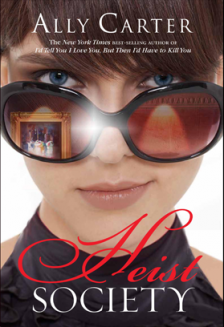
First, I need to get this out of the way: this is a slickly designed book. Check out the cover:
Heist Society by Ally Carter cover


It's big and bold and while I don't think the model quite looks like Kat (she's described often as being hopelessly unfashionable) it captures the mood of the book well. The smirk makes the model look a little cheeky, which is definitely a way to describe Kat. If the movie gets made, the poster's already done, just replace the model here with the actor and you've got a slick poster. It's also so refreshingly different from the covers of Carter's Gallagher Girls series (see the covers of all of Carter's books here), which all chop the face off of the models, which is a trend I just can't stand. Also the book keeps a clear countdown so we know exactly how many days Kat has left to pull off her heist, and where she's at now, as she crisscrosses Europe in her search for the paintings. The countdown pages are filled with old-looking maps and every time I came to one I got the theme from Where in the World is Carmen Sandiego? stuck in my head.


However, slick design doesn't make up for the fact that this book hit one of my major pet peeves: seeming to go out of its way to fail the Bechdel Test.

Heist Society has exactly two female characters who get more than a page of screen time: Kat and Gabrielle. There's also a female Interpol agent who is in charge of tracking Kat's father, but we hardly see her, and certainly don't see her talking to Kat or Gabrielle. There are no women in Kat's extended thief family (her mother died years ago for no reason other than to make another character sympathetic towards Kat). No women work in museums or are art historians, or even serve hot chocolate in the Alps. When Kat and Gabrielle talk, they're usually being bitchy to each other (I never figured out if there was an actual reason for this animosity), and often being passive aggressive about a boy.

The point where I got absolutely furious about this, however, is when Kat and Gabrielle go to confront the man who's blackmailing Kat and her father. Gabrielle accompanies Kat as "the muscle" so this guy can't just kidnap Kat or whatever. Gabrielle doesn't say a word for the entire scene. It's all about Kat. What the hell was the point of sending Gabrielle along? It was epically disappointing.

The ending clearly sets this up to be the first in a series (though it's not a ridiculous cliffhanger - the story is 99% self contained, with one major element to be picked up as a plot point in another book), and I might even pick up the second one, but I can't guarantee I'll finish it if the gender disparity continues the way this one did.

Wednesday, March 17, 2010

Review: Fallen by Lauren Kate

Found via: Rachel in the comments to my review of Devil's Kiss

Holy crap this book is popular. I put it on hold at the library in mid-January and I was the 50th hold request. I only got it a week ago. So...people like this book. Angsty supernatural romance doesn't seem to be going anywhere.

Luce has been sent to the Sword & Cross boarding school after a mysterious fire at her last boarding school left a boy burned to death. On her first day at her new school, Luce meets the usual sort of characters one runs across at reform schools: mildly-psychotic girls that want to be BFFs, girls that appear to be total goody two-shoes and make you wonder why they're in reform school, and, of course, darkly handsome brooding young men. Luce actually gets two of that last category: Cameron Briel and Daniel Grigori.

Cameron is charming and handsome and latches onto Luce as soon as he can. Luce likes him well enough, but the real focus of her attention is Daniel, who alternates between giving her smoldering looks across the library and flipping her off. But Luce is determined to get closer to Daniel - she feels an immediate connection to him, like they've known each other before arriving at Sword & Cross. Luce is determined to find out more about him, and recruits her new friend Penn, the lone sane-person in the school, as an accomplice, while trying to avoid the attention of Arriane (an all-around trouble maker, Luce's guide on her first day and the closest thing she has to a friend at Stone & Cross before Penn) and Mary (whose sole purpose in life appears to be making Luce miserable).

As if adjusting to a new reform school and juggling boys and friends weren't enough for poor Luce, she also seems to have hallucinations. Since she was a child she's seen apparitions of threatening shadows, but until she arrived at Sword & Cross that's all they've been: hallucinations. Now the shadows are getting a lot bolder, and might even be able to hurt her, or her new-found friends.

There is a huuuuuuuuuuge Twilight vibe throughout this book, even though Rachel described this as one of the less-Twilight-esque angel stories out there. From the creepy atmosphere (perpetually overcast Forks vs. humid and creepy southern US reform school) to the plain Jane but irresistible main girl. She's even clumsy like Bella! The prime candidate for being a not-human cute boy saves her from a lethal accident! Aside from cuteness, Luce's continued attraction to Daniel is only slightly better than Bella's to Edward; at least Luce is convinced she knows Daniel from somewhere else.

Over at Teacozy, Liz suggests that this is the sort of book where you're not supposed to think too hard about the story. Just accept that it's a rather fluffy and angsty romance and roll with it. I can see her argument on the one hand, but that doesn't quite work for me with this one. I can overlook many of the small questions, like why the hell is there such an emphasis on the black uniforms? Co-ed dorms at a reform school notorious for being strict? Easily-evaded cameras in lieu of supervision from actual adults? (Okay, I really want an answer on the black uniforms thing. It's seriously emphasized so much that I was waiting for the big reveal as a Chekhov's gun) But Luce is kind of a passive protagonist. Stuff happens to her, but she doesn't cause anything to actually happen. And after the big reveal that angels exist, Luce is treated a lot like Thomas was in The Maze Runner when he first arrived in the Glade: don't ask stupid questions (even if the audience is wondering the same thing) because we're not telling you anything until the next book.

Unfortunately, because I appear to be missing the gene that makes me love straight-up romances, I don't think I'm going to be sticking around for the next book. Unless someone promises me the black clothes are explained.

As for this whole angel trend? Unless it starts popping up in non-romance stories (like Once Dead Twice Shy, I think I'm done. I can see their appeal in some ways (Fallen is a more chaste love story than even Twilight), but they hold zero for me.

Wednesday, February 3, 2010

Review: The Comet's Curse by Dom Testa

Found via: Jen Robinson's Book Page

I've read several reviews on this one...and of course the one review that I want to link to now is the one I never saved! Argh. How frustrating.

Also frustrating: How myself and that one unfindable reviewer seem to be the only ones not enamored with The Comet's Curse.

In the not-too-distant future, the comet Bhaktul passes near enough to Earth that its tail passes through our atmosphere. However, instead of being just another fascinating astronomical event, it turns out that Bhaktul was carrying microscopic particles in its tail that are fatal to humans over the age of 18.

As adults around the world start to die in droves, Dr. Zimmerman is one of the few who realizes that instead of wasting time trying to develop a cure before all the adults die, his energy should be focused on saving at least a sliver of the human race. And so the Galahad project is born - choosing 251 teenagers to be sent on a 5 year space flight to begin colonizing another planet.

The teenagers are the best and the brightest 15 and 16 year olds from around the world, and the best of the best make up the Council that will govern the ship and the crew. Guiding the Council and helping to maintain the ship is Roc, the ship's smart-alec computer system.

But on Earth, not everyone is happy with Dr. Zimmerman's plans. Whether they disagree with his methods of choosing a crew, or his focus on space, they write letters and protest and use everything within their means to foil the launch. Nothing seems to succeed - that is, until a few days after the Galahad has launched, and there are mysterious sightings and incidents of vandalism throughout the ship. Just when the Galahad crew thought they were safe, it seems a new problem has followed them on board.

I've mentioned before that I really like stories where all of the adults are gone. I'm sure a psychologist would have a field day with that, but there you have it. However, The Comet's Curse left way too many questions and leaps in logic for me to really remain interested. It seemed like all of the adults were just giving up on Earth as soon as the Bhaktul virus/plague/epidemic began - negating the fact that all of these children and teenagers still had several years to live before the virus would even start affecting them. This isn't like other stories where when you turn 18 you immediately sicken and die - Dr. Zimmerman lasts more than two years before even starts to fall ill. Plus I really doubt imminent death is the factor that's going to convince teenagers to stop having babies.

Also never explained: why 251 teenagers? That seems like a really small number for repopulating a civilization. In Battlestar Galactica they were concerned about repopulating and they had more than 100 times more people than the Galahad carried!

This is supposed to be the beginning of a six part series, but I really don't see how the drama is going to hold up for six books. This book is told half through flashbacks from the development of the Galahad project - but those flashbacks cover the entire development, so there's nothing else to add there. After the crew dispatches the danger presented in this particular book, it seems like there are only so many more options for drama and they would get old well before book 6.

On a positive note? This isn't a future where America saves the world. The crew is definitely multi-cultural, and the Chinese-born second in command is even featured on the cover. Unfortunately many of the characters felt thin, and the romances that Testa is setting up have all the heft of a soap opera (really: one guy observes the girl he likes hugging another guy in a moment of triumph and immediately decides that she really must like that guy. Never mind no one knew this guy was in close enough proximity to hug as well, or the fact that they were celebrating not being dead - if I'd just averted a disaster, I'd be hugging whoever was closest too, whether I liked them, or liked them, or not).

If you're a fan of the "all adults are gone/dying" genre, you might want to give this one a try, if just to satisfy your own curiosity. It's a short read so it wouldn't require too much of an investment. If you're not already a fan of the genre, however, there are plenty of other titles you should seek out first!

Wednesday, January 20, 2010

Review: Once Dead Twice Shy by Kim Harrison

Found via: Meg in the comments of my review of Devil's Kiss

Because I know my mom reads my blog from time to time, let me preface what I'm about to say with a reminder that I really do in fact love her and think she's all around awesome.

But sometimes I seriously question her taste in books.

Seriously, she'll be all "oh, I read this great paranormal romance! Vampires! Werewolves! Awesome!" And I roll my eyes and say that, no, an awesome book is something like The Hunger Games and she stares at me, aghast that I could find children killing each other to be entertaining, and then I wonder if maybe I was actually adopted from a family of dystopian-fiction lovers, and that family has some mysterious paranormal-romance-loving child in my place.

So when, in the comments to my review of Devil's Kiss, Meg mentioned that my "angels are dicks" refrain reminded her of Kim Harrison's Once Dead Twice Shy...I was hesitant to pick it up. Because the author's name was familiar and once I Googled I saw that this is one of the authors my mom loves.

But then I read more about this actual book and saw that the protagonist, Madison, has purple hair, and we've already discussed my fondness for multi-colored hair. So I had to pick this one up, Mom's taste be damned.

Madison Avery's story actually began in the short story collection Prom Nights from Hell, but it seems like most of the back story is filled in here for new readers (I haven't read the original story, but I'm pretty sure I followed everything). On prom night, in order to get out of a date with Josh, who only asked Madison out as a favor to her dad, Madison runs off with Kairos, a tall dark and handsome stranger. However it turns out that the old adage of you shouldn't talk to strangers is true, because Kairos is actually a type of reaper, as in grim reaper, who was determined to kill Madison.

But Madison is a tricksy girl and manages to steal Kairos' amulet, which grants him his powers, and by claiming the amulet she's able to retain a tenuous hold on her life. Tenuous because she actually is dead - the amulet she now possesses is the only thing giving her the illusion of a body.

Madison is assigned to work with Barnabas, a light reaper, while it's decided what should be done with her. No human has ever taken an amulet before - touching it should have shattered her soul on contact. In the meantime, she hangs out with Barnabas and tries to help him in his work. As a light reaper, his job is to counteract the chaos the dark reapers, like Kairos, try to encourage. Light reapers believe humans have free choice, while dark reapers believe in fate and will preemptively reap a soul if they believe that person is going to do something terrible in the future.

Madison's a bit of a trouble maker, but she certainly doesn't have any evil plans for the future, so she has no idea why a dark reaper might target her.

It's been a few months since prom, and Madison hasn't made any progress on learning the reaper-tips that would help protect her should Kairos come looking for her - and it's certainly only a matter of time before he does. Also back in her life is Josh, who isn't so terrible despite being in cahoots with her dad for a date. But being involved with a dead girl isn't the safest position, so Madison finds herself using all of her wits and burgeoning supernatural abilities, plus a feisty guardian angel sidekick, to keep herself and Josh safe until someone "upstairs" is finally willing to explain to her what this new existence means.

Unlike Meg, I didn't come away from this with a huge "angels are dicks" feeling - there actually are some different personalities here and while some are dickish, others are just as confused as poor Madison.

Madison herself I'm kind of torn on. Overall I like her as a character, but I think Harrison was trying too hard to be witty with her teenspeak, because she'll say things like "son of a dead puppy" or "puppy presents" instead of actually cursing (I swear all of her phrases didn't involve canines, but those are the two that stuck in my mind). It's just a little too cutesy for my taste.

On the other hand, kudos for this clearly not being a paranormal romance title. The burgeoning romance with Josh is clearly secondary here, though it's also pretty clear that future stories in the series are going to build up that relationship. Madison has much bigger things to worry about than boys, so while she spends a lot of time with Josh, most of her thoughts are "how can I keep him safe?" rather than "how well does he kiss?"

Also, I totally love Grace, the guardian angel, and Nakita, a badass dark reaper that Madison tangles with. Through her supernatural characters, Harrison weaves in some very interesting musings on what it is to be human. Aside from the usual commentary on free will that angels often blather on about, there was also fear, which totally caught me off guard in a very fun way.

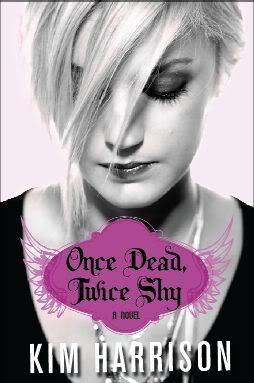
Cover thoughts: Once Dead Twice Shy by Kim Harrison

I wanted to give HarperCollins some recognition here for not lopping off Madison's head here. The headless girl cover is almost as irritating as whitewashed covers. Madison's purple hair isn't present, but at least the monochromatic cover is tinged with purple. Very goth and cool.

On a final note: I told my mom I had read this book. She told me she had beaten me to it - but hadn't mentioned it to me because she figured that would turn me off completely! Sometimes we think way too much alike. Maybe I really am related to her after all.

Wednesday, November 4, 2009

Review: Fire by Kristin Cashore

When Lynn and Cindy reviewed Fire on Bookends, I got super excited - I had known that a prequel to Graceling was in the works, but hadn't realized it was published! Of course, thanks to my inability to keep track of publishing dates, that meant there were already half a dozen people on the library's waiting list. I lamented that this meant I probably wasn't going to get to read the book before February.

Not long after that, Cindy sent me a cryptic e-mail, asking for my mailing address so she could send me a book. A few days later, imagine my excitement when my very own galley of Fire arrived in the mail! And just a little bit before my birthday, too.

The same day, The Ask and the Answer also finally made it to me via the library. Deciding which to read first was a very tough decision.

(I decided on Fire - The Ask and the Answer will be reviewed on Friday)

Fire is set 35 years before Graceling - but isn't set anywhere that is entirely familiar to Graceling fans. Graceling was filled with gracelings - people who had unusual abilities. Fire is filled with monsters: bug monsters, bird monsters...even human monsters, all with an unnatural beauty, the ability to force people and animals to act as the monster desires, and with a thirst for blood. Fire (the main character that the novel is named after) is the daughter of a monster and a human. She has a mane of fiery red/orange/green/pink hair that inspired her name, and shares her father's beauty and mental abilities, which makes Fire both feared and coveted.

In the kingdom of the Dells, King Nash is barely holding his kingdom together, as rival lords seem to be plotting together to overthrow him. A series of mysterious deaths have been plaguing the kingdom: committed by expert archers who seem able to assassinate someone against impossible odds. Nash and his brother Brigan know of Fire, as her father was their father's closest adviser. Fire prefers to live in a tiny rural settlement, far away from the center of the kingdom, but when her king asks for her, she chooses to help him as much as she can.

If you enjoyed Graceling, you're going to enjoy Fire - it has the same action/adventure/romance feeling of Graceling, as Fire spends almost as much time mildly angsting over her feelings for the male lead(s) as she does kicking ass and taking names. In some ways, I think Fire may actually be a more impressive protagonist than Katsa: Katsa threw herself into battle knowing that she had superior fighting skills; Fire is a well-trained archer, but she has no super-human ability to help her fighting (at least, she never seems to use her ability to control human minds as a battle tactic. I suppose theoretically she could).

One similarity between the books I found extremely interesting: both Katsa and Fire spend a lot of time thinking about babies and how they really don't want them. They don't necessarily dislike children, they just don't want to pass on potentially dangerous traits to their children. I think this sticks out for me because I'm not used to seeing issues that I currently deal with in young adult books - usually my connection with YA characters is a little more removed, as in "I remember feeling that way, back in the day." Or with fantasy/sci-fi characters, the connection is on the emotional, not literal, level.

Tuesday, September 22, 2009

Double Review: "Gone" and "Hunger" by Michael Grant

Michael Grant and I go way back. Well, not personally, but my first intense fandom was Animorphs which Grant co-wrote with his wife, K.A. Applegate (at least according to Grant's twitter page).

So knowing the author was one reason I picked up the series, but I also love reading the "adults disappear" genre - how many books have sprung from the premise that all of the adults mysteriously disappear? And added in to this one is the kids developing super powers. This has gotta be fun, right?

Set in a bit of California colloquially known as Fallout Alley, officially Perdido Beach, after an accident at the nuclear power plant 15 years before (a meteorite hit the plant and kept right on going, burying itself deep underground), on one normal fall day in the middle of school and everything, all of the adults and teenagers over 15 disappear. Poof. One minute they're there, the next they aren't.

It's a terrifying time - the first couple of days are spent getting their bearings. Finding someone to take care of the infants in day care, keeping curious 5 year olds from setting fire to their houses, and discovering that some of the kids aren't just normal kids anymore: they've started to develop super powers.

Not to mention that there's also some sort of barrier around the whole town, meaning that the kids of Perdido Beach only have a bit of land with a ten mile radius to live in. There's no way of knowing what's outside of the barrier; perhaps that's where their parents are and are trying to get back in to Perdido Beach. Or perhaps Fallout Alley is all that's left of humanity?

There's another group of kids in Fallout Alley as well, Coates Academy, a private boarding school for kids with "problems." While the Perdido Beach kids are nominally led by Sam, a local hero for his quick thinking when his bus driver had a heart attack, the Coates Academy kids are led by the charismatic - and at least slightly dangerous - Caine. It turns out Caine has developed super powers as well - he has telekinesis - and has a raging case of megalomania with a burning need to be in charge and to be the most powerful of anyone in Fallout Alley. Gone follows Sam's struggles to establish some order in the town and protect the kids from Caine, while Hunger focuses on the next logical step: when you have a finite amount of space and over 300 kids to feed, food starts running out fast. Caine is still trying to wrest control of Fallout Alley from Sam, but has to deal with the crippling effects of hunger on himself and his Coates Academy minions, plus the ever present pull of the mysterious "Darkness," an entity that lives below the ground in Perdido Beach and seems intent on killing all of the humans.

These are big, action packed books, with some really great characters. Grant has absolutely nailed some of these characters; Astrid, Sam's girlfriend, has a little brother named Pete who is autistic. I absolutely love how Grant portrays Astrid's conflicting feelings about her brother: she absolutely loves him and wants to protect him, but his lack of communication and stubbornness drive her up a wall sometimes. I have a younger autistic brother myself, and that is exactly how I feel about him sometimes. However, I'm also worried that Grant is going to drift into the autistic savant trope with Little Pete - Pete is extremely un-communicative, yet he may have the most powerful superpower in all of Fallout Alley.

Also in the first book I was getting extremely frustrated by how roles in the town were being apparently divided by gender: all of the girls were extremely nurturing and caring while the boys were off having the adventures (Astrid was sometimes along for the adventure, but she was there more for her brain than taking part in anything exciting). The second book introduced a little more variety in the girls - there's even an African American lesbian with superpowers - but more could be done.

While I definitely enjoyed the first two books, I really wonder how the drama and tension is going to last for six books. Right now it feels more like this should have been a trilogy - after all, at the end of Hunger they do figure out some things to do about the food situation, but a ten mile radius, some of which is desert or rocks or ocean, doesn't provide a lot of space for growing food for 300+ people. But I'm anxiously waiting for the next book, which comes out in May 2010.

Saturday, January 31, 2009

Review: Graceling by Kristin Cashore

Ready for another book confession? Here it is: I don't like fantasy books. I have read and enjoyed about ten fantasy books in my entire life, seven of them start with the words "Harry Potter and the..." and the last three are "His Dark Materials." That's considered fantasy, right? Yeah, it has bears that talk for no scientific reason; it's fantasy.

Why don't I like fantasy? I haven't a clue. But every time I've tried to pick one up (outside of the aforementioned ten - and I picked up Harry Potter under duress), I get bored or frustrated and don't finish it.

So I'm surprised by how much I liked Graceling. I didn't just like - I really, really liked it. Generally "I couldn't put it down" is the highest compliment a person can give a book, but I kept forcing myself to take (short) breaks from this one - because I didn't want the adventure to be finished!

Katsa discovered her Graceling power at the tender age of eight - when she killed a lecherous cousin by punching him in the nose and sending shards of bone into his brain. In a world where Graceling abilities can range from swimming to cooking to archery to mind-reading, Katsa's is a fearsome Grace that is immediately put to use by her uncle, King Randa. He has Katsa trained to become his lady killer - a lady of the court who can also kill with her bare hands - or an arrow, or a sword, or a dagger.

But Katsa is more than just the lady killer - with the help of a few sympathetic members of the king's court, she has formed a Council that seeks to right the wrongs committed by kings and other people in power who would abuse their place. While a killer certainly is good as an assassin, Katsa finds her skills are just as useful at helping her sneak through the dark, or incapacitating people who are in the wrong place at the wrong time.

When the Council undertakes a mission to rescue the kidnapped father of the Lienid king, Prince Po becomes one of those who were in the wrong place at the wrong time - Katsa quickly incapacitates him and continues with her mission. But Po - grandson of the man Katsa was rescuing - is a Graceling himself, with skills that are almost a match for Katsa.

Katsa finds Po's presence at court intoxicating and confusing - but when the kidnapping of Po's grandfather leads to a deeper mystery, he and Katsa are the only ones who can save a young princess in danger from her father, and unravel the mystery that could threaten the stability of the seven kingdoms.

This book pretty much has everything one could want in a book: action, adventure, mystery, and romance. Cashore has created a very well rounded world that I hope we get to visit again. Some of her world building comes off as a bit heavy handed; for example, Katsa and Po have several conversations about Graces that at first feel like really, really obvious foreshadowing, but when those conversations don't actually have any bearing on anything else that happens in the story it begins to feel like they were stray thoughts about how Graces work that Cashore felt she absolutely had to address, and did so in an awkward way. Not to mention that at times Katsa comes off as a little overpowered - is there anything she can't do?

What was wonderful, however, is the strong feminist undertone throughout the book. Katsa has lots of extremely feminist thoughts about marriage and self-defense for women, noting that men, who have the most power, physically and politically, are the ones who are trained to wield weapons and fight, while women who are powerless in every way, and in most need of defense, learn nothing. I always love a good story about a woman who knows how to take care of herself (whether that's physical fighting like Katsa, or a more intellectual wit, such as Frankie Landau-Banks has) and wants to teach others the same skill.

Finally, is it just me or is this other cover for the book soooooooooooo much cooler than the cover my version had. Because women with weapons just look badass, and I don't recall sai's appearing anywhere in the story.

Thursday, January 15, 2009

Review: Zoe's Tale by John Scalzi

I have long been a fan of science fiction. I blame my parents: they've been Trekkers since the original series was out (though we're all nervous about that new movie that's coming out...but that's a post for a different blog!). Hence, a lot of my reading skews towards science fiction, though often it's "soft" science fiction - as opposed to hardcore Isaac Asimov or Arthur C. Clarke. Those stories focus a lot on the science and technology of the future - like a lot of Star Trek can do. The stories that generally appeal to me however are of the softer variety, where the story is clearly in the future and science-y stuff has happened, but that's kind of on the periphery and the story is going to focus more on the characters and how they feel. And while I like the "hard" science fiction, there's one big turn off for me: it's all about dudes. Women and girls don't get to have rollicking action adventures nearly often enough.

Which is why I found Zoe's Tale to be so fun. There's lots of hard science fiction in here - we've got new space colonies being settled, aliens that have had consciousness artificially installed, and space battles.

Big space battles.

And right in the thick of all of this science fiction action adventure is Zoe. Adopted daughter of the leaders of the new colony (called Roanoke. And their first settlement is Croatoan. Of course this colony is going to have Big Problems) and a revered almost-Goddess of the Obin - the aliens with the artificial consciousness, thanks to the work of Zoe's biological father. For most of her life, Zoe has constantly been accompanied by two Obin, named Hickory and Dickory, who act as her bodyguards while they record her entire life in order to teach the Obin back home about what it means to live.

Being part of the first waves of colonists to Roanoke isn't exactly exciting, but it's a lot more exciting than continuing to live a comfortable life on New Delhi, Zoe's last home. But founding the new colony becomes much more exciting (in a less-than-positive way) when the Colonial Union government reveals at the last minute that the colonists aren't being sent to the planet they originally thought - they're going to found Roanoke on a completely different planet, and be completely cut off from the rest of human civilization in order to shield the colony from being discovered by the Conclave - a group of aliens who are hostile to humans expanding their colonial presence in space. The Conclave wants to destroy Roanoke, and the only way to protect the fledgling colony was to mislead the Conclave about their location and cut off all radio contact with Roanoke.

Of course, even the best laid plans can fall apart. And that's where the science fiction action adventure really kicks in. While life on Roanoke is initially rather quiet, with the colonists having to learn how to live without any of the electric devices they've always relied on (from PDAs to farm equipment). Adapting to life on a different planet presents its own set of challenges, everything from learning to live with the rotten smell of the plant-life to the presence of other species on the planet. Zoe has some adventures while on the surface, but it's nothing compared to what happens when the Conclave does find Roanoke...and the choices Zoe must make in order to protect her family, friends, and the sacred bond she has with the Obin.

This is the fourth book in Scalzi's Old Man's War series. I haven't read any of the other books, but was convinced by Lynn Rutan's review over here that not only would this be right up my alley, but it wouldn't be hard to get into. She was absolutely right. Scalzi does an excellent job giving the backstory so it's entirely possible to enjoy this without any previous knowledge of the story. It doesn't hurt that Zoe is an incredibly fun character with razor sharp wit. Scalzi includes an extremely informative author's note at the end about how he went about writing a parallel novel (this follows the events of The Lost Colony) and writing a teenage girl. Not having read The Lost Colony, I have no idea how successful this works as a parallel piece, but he definitely got the teenage girl part exactly right.

I didn't run out immediately to get the previous Old Man's War books (I had a huge stack of books I reserved from the library come in all at once, so I have to wade through some of those first!), but I'm sure I'll eventually wander over to them.
Related Posts with Thumbnails