Showing posts with label animals. Show all posts

Thursday, January 13, 2011

Review: Jumpstart the World by Catherine Ryan Hyde

This one's been on my TBR list for awhile, but it's such a slim book that I put off reading it for awhile after picking it up from the library - short books like this I usually finish up in less than two subway rides, leaving me bored and bookless for part of my commute home. But then I heard some Printz rumblings for this and figured that a lazy Saturday night spent in bed, where I was trying to rest and kick the last bit of my week-long cold, was the perfect time to pick it up.

Jumpstart the WorldWhen Elle's mother picks up a new boyfriend that doesn't want to deal with a teenager in the house, she's set up in her own apartment on the other side of New York City. For most almost-16 year olds, this would be a dream come true, but Elle's just angry that her mother is pushing her aside for the comfort of her newest boyfriend - who, by the way, is taking her mother on a cruise over Elle's 16th birthday. There are only two good things about the new apartment: getting to pick out a new cat (a scared, scarred black cat, the antithesis of everything her mother likes), and her new neighbors - specifically Frank, who may be older and has a girlfriend, but Elle can't help immediately forming a little crush on him.

The new boyfriend also doesn't want to pay for Elle's private school, so she's starting a new school year at a new school, where the only people interested in being friendly are a group of outsiders, most of whom happen to be gay.

When Elle isn't sure she wants to be friends with this group - not that she's homophobic or anything - Frank is the one that listens to her. Frank and his girlfriend invite Elle over for homemade chicken soup, and introduce her to the wonders of photography. Just as Elle begins to acknowledge she's falling for Frank and falling hard, she's shocked to discover that "Frank" hasn't always been Frank - he is, in fact, a transgendered man. The truth turns Elle's world upside down, forcing her to search for the true meanings of friendship and family.

The writing here is spare but thoughtful, and feels very much like we have a direct line to Elle's thoughts. On that level I can totally see why there was Printz buzz for this. On the other hand, there's a stunning lack of character development. Elle, Frank and Elle's new school friend, Wilbur, are the only three that get any sort of depth, but even Frank and Wilbur feel more like stock characters. Here's how bad it was for me: at one point, Elle's cat is sick and needs to be given antibiotics twice a day. At the same time, one of the other characters ends up in the hospital and Elle is spending most of her time there. During this dramatic time, all I could think was that she needed to keep giving the cat antibiotics or it was going to die. I know my great love of cats probably makes me biased, but I really shouldn't have more sympathy for a cat than human characters.

Hyde does do a good job presenting Frank as just another character and never slips into being too didactic about the particulars of trans life. Details of Frank's transition, and of continuing issues as part of his trans identity, are integrated into the story and only those bits that have an impact on what's happening at the moment are included. I note this because the last book I read with a transgendered character was Almost Perfect, which did stop to explain the minutiae of transitioning. However, the presence of a transgendered character is about the only similarity between the two novels (I still highly recommend Almost Perfect - and, of course, so did the Stonewall Award committee!).

Wednesday, December 15, 2010

Double Review: Rampant and Ascendant by Diana Peterfreund

OMG, you guys. You guys, why didn't anyone tell me that books about killer unicorns are FREAKING AWESOME?!

I don't know exactly why I decided to skip on Rampant the first time around. I think I was focusing more on the "unicorn" rather than the "killer" part of the description, plus I'm just generally prejudiced against fantasy. Then I read Peterfreund's contribution to Zombies vs. Unicorns and was intrigued - I was curious about whether the characters were original and just set in her previously established world (like Carrie Ryan's contribution), or if these characters appeared in the series proper. But then I never made an effort to seek out Rampant. Until I was browsing at the library and Rampant was sitting face out on a shelf. On an impulse, I picked it up.

And I'm so glad I did. And I'm also so glad I didn't get Rampant until Ascendant was already out, so I only had to wait a week rather than a year to get more of Astrid's story.

RampantAstrid Llewelyn has grown up listening to her mother's crazy stories about killer unicorns. When the rest of the world believes unicorns are mythical sparkly creatures, what else can a trying-to-be-normal 16 year old do? So when her boyfriend is attacked by a real live killer unicorn during a late night make out session in a forest, Astrid's concept of reality is turned upside down.

Her mother, however, sees this as an opportunity, and doesn't hesitate to ship Astrid off to a nunnery in Rome that is the 21st century reincarnation of the ancient Order of the Lioness - an order of nuns who dedicated their lives to protecting humanity from the unicorn scourge. And it just so happens that Astrid's family line was historically known to be the biggest, baddest hunters out there. With the financial support of a pharmaceutical company hoping to find the mythical Remedy derived from unicorns and said to be able to cure anything, Astrid and an international crew of hunters band together to learn the truth of the unicorn Reemergence and defend humanity from the long-forgotten threat.

AscendantAscendant picks up shortly after Rampant ends. While the world at large is well aware of the unicorn threat, the Cloisters is still falling short in their funding and recruitment goals. As soon as they find a girl capable of being a hunter, she quickly decides to relinquish her eligibility. And the only organization willing to fund the Cloisters is the Vatican, who want to place some strict rules on the young women who've taken over their nunnery. To add more worry to Astrid's plate, her boyfriend is heading back to the US and one of her best friends and fellow hunters is mysteriously losing her hunting powers.

So when Astrid has the chance to escape the Vatican's strict rules, gain funding for the Cloisters, and re-focus on her scientific passions all in one go, she leaps at the chance. It doesn't hurt that she also gets to hang out in the French countryside, too. But being part of Gordian Pharmaceuticals again opens up a host of new questions for Astrid, making her question her loyalties as a hunter and a scientist.

What excited me the most about these two books is just how darn feminist they are. Seriously, these are some of the most feminist books I've read since The Disreputable History of Frankie-Landau Banks. Throughout both books there are positive depictions of young women's sexuality, and then especially in Ascendant there's discussions about women (even those who weren't unicorn hunters) who defied traditional notions of femininity to follow their passions in science and medicine. And then yes, there's the idea of a secret group of women who are all that stands between humanity and the unicorn scourge. Women with big swords = awesome.

In Ascendant, Peterfreund also excels where Suzanne Collins failed in Mockingjay to give us an injured protagonist who is a little foggy...yet still manages to keep the story going. Whereas Katniss became half-comatose every time a big plot point comes up, Astrid powers through her injury, acknowledging she's weaker and she can't remember some things sometimes while other things are crystal clear (even if they might be hallucinations...?). Yes, it's a bit confusing, but damn if it doesn't work amazingly. I felt Astrid's frustrations right along with her.

On the other hand, every once in awhile Astrid is a bit...dumb. Even before her catastrophic injury. Her ex-boyfriend disappears right after she tells the pharmaceutical rep that he's the only living person to receive some of the Remedy...and she really believes he just coincidentally ran away? The big biology student can't figure out why a female unicorn may be hugely fat while all of the rest are grotesquely thin? Neither of these require a degree in rocket science to put together a working hypothesis for. Thankfully, Astrid's inability to put two and two together only happens rarely, and doesn't detract from the overall awesomeness of the two stories. My other minor quibble is the lack of description of what's going on in the rest of the world. By Ascendant it's clear that unicorns are known by the general public, but I want to know how on Earth they reacted. Panic in the streets? Mass migrations back into the cities? Inquiring minds want to know! But otherwise, both of these books fall into the "couldn't put it down" category, and they're so richly written that I did find it took me longer to read them than books of similar lengths, because I just didn't want to miss a word.

Peterfreund also does an excellent job in both books of finishing the main story, while leaving a few hooks for the next book to pick up on. This didn't stop me from feeling extremely impatient while waiting to get Ascendant from the library, but that was out of desperately wanting more of Astrid's adventures rather than needing to know how the darn story ends. Of course, there's a big question left unanswered at the end of Ascendant, and I'm certainly desperate to know the answer!

Rampant is actually what really inspired me to put together my What have I missed? personal reading challenge. Technically it doesn't fit into the guidelines I've set for my reading next year, but it got me thinking about all of the similarly awesome books I've missed out on just because I wasn't paying attention to YA when they were published! So please pop into the comments over there and leave more suggestions - and then go pick up Rampant and Ascendant if you haven't already!

Monday, December 6, 2010

Review: The Turning: What Curiosity Kills by Helen Ellis

Found via: Forever Young Adult

When I was 12 years old, I received my first Animorphs book (#2, The Visitor) in my Easter basket. Did my mom choose it because it was excellently reviewed, popular science fiction with a diverse and engaging cast of characters?

No.

She picked it out because there was a girl turning into a cat on the cover, and I liked cats.

Since the Animorphs books aren't being re-printed until Spring 2011, I think 12-year-old-me would be getting The Turning: What Curiosity Kills for Christmas 2010. And the girls-turning-into-cats thing isn't even the only bit these two books have in common.

The Turning Book 1: What Curiosity KillsHaving been adopted into an elite Manhattan family at a young age, all Mary wants to do is fit in. While her sister Octavia is outspoken and brash, Mary attempts to be normal and unassuming in every way possible - even if that means the boy she's crushing on hardly knows she exists. When she starts feeling tired all the time and having weird cravings, Mary can write that off as a growth spurt. But what about her sudden dislike of running water? And an amazing sense of smell? Oh, and the thick patch of orange hair that sprouted on her leg after a run in with the neighborhood stray?

Mary is far from normal, it turns out. Bit by bit, she's transforming into a cat, at a time when there's a bit of a power struggle happening between different cat factions in New York City - and each side wants Mary to join them, when all Mary wants is to return to her normal life. Enlisting the aid of Octavia, who has some excellent research skills on top of her sauciness, Mary desperately searches for a way to end her turning before there's no turning back.

So aside from turning into a cat, what does this book have in common with Animorphs? The length. This book goes at a ridiculously quick pace, and it's one of the few stories that I wish were a hundred pages longer just so everything can be slightly more fleshed out. There are lots of details that are glossed over - like there are bits where cats will speak to Mary, with their dialog indicated in italics. It's never explained whether these cats are psychic and are putting fully formed phrases in Mary's head, or if maybe Mary is just translating cat behaviors into human speech. The ending is also quite abrupt, which is no problem if the next installment is coming out in a month or two, but leaves us hanging in the worst way when the wait between titles is indefinite (Google revealed nothing about book 2 of The Turning and Helen Ellis' website isn't the easiest to navigate. I'm not a fan of video blogs). This isn't a book with a cliff hanger ending - the climax finishes and then...the end. No denouement, no closure, and no real indication of what could happen next.

Octavia has gotten some blogger love, as she well should. First of all, she's a debate geek, and while I technically didn't do debate, forensics was debate-adjacent, so I love that about her. At first she comes across as a horrible sassy-black-girl stereotype, but Ellis does an excellent job of revealing why Octavia presents herself the way she does. Very interesting.

Also thought it was interesting that both Mary and Octavia are adopted. At first it's totally random and seems like it's just a way to put two non-New-Yorker characters (Mary is originally from Alabama, Octavia from Nebraska) in the big city. So far it hasn't added a lot to Mary, but again it adds some real depth to Octavia's character, as the girl who appears to totally have it all together does in fact have some deep rooted insecurities tied to being adopted.

This is a fun, short read with an interesting twist to the ever-expanding genre of fantasy and paranormal creatures taking over YA. Not a book I'd necessarily run out to get, but certainly fun once you dive in.

Friday, October 8, 2010

Sci Fi Friday Review: Behemoth by Scott Westerfeld

It's no secret to long-time readers of this blog that I have a thing for Scott Westerfeld's writing. I wrote my senior thesis on the Uglies series, for goodness' sake! So it's probably no surprise, given my history with Westerfeld's work and my feelings about last year's Leviathan, that I enjoyed Behemoth. Just wanted to get that out of the way in case the curiosity was killing you.

Behemoth (Leviathan)When we last left the crew of the British airship Leviathan, they had just picked up several Austrian passengers, including the son of the recently-assassinated Archduke Franz Ferdinand, Alek - not that any of the British crew know that. Alek's lone friend among the crew is a young airman Dylan, who is actually a young woman, Deryn, disguising herself so she can serve in the air force - not that anyone knows about that. The airship is carrying some precious cargo and distinguished guests, including the granddaughter of Charles Darwin, who has some very special eggs she wants delivered to the ruler of the Ottoman Empire before a great war can break out among the European nations in response to the murder of Alek's parents.

The Ottoman Empire is at a crossroads when the Leviathan docks. They are technically neutral in the burgeoning conflict, but are being courted by both German and British forces for an alliance. And all is not well within the Empire, as the current sultan has only been in power for a few years and already militants are planning a coup to replace the monarchy with a democratic government. Alek and Deryn know that technically they are on opposite sides in this war - Clanker and Darwinist, royalty and commoner - but discover they will have to work together, along with an eclectic mix of allies, if they ever hope to achieve their mutual goal: stop a world war from beginning.

If you haven't read Leviathan yet, you absolutely need to read it before reading Behemoth. The story picks up mere days after the end of Leviathan, and the action starts within just a few pages, leaving precious little time to catch the reader up on what happened in the last book. I really liked the fact that Westerfeld just goes with the assumption that the reader already knows the back story, because that means each and every page can be devoted to developing what happens next.

This is one wild ride both similar to and very different from Leviathan. In the last book, we followed Alek wandering in the wilderness towards safety with his body guards, and Deryn spent much of her story alone among the crew out of need to protect her secret. In Behemoth, less physical ground is covered, as the story stays focused on Istanbul, and the story becomes more of a political thriller as Alek and Deryn become involved in the resistance movement - which introduces my favorite character, the feisty revolutionary Lilit, who has dreams of bringing women's liberation to Istanbul. She also has a huge crush on one of our dashing heroes. Lilit is a young woman destined for greatness and could probably support a whole novel of her own!

As expected, there are more great beasties and machines this time around. The Ottoman Empire is a Clanker nation, but they're more in touch with nature than the Germans or Austrians, as their mechanics are based on animals. My favorite was probably the spider-like machine that worked the great library. On the Darwinist side, we finally get to see what was in those eggs that were so carefully guarded in Leviathan and, of course, there's the title beastie, the Behemoth. It's awesome, in every sense of the word.

Because I feel like it's becoming my trademark, I do have to comment for a moment on the romance element of the book. Deryn is beginning to develop "feelings" for Alek. Maybe this just annoyed me because I read it shortly after The Education of Bet and A Golden Web, two other novels about young women dressing up as men, but I'm getting quite tired of girls putting all of their other goals at risk because of some boy that literally thinks they're just one of the guys. Deryn keeps a handle on herself better than the protagonists of the other two books, and it's really just a small bit of this otherwise giant story, but it still rankled me a bit. I am certain Goliath won't go the way of Mockingjay in terms of focus on relationships, but I can't deny there's a little bit of worry in the back of my head. Hopefully, averting World War I will remain the focus.

Rot & Ruin Giveaway Reminder: I'm going to draw the winner for the Rot & Ruin giveaway at 12 pm Eastern time today! If you still want a chance to win, enter here!

Reviewed from ARC picked up at ALA 2010.

Tuesday, August 10, 2010

Review: Little Blog on the Prairie by Cathleen Davitt Bell

I wasn't a Little House on the Prairie fan as a kid. Admittedly, I don't recall actually giving the books or the TV show a chance, I was just pretty sure I wouldn't like them and went on my way. Luckily, the Little House allusions seem to be primarily confined to the title, so don't think you have to be a fan in some way to enjoy this thoroughly entertaining book.

Little Blog on the PrairieGen's family isn't big on "family time," as each family member seems to be going in her or his own direction at any given time. Her dad doesn't even get involved with vacation plans, preferring to leave all that to her mom - which is how the family gets signed up for an entire summer at Camp Frontier - an immersive summer experience where families live, dress and work like they're on the Wyoming frontier in 1890.

To 13 year old Gen, this is the end of the world. She's supposed to be hanging out with her best friends and practicing soccer all summer so she'll be prepared for the high school's team in the fall. So her mom bribes her - come to camp without complaint, and get a fancy cell phone at the end of the summer. Gen agrees, but the allure of the phone is too much - she sneaks it to camp, promising to text her friends for as long as the battery holds out (after all, there was no electricity on the frontier - where will she charge the phone?)

Several families have come together to live the frontier life for the summer - and none of the kids seem terribly fond of the idea, including Nora, the daughter of Camp Frontier's organizers who has to live every day like it's 1890. Almost immediately, Gen bonds with Ka (short for Kate, rhymes with Saw, her favorite movie), the goth chick from a family of perky blondes set adrift without her supply of black  hair dye to keep her own blond roots at bay. And then there's the camp heartthrob, Caleb, who has just about every girl in the camp swooning in his wake, but doesn't seem to realize this.

The complicated interpersonal relationships, as well as the hardships and indignities of life on the prairie (three words: outhouse at night), are faithfully recounted by Gen via text message - which her friends back on the outside are faithfully translating into a blog. And not just any blog, but an overnight blogging sensation that has repercussions all the way back to the 1890s life of Camp Frontier.

This is a lighthearted, feel good book, totally entertaining book that is going to appeal to a variety of middle grade and young adult readers. Gen is only 13, and keeps her thoughts about Caleb on a totally PG level - when she discovers an illicit "electricity shack" on the farm, her first thought is about charging her phone, not about getting Caleb alone. Her sarcastic attitude is just enough to keep readers used to edgier fare interested in her misadventures on the farm, while being tempered with an innate sweetness that keeps her from coming off as a spoiled teenager. Gen isn't happy about being at Camp Frontier, but she does love her family, and is willing to put on a good face at least for their sake for the duration of the adventure.

The book is filled with great supporting characters as well. Even the adults have some personality - I about cheered when the moms threatened a feminist uprising when the camp owner tries to keep the women from speaking (Gen's mom is the first to point out that Wyoming had given women the vote well before 1890, meaning that women would certainly be used to speaking in their communities if nowhere else). Of course, bringing up that women were expected to fulfill 19th century societal roles gets a bit uncomfortable if you follow it to its logical conclusion - if you expect women to keep quiet, what would happen if an African- or Asian-American family signed up? It seems like some aspects of 1890 are best left ignored, like the corsets that aren't required thanks to liability issues. The feminist uprising is extremely brief, just a quick opportunity for some educational humor, and clearly isn't meant to be dwelt on.

Another educational bit is the mini-moral slipped in by the end regarding technology and expectations of privacy. It's not heavy handed, over the top, or totally obvious, but hopefully it will get younger readers thinking about privacy issues regarding e-mails and text messages - namely that once a message leaves your phone or computer, you no longer have much control over who else might see it.

While I know the summer is winding down, there's still a few weeks left for most people, and this would make an excellent last minute addition to your summer reading list!

Tuesday, July 27, 2010

Review: Stolen by Lucy Christopher

Found via: Publisher's Weekly 4/12

I think I'm just a contrarian, whether I mean to be or not. It's been a few weeks since I read this and didn't make any notes on it, so now I'm looking at the original Publisher's Weekly review (it's starred even!) that made me get this book, and I an't figure out what drew me to it in the first place, since I found it to be a rather underwhelming read.

StolenGemma isn't happy with her parents - but that doesn't mean she ever wanted to be drugged and kidnapped from the Bangkok airport in the middle of a trip with her parents and whisked away to the Australian outback by a guy who's been stalking her for 6 years.

Ty first saw Gemma in the park in London when she was ten years old, and has spent his life since then preparing to bring her to the beautiful outback. He's convinced her parents don't actually love her, certainly not the way he loves her, and he's sure she'll come to love the wild outback the same way he has.

Lucy recounts her life in captivity in a diary or letter addressed to Ty, detailing her frustrations, anxieties, and even the occasional moment of exhilaration so far from civilization, even as she desperately want to return home.

While the story itself is solid, I felt the pacing was way off throughout the story, as Gemma's captivity only lasts a couple of months, and we never see the complications in Gemma's emotions that she claims to feel at the end. She's diagnosed with Stockholm syndrome, but while she's in captivity Gemma feels no ambivalence, let alone affection, for Ty. Not to mention her escape from captivity feels like a big deus ex machina, coming out of nowhere even after she and Ty have negotiated terms for bringing her back to civilization. I would much rather have followed the story for six months, which would have allowed Gemma more time with her captor with the promise of release and thus more opportunities for complicated emotions to arise.

Ty was a creepy yet oddly sanitized villain and I never felt I really understood his motivations for kidnapping Gemma in the first place. I say sanitized because let's face it, how many real life kidnappings of teenage girls lack physical or sexual violence. Ty maintains he's a gentleman (despite taking a girl against her will) and even shows embarrassment when he has to see Gemma in a state of undress (she messes herself up a couple of times, requiring changes of clothes or even nudity in order to heal from things like extreme sunburn and dehydration).

There are a few brilliant moments of writing. Gemma's interactions with the camel Ty captures and tries to domesticate are heartbreaking, as she confides in the camel how they're both captives and Ty will try to break both of them. It's an absolutely tragic and apt parallel.

Wednesday, June 23, 2010

Review: Thief Eyes by Janni Lee Simner

Found via: Publisher's Weekly 4/5

Thief Eyes


I read Simner's Bones of Faerie last December and found it to be a really interesting take on both the fantasy and post-apocalyptic genres. Simner's back again already, dealing once again with fantasy elements, this time tackling Icelandic sagas with a thoroughly modern heroine.

One year after her mother disappeared, Haley has joined her geologist father in Iceland, hoping to retrace her mother's steps and bring her home. What she never expected were those steps to draw her into the magical entanglements of her ancestors and the complicated rules of Icelandic myths!

The magic began with Hallgerd, a woman forced into an unhappy marriage who casts a spell that affects all of her female descendants - including Haley and her mother. In her quest to escape the magical realm and return to the real world, Haley encounters Muninn and Freki - a talking raven and fox, respectively, who offer their help, though always at a price. Also accompanying her is Ari, a handsome Icelandic boy, the son of her father's colleague in Iceland. As the magic sinks deeper into both Haley and Ari, the question is no longer whether they can find Haley's mother, but if they can save themselves from also suffering her fate.

Although this is only the second Simner novel I've read, I'm already detecting a theme in her novels. For one thing, she's got mother abandonment issues, as both this and Bones of Faerie focus on a girl trying to find her mother after a magical intervention (though this time Haley didn't know magic was going to be involved at the beginning).

The novel could be a little frustrating as sometimes Haley's reactions would be very cyclical. Isn't the definition of insanity doing the same thing over and over and expecting a different result? Haley would often make virtually the same mistake multiple times.

I enjoyed the exploration of the Icelandic myths - there are a lot of similarities with Norse mythology which I have a passing familiarity with, but several key differences as well. Simner explains in an author's note that she drew much of the story from Njáls saga, but since the events took place 1000 years ago and weren't written until the 13th century, it's impossible to know what's historical and what's fictional while also leaving plenty of room for Simner to add her own interpretations. She also explains why Freki, traditionally depicted as a wolf, appears as a fox in this story.

Friday, March 12, 2010

Review: Ice by Sarah Beth Durst

Found via: Liz B at A Chair, a Fireplace, and a Teacozy


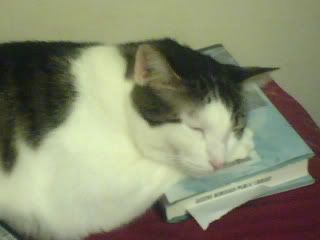
My cat, Gopher, thinks that books are pillows. He approves of Ice!


My love of fairy tale retellings is well documented here, but Ice gave me something new to ponder. It re-tells a story I'd never heard before, East o' the Sun, West o' the Moon, and I've been trying to figure out if I like retellings of familiar or new stories more.

Not that it really matters when the story is so well written, as Durst's is here (even after going through and reading two versions of the original, my opinion holds).

As a little girl, Cassie's grandmother told her the story of how her mother made a deal with the Polar Bear King that went sour, and condemned her to being swept away to the ends of the Earth. At 18, Cassie recognizes that the story was just a way of explaining her mother's death to a little girl, and is far too focused on her life as a budding scientist with her father in an Arctic research station to think of childhood fairy tales.

Until Cassie learns that some fairy tales are true. There is a Polar Bear King, and part of her mother's bargain including betrothing her unborn daughter to become the king's wife. Cassie makes a deal of her own with the king in order to secure her mother's rescue from the trolls' castle east o' the sun and west o' the moon. In return, Cassie returns with the Bear to his castle of ice near the North Pole.

The Polar Bear King is, of course, not a real bear - he is a munaqsri, a "caretaker of souls." Every species on the planet has its own munaqsri (sometimes several for large populations, like humans, but the polar bears only have the one) who takes the souls from the dead in order to give them to the newborns of the species. Bear wants a wife so he can have children to take his place, but with the intelligence of humans, rather than polar bears. Cassie is appalled - she is only 18! She doesn't want to be a wife yet, let alone a mother - but she remembers her deal to save her mother's life, and consents to the marriage.

But because this is a fairy tale, that bargain she struck with Bear has a price. When Bear is forcefully wrenched from her by the trolls after Cassie violated the rules of the bargain (rules Bear couldn't tell her about, as part of the rules), Cassie finds herself alone and several months pregnant in the middle of the arctic. That is the start of her adventure to save her husband - a journey that takes her not only across the world, but beyond, to the castle east o' the sun and west o' the moon, both helped and hindered by other magical creatures along the way.

I absolutely loved most of this book. By the time I finally got this one from the library I'd forgotten what fairy tale it re-told, and actually was seeing a lot of Beauty and the Beast in Cassie's relationship with Bear. Perhaps that was intentional on Durst's part, because bits like Cassie arranging to visit home aren't in any of the original stories I read. Durst did, however, include excellent allusions to the original stories - one translator's last name is Dasent, which just so happens to be Cassie's last name in the novel. Another great touch is Durst's totally original take on trolls - fantasy lovers need to read this book for the trolls alone, because while I haven't read a lot of fantasy I'm pretty sure you've never seen trolls like these before.

One thing that was simultaneously awesome and uncool was Cassie's pregnancy. First of all, how the pregnancy came about was seriously uncool. But then Cassie goes on this epic journey, contents of her uterus be damned, because she has a quest she must complete in order to save her husband. They're on totally different scales, but as I was reading this in the middle of Olympic fever I couldn't help but think of Kristie Moore, the Canadian curler who was 5 1/2 months pregnant during the game. We have this cultural trope that pregnant women are delicate flowers who should just lay in bed eating bon bons for the duration of their pregnancy (but, y'know, not too many, lest they get fat). Cassie does some stuff that I'm sure isn't recommended for pregnant women, but then again we're also in a fairy tale so we can let it slide. But the other uncool part of Cassie's pregnancy comes from all the other characters who think that Cassie shouldn't be allowed to do anything because her fetus is practically sacred. She is literally imprisoned until she convinces other characters that she agrees with them. It definitely provided some great drama, and Cassie proves them all wrong, but it still freaked me out a little bit. But I guess since it wasn't really the good guys who were hindering her, that was probably the point.

One other weird thing: it seemed to me like Cassie has some misplaced anger issues. She spends a lot of time railing against her father for lying to her about the truth behind her grandmother's stories and for failing to rescue her mother from the trolls, when it's her mother that made the deal that arranged for Cassie to marry a supernatural being when Cassie was merely an infant. Her dad really had nothing to do with it.

Ice is an excellent story, period. It definitely doesn't rely on previous knowledge of East o' the Sun, West o' the Moon to be enjoyed. It's a flat out fantasy adventure story, that turns a few tropes on their heads, with a dash of romance for good measure. Highly recommended.

Once Upon a Time Challenge

Wednesday, December 9, 2009

Review: The Sweetheart of Prosper County by Jill Alexander

Found Via: BBYA 2010 nominations

I've been reading a lot of heavy, serious books lately. Like Into the Wild Nerd Yonder, The Sweetheart of Prosper County provided some lightheartedness to break up the downer books - though this one does have a serious story at its core.

After being made fun of by the school bully at her small Texas town's No Jesus Christmas parade, Austin Gray decides that she needs to be elected as the Sweetheart of Prosper County. If she gets to wear a pretty dress and ride in the parade, no one will be able to make fun of her! Of course, in order to win the crown, she has to join the Future Farmers of America club, and raise a prize-winning farm animal. Enthusiastically supported by her best friend Maribel, and just slightly less so by her overprotective mother, Austin throws herself head first into raising a prize rooster, named Charles Dickens.

When she's not carefully attending to Charles Dickens, Austin is also carefully learning how to grow up and assert her independence under her mother's tight reign. She's been extremely protective of Austin ever since Austin's father died in a car accident one rainy Christmas Eve. Naturally Austin misses her father terribly, but she doesn't understand why his death means she has so fewer freedoms than her peers. And being kept under strict rules isn't exactly conducive to going out with Josh, the cutest boy in the FFA!

I felt there were some uneven spots in this book - the men and boys are a little underdeveloped (I never figured out why the bully was so damn MEAN to Austin - sure she's an easy target since she won't stand up for herself, but he really takes it too far), and the animal-raising plot seems resolved too early so for chapters at a time there's no mention of Charles Dickens, who is so essential to the first half of the book. However, those uneven spots don't take away from the delightful charms of Austin and her relationships with her friend Maribel and her mother. Austin and Maribel are delightfully close, even though the rural town has more than its fair share of racist rednecks who aren't afraid to throw slurs at Maribel. Austin even takes part in Maribel's quinceanera.

It's also always nice to see a functional mother/daughter relationship. Yes, Austin's mother is a bit overprotective, which Austin sometimes resents, but the two of them are also affectionate and there's obviously a deep bond there. They aren't perfect, but they don't hate each other.

Another plus: the book's subtle but ever-present portrayal of religion. A lot of YA books totally gloss over religion - if it's mentioned, the character is either fervently anti-religious, or the whole book is religiously themed. The Sweetheart of Prosper County isn't a religious book, but there are plenty of references to Austin's religion sprinkled throughout the text, mostly through her strategy of "praying the problem:" instead of asking god for a specific outcome, you just pray about what's going on and trust that it will be resolved. Also the quinceanera takes place in Maribel's catholic church, which is very different from anything Austin had experienced before. Though I'm not religious myself, it's nice to see religion acknowledged as part of a character's life.

Thread plug: Yesterday I put out a request for books with explicitly female characters - I'd still love to hear from you and your thoughts in the comments!

Tuesday, October 6, 2009

Review: Leviathan by Scott Westerfeld

ARC picked up at BEA

My main reason for getting into BEA back in May was the release of the Catching Fire ARC. A nice bonus was picking up Leviathan, written by my hero Scott Westerfeld. I've written more about my love affair with Mr. Westerfeld's work here.

Leviathan has gone through quite a bit of cosmetic changes since I got my ARC. Mine has the original cover, which was nice and all, but I really love the actual cover.

But a change in covers isn't quite enough to get me to go out and buy a new copy of the book - however, the new endpapers might get me to change my mind. Check out Scott's blog for an awesome .jpg (it's now my desktop background at work) and background information on allegorical maps and an explanation of the imagery in Leviathan's map.

But what about the actual story, you're asking? It is, in a word, awesome.

Set in an alternate WWI-era Europe, Leviathan follows two teenagers: Deryn is a Scottish girl who dresses up as a boy (and goes by the name Dylan) in order to join Britain's air service. Alek is the son of Archduke Ferdinand. Yeah, that Archduke Ferdinand.

But because this is steampunk, this isn't just a piece of historical fiction: in this version of WWI, the British have learned how to genetically engineer animals (these are the Darwinists, as here it was Charles Darwin who discovered DNA and paved the way for such engineering), while Germany, Austria-Hungary and the Ottoman Empire rely upon great mechanical war machines that do in some ways emulate the animal fabrications of the British. In our history, machines have usually moved on wheels, but in Leviathan's world, the machines (clankers - any more explanation necessary?) move about on sets of legs.

Deryn and Alek have parallel adventures through Europe for most of the book: Deryn is serving on the great airship Leviathan, which is transporting precious cargo to Russia, while Alek is on the run for his life from the people who would have him assassinated.

Leviathan has a lot of the hallmarks of a great Scott Westerfeld book: the action scenes are epic, there are long journeys through the wilderness (not unlike Tally's quest to find the Smoke back in Uglies), and great, distinct characters. Of course Deryn is a very strong female character (because Westerfeld doesn't seem to know how to write any other kind!), and I really appreciated how in the author's note at the end of the book it's noted that, in reality, much of the past was a terrible time to be a woman. But that's part of the fun of steampunk, that you can take a setting that was less-than-ideal in many ways and create something new. (For more on alternate histories, including some thoughts by Scott Westerfeld on this very subject, check out this video from BEA where Scott Westerfeld speaks, along with Holly Black and Cassie Claire).

Saturday, September 5, 2009

Review: Reality Check by Peter Abrahams

Found via: BBYA 2010 nominations

It took a little searching to confirm my hunch, but Peter Abrahams started his writing career with mystery novels for adults. Then apparently he took a turn into young-teen mystery writing before producing Reality Check, a mystery novel for older teens. I couldn't quite put my finger on it, but the tone and writing style of this novel definitely evoked more of an "adult" novel than a YA novel. There was a bit of...restraint in the narration, that's the best I can put it. A restraint we don't usually see in YA novels. There's always a bit of distance between our narrator and what's happening in the novel.

At the beginning of his junior year, the most important recruiting season for college football, Cody sustains a potentially career-ending knee injury; at the very least he's going to be on the bench for the rest of the season. What a way to start the year. To add insult to his injury, his rich girlfriend, Clea, has been shipped off to an East Coast boarding school, in part to keep her away from the decidedly-working-class Cody. Cody breaks up with Clea before she leaves, drops out of school, and settles into a job with a local landscaper - and halfway figures that's going to be the rest of his life, since without football college is definitely not an option.

But not too long after she leaves, Clea is reported missing out at her school. Cody, despite being unsure what his feelings for Clea are, knows he needs to go out there to help in the search. He drives from Colorado and Vermont, hiding who he really is and his relationship with Clea, and joins in the search, even taking a job at the school in the horse stables to stay close to the action.

Out at the school is a cast of suspicious characters, from the eccentric stable hand and Clea's brooding new boyfriend, two rival law enforcement agents, who seem to want conflicting things from Cody. He doesn't know who to trust - or whether Clea is even still alive.

This is a compact, solid mystery novel, though I felt the ending fell short in the same way that School for Dangerous Girls did - there's a distinct climax, and then a very rushed description of the aftereffects of that climax. Like once the mystery is solved, there's no point in reading any more book. Yes, the journey and figuring out "whodunnit," or even what "it" was, is the point of the story, but I still prefer a satisfying, complete conclusion to the story.

Wednesday, January 21, 2009

Review: Another Kind of Cowboy by Susan Juby

Oh, man, when I was a kid I loved horse books. Is there a woman out there who didn't devour them when she was a kid? I think there's something about it in our DNA. Misty of Chincoteague was the one I read over and over again - probably because it was one of the books my mom remembered reading as a kid, so it was something we could share.

I don't recall actually, seriously, wanting a horse though. I do, however, remember once terrifying the daughter of one of my mom's friends while we were pretending we had horses. I was very thorough in my pretending - after galloping the horses around the yard and making sure they were well fed, I decided we also had to clean up after the horses - conveniently we had a rock pile the looked rather like horse manure. This apparently was too much for the girl and she ran crying to her mom. :-( I wasn't trying to traumatize her - it was just a natural extension of pretending you had a horse!

Which is probably part of why I found Alex in Another Kind of Cowboy to be so charming and endearing. As a kid, Alex dreamed of riding horses. When his family couldn't afford a horse - or his mother simply refused to allow one anywhere near her house, believing that Alex wasn't responsible enough to care for one - Alex rode his bike around the neighborhood, using an old red dog leash as reins and making sure the bike/horse had feed and water every night.

While Alex loved everything about horses, his true passion was awakened after seeing dressage riding on TV. Not that his dad was ever going to allow that - so when his dad wins old Colonel Turnipseed (Turnip for short) in a poker game, Alex takes up the manly cowboy event of Western riding. But Alex never gives up his dream of dressage, and when a pair of dressage riding teachers, Fergus and Ivan, move into town, Alex works out an agreement with them that lets him learn the art of dressage in exchange for chores around the farm.

Living in a completely opposite world is Cleo, daughter of a rich and famous LA director, Cleo loved collecting plastic horses as a child. She never wanted anything to do with real horses, but her parents, wanting to get her involved in an athletic activity, threw money at all of the right people until Cleo was able to get riding and dressage lessons with one heck of a horse. After a significant lapse in romantic judgment leads to the family's house being robbed, Cleo's parents ship her off to Canada where she can attend an elite all-girls riding school. However, the school's focus is on jumping - which terrifies the hell out of Cleo - so with more money exchanging hands, Cleo's parents arrange for her to begin taking lessons from Fergus and Ivan as well.

Alex and Cleo have almost nothing in common. Alex adores his horse, adores riding, and doesn't mind putting in a hard day's work. Cleo is indifferent to her horse, couldn't care less about riding, and thinks it's incredibly unfair that she is paying for lessons and boarding her horse yet she's expected to clean out the horses stall. The only thing they do seem to have in common is Cameron, a dreamy boy Cleo meets at a party and falls head over heels for, but Cameron is a lot more interested in Alex than he is Cleo!

After an awkward almost-date, Alex comes out to Cleo, and an uneasy friendship begins. Cleo supports Alex's sexuality and pesters him to come out to his eccentric family - twin sisters who want to be movie stunt women and a hair dresser aunt who consistently tries to kill the family with her attempts at cooking. But Alex finds Cleo's fascination with his aunt and his sister's frustrating, as well as her inattention to her horse and the art of dressage. Additionally, Alex has the constant pressure of hiding his identity from his alcoholic father and his latest girlfriend - a local realtor who lends Alex her dressage-trained horse when it becomes obvious that old Turnip can't handle the rigors of the event.

Alex finally seems to get one wish answered when Cleo gets a new roommate at school - one who is more interested in partying and booze than horses or school. Cleo starts spending more and more time drunk at parties, leaving her unable to visit Alex's family - or show up for dressage lessons on time. Meanwhile, Alex's father begins to grow suspicious of why his son would be interested in a "girly" event like dressage, and life for both Cleo and Alex looks like it's going to collapse at any moment.

Juby seems to really know her stuff about horses and dressage - or at least she knows enough to sound smart, which is more than enough to fool a total lay-person like me. Yet despite all of the information on horses and dressage, it's all explained well enough that said lay-person can understand what is going on.

Alex's sexuality is handled extremely well - while in some ways this is a book about coming out and accepting yourself, since the book has the larger story of dressage it no longer becomes a Book About Being Gay. On the other hand, Cleo's problems are handled with much less subtlety and sometimes have the feeling of an after-school special.

One final note of interest: the story is told in alternating chapters by both Alex and Cleo, with Alex's chapters being told in third person and Cleo's in first. Just one of those writing choices that make me go "huh" and wonder why the author went that route. Right now I'm thinking it's because Alex is such a private person that he would never tell his story, but then why not just stick with third person throughout?
Related Posts with Thumbnails