Wednesday, August 12, 2009
Quick Book Link: Want a free e-book?
To build up excitement for the October release of Scott Westerfeld's Leviathan, Simon & Schuster is offering a free download of the first book of one of Westerfeld's other incredibly successful series: Uglies. It's a .pdf copy, so you can read it even if you don't have one of those fancy e-readers yet. Just give them your e-mail address and zip code and you've got a free electronic copy of Uglies!

Tuesday, August 11, 2009
Review: Geektastic ed. by Holly Black & Cecil Castellucci
So last week I started reading the much anticipated Pride and Prejudice and Zombies...after four days of reading I'm only half way through. Last night I knew I was going to be out late being supremely geeky, and while that geekiness did involve zombies, it was also going to involve a late-night subway ride home, which necessitated more engaging reading material.
Enter Geektastic: Stories from the Nerd Herd, edited by Holly Black and Cecil Castellucci and featuring stories from all sorts of YA authors, who proudly proclaim their geekery in the author bios at the end of each story.
Considering my own late night geekiness involved table top role playing where zombies had taken over New York City, I felt it was a delightfully appropriate choice. I thoroughly entertained my husband and his friends since I was reading while my husband taught them role playing basics, because I kept cracking up.
The stories here range from the absurdity of a Klingon warrior and Jedi Knight ending up in bed together at Comic Con or a cheerleader trying to learn the finer points of geekdom for the sake of her football playing boyfriend, to awkward and tender stories of geeks finding their first love or their first heartbreak. Every kind of geek is represented: LARPers, theatre geeks, astronomy nerds, band geeks, dino geeks - even a pair of young Rocky Horror aficionados. The strongest stories - in my opinion - probably bookend the book, but then again the first two and the last story touched upon some of my nerdier habits, so of course I was going to be drawn to them.
Anyone who has ever felt so passionate about something that they're seen as weird - or maybe just knows someone who is that passionate - needs to read this book. Also, I got a great kick out of seeing which authors were what sorts of geeks (Barry Lyga has hurt me deeply by claiming that being a Trekker is beneath his geek standards - somewhere there are pictures of me dressed as a Klingon for Halloween. Twice, actually, since once I was B'Elanna Torres and then another year I was a full-fledged Klingon warrior complete with cardboard-and-tin-foil bat'leth).
'Fess up readers - what's your geeky pleasure?
Enter Geektastic: Stories from the Nerd Herd, edited by Holly Black and Cecil Castellucci and featuring stories from all sorts of YA authors, who proudly proclaim their geekery in the author bios at the end of each story.
Considering my own late night geekiness involved table top role playing where zombies had taken over New York City, I felt it was a delightfully appropriate choice. I thoroughly entertained my husband and his friends since I was reading while my husband taught them role playing basics, because I kept cracking up.
The stories here range from the absurdity of a Klingon warrior and Jedi Knight ending up in bed together at Comic Con or a cheerleader trying to learn the finer points of geekdom for the sake of her football playing boyfriend, to awkward and tender stories of geeks finding their first love or their first heartbreak. Every kind of geek is represented: LARPers, theatre geeks, astronomy nerds, band geeks, dino geeks - even a pair of young Rocky Horror aficionados. The strongest stories - in my opinion - probably bookend the book, but then again the first two and the last story touched upon some of my nerdier habits, so of course I was going to be drawn to them.
Anyone who has ever felt so passionate about something that they're seen as weird - or maybe just knows someone who is that passionate - needs to read this book. Also, I got a great kick out of seeing which authors were what sorts of geeks (Barry Lyga has hurt me deeply by claiming that being a Trekker is beneath his geek standards - somewhere there are pictures of me dressed as a Klingon for Halloween. Twice, actually, since once I was B'Elanna Torres and then another year I was a full-fledged Klingon warrior complete with cardboard-and-tin-foil bat'leth).
'Fess up readers - what's your geeky pleasure?
Wednesday, August 5, 2009
Review: Soul Enchilada by David Macinnis Gill
Oh, man, this was a fun book.
I love gripping adventure stories, protagonists in peril and deep character dramas, but while all of those are often gripping and intriguing, they can rarely be described as "fun" (example: I love The Hunger Games and Catching Fire more than is probably healthy, but I am EXHAUSTED by the time I'm finished reading them because of the emotional ups and downs throughout. Entertaining and satisfying describe both books, but "fun"? Not unless you're Machiavelli).
Soul Enchilada, however, is fun, despite the literal life-or-death circumstances Bug finds herself in when she finds out her grandfather put her soul and beloved car up for collateral in a literal deal with the devil.
Bug hasn't had an easy life - her mother died in a house fire when she was young and she and her grandfather have bounced from one crappy apartment to another. But Bug doesn't wallow in self pity - instead these hardships have given her an admirable backbone and a bit of an attitude. That attitude gets her into lots of trouble throughout the book, but it's also the source of her strength and what keeps her determined to stay one step ahead of Lucifer and Beelzebub - the Devil's repo man.
There's a wide variety of supporting characters, each more colorful and entertaining than the last. I loved Bug's strength - and also loved that she wasn't the only female character with spunk in the book. Strong female characters can exist in a vacuum - they are the soul woman who can stand among men. But Bug not only has Pesto, an easy on the eyes demon hunter, in her court, but Pesto's (good) witch of a mother plus the mysterious E. Figg, the only attorney not on the devil's payroll on her side. Both women play small but influential parts in Bug's story - it's safe to say that Bug probably wouldn't have had a snowball's chance against Mr. Beals and Lucifer without their help.
On a side note, I also loved the cameo appearances of my college friends in twenty years: the middle aged guys that work with Pesto whom we first meet during an epic Halo battle that involved tea bagging. I know several guys who could turn out like that (minus the demon-hunting; outside of D&D, anyway).
I love gripping adventure stories, protagonists in peril and deep character dramas, but while all of those are often gripping and intriguing, they can rarely be described as "fun" (example: I love The Hunger Games and Catching Fire more than is probably healthy, but I am EXHAUSTED by the time I'm finished reading them because of the emotional ups and downs throughout. Entertaining and satisfying describe both books, but "fun"? Not unless you're Machiavelli).
Soul Enchilada, however, is fun, despite the literal life-or-death circumstances Bug finds herself in when she finds out her grandfather put her soul and beloved car up for collateral in a literal deal with the devil.
Bug hasn't had an easy life - her mother died in a house fire when she was young and she and her grandfather have bounced from one crappy apartment to another. But Bug doesn't wallow in self pity - instead these hardships have given her an admirable backbone and a bit of an attitude. That attitude gets her into lots of trouble throughout the book, but it's also the source of her strength and what keeps her determined to stay one step ahead of Lucifer and Beelzebub - the Devil's repo man.
There's a wide variety of supporting characters, each more colorful and entertaining than the last. I loved Bug's strength - and also loved that she wasn't the only female character with spunk in the book. Strong female characters can exist in a vacuum - they are the soul woman who can stand among men. But Bug not only has Pesto, an easy on the eyes demon hunter, in her court, but Pesto's (good) witch of a mother plus the mysterious E. Figg, the only attorney not on the devil's payroll on her side. Both women play small but influential parts in Bug's story - it's safe to say that Bug probably wouldn't have had a snowball's chance against Mr. Beals and Lucifer without their help.
On a side note, I also loved the cameo appearances of my college friends in twenty years: the middle aged guys that work with Pesto whom we first meet during an epic Halo battle that involved tea bagging. I know several guys who could turn out like that (minus the demon-hunting; outside of D&D, anyway).
Monday, August 3, 2009
Review: Almost Astronauts by Tanya Lee Stone
Winner: Siebert Medal 2010
I've never seriously wanted to be an astronaut - unfortunately, I'm one of those women who dropped out of math and science way too early to think of making a career of it. But I've always been fascinated with space (I blame family Star Trek nights as a child). Combine that with my desire to read anything about women's history I can get my hands on and Almost Astronauts becomes my kind of book!
Stone has packed a lot of history into a compact book, giving great descriptions of not only the physical astronaut trials the Mercury 13 women went through, but also the social and political trials they faced in daring to want to pilot a space shuttle. Stone does an excellent job conveying the various injustices these women faced; the jokes made at their expense, and the outright discrimination they received from the highest levels of government. Sprinkled throughout the book are also concise glimpses of what was going on for women outside of NASA in the 60s and 70s, so contemporary readers get the feeling that these women weren't only being shut out of NASA, but they were shut out of institutions we now take for granted (I don't know how I would function if I weren't allowed to do banking on my own without my husband's permission!)
Stone also follows up on the Mercury 13's history by showing what has happened for women in flight in the last 40+ years, from Sally Ride being the first female mission specialist (which was actually quite different from what the Mercury 13 were trying to accomplish - they wanted to be pilots, while Ride was a scientist. And important and exciting position, but her presence on the shuttle wasn't the success the Mercury 13 had been waiting for) to the first woman Thunderbird pilot. But Stone also isn't afraid to point out that everything is roses now - I was very happy when she pointed out that in media portrayals of contemporary astronauts, the men are still portrayed as heroes off to do a job while stories on the female astronauts tend to focus on their non-spaceflight hobbies and how their children will cope with Mommy being away. All too often these subtle forms of sexism go unnoticed, and while it's disheartening they're still there, we can't eradicate them if we don't recognize their existence.
Be sure to check out Stone's website for bonus material - poems that she wrote when she was originally envisioning this book as a children's poetry picture book. It's a fun addition to the text of the book - like an Easter Egg on a DVD, but more literary.
Almost Astronauts is absolutely a must read for anyone interested in space, NASA, and previously-unknown tidbits of women's history.
I've never seriously wanted to be an astronaut - unfortunately, I'm one of those women who dropped out of math and science way too early to think of making a career of it. But I've always been fascinated with space (I blame family Star Trek nights as a child). Combine that with my desire to read anything about women's history I can get my hands on and Almost Astronauts becomes my kind of book!
Stone has packed a lot of history into a compact book, giving great descriptions of not only the physical astronaut trials the Mercury 13 women went through, but also the social and political trials they faced in daring to want to pilot a space shuttle. Stone does an excellent job conveying the various injustices these women faced; the jokes made at their expense, and the outright discrimination they received from the highest levels of government. Sprinkled throughout the book are also concise glimpses of what was going on for women outside of NASA in the 60s and 70s, so contemporary readers get the feeling that these women weren't only being shut out of NASA, but they were shut out of institutions we now take for granted (I don't know how I would function if I weren't allowed to do banking on my own without my husband's permission!)
Stone also follows up on the Mercury 13's history by showing what has happened for women in flight in the last 40+ years, from Sally Ride being the first female mission specialist (which was actually quite different from what the Mercury 13 were trying to accomplish - they wanted to be pilots, while Ride was a scientist. And important and exciting position, but her presence on the shuttle wasn't the success the Mercury 13 had been waiting for) to the first woman Thunderbird pilot. But Stone also isn't afraid to point out that everything is roses now - I was very happy when she pointed out that in media portrayals of contemporary astronauts, the men are still portrayed as heroes off to do a job while stories on the female astronauts tend to focus on their non-spaceflight hobbies and how their children will cope with Mommy being away. All too often these subtle forms of sexism go unnoticed, and while it's disheartening they're still there, we can't eradicate them if we don't recognize their existence.
Be sure to check out Stone's website for bonus material - poems that she wrote when she was originally envisioning this book as a children's poetry picture book. It's a fun addition to the text of the book - like an Easter Egg on a DVD, but more literary.
Almost Astronauts is absolutely a must read for anyone interested in space, NASA, and previously-unknown tidbits of women's history.
Saturday, August 1, 2009
Book Thoughts: "The Kids Don't Read"?
When I'm not blogging, I work as at a remainder book wholesaler. We're the people that supply (some of) the bargain books to retailers like Barnes & Noble, Borders, etc. This means that day in and day out, I'm surrounded by all kinds of books - it's kind of exciting for a book nerd like me.
When I started working there, I was definitely excited to see a bulging book shelf filled with YA books - the world needs as many YA books as it can get, I figure. However, from the attitudes of my bosses I quickly gathered that the YA section was the red-headed stepchild of our showroom. The bookshelves were packed because publishers keep sending us books but no one out there is buying them.
The other day a buyer was in the showroom and chatting with one of our sales reps, and the conversation turned to YA books. The buyer was complaining that "the kids don't read." He still does a brisk business in kids' books because the parents and grandparents want to encourage reading, but teenagers are "too obsessed with the Wiis and the X-Box to want to read!"
Now, I happen to know for a fact that this just isn't true. Fantasy series like Harry Potter and Twilight brought out legions of young people eager to devour those books and, I would bet, enticed them into trying some new titles while waiting for the next in the series. Over at Bookends you can see pictures of the 60+ teens who turned out for the BBYA teen session at ALA. The number of YA books being published in the last ten years has skyrocketed (back at the NYC Teen Author's festival, David Levithan said that before 10 years ago or so, the YA genre hardly existed, and it certainly didn't exist as today's teens now enjoy it). That genre wouldn't have exploded as it has if kids weren't reading.
So that got me to wondering why there doesn't seem to be a market for YA bargain books - or if maybe this idea that teenagers aren't reading is a self-fulfilling prophecy. Afterall, I've never seen a table of YA bargain books at Barnes & Noble or Borders (I was even in B&N yesterday looking for YA bargains specifically). The particular book buyer I overheard wasn't from either of those stores - I honestly have no idea what company he was from but I know it wasn't Borders/B&N - so maybe his store just isn't drawing in teens anyway so they aren't going to make a special trip just to check out his bargain books.
First I wondered if maybe it's true that teens aren't buying books in huge droves. Yes they'll go out and buy the latest event book like Harry Potter or Twilight, if only because it would take months to get the book through the library, but are they seeking out other books at the bookstore? I know when I was in high school I bought precious few books - I didn't have a job until my senior year and then I barely made enough money to put gas in my car so I could make it to work. Throughout middle school I would skip lunch some days so I could save up enough money to buy the next month's Animorphs book. So even though I was constantly reading library books, I wasn't contributing to the publisher's - or booksellers - bottom line.
The second thought that occurred to me was that teens are still buying books - but they're buying new books, and by the time a book ends up on the bargain table it's considered passe. Movies are seeing a trend where box office receipts are extremely front loaded - everyone goes out to see a movie its first weekend and from then on it just kind of lingers on the box office top 10 until something newer and flashier comes along. Any given movie is pretty much only going to get one weekend as the top box office draw, unless absolutely nothing opens the next weekend. Are books the same way? Teens hear about a book they want, buy it close to it's publication date, and from then on the title just lingers on the shelf until the publisher finally decides it's wasting precious catalog space and sends it on to someone like my company to deal with?
Food for thought.
When I started working there, I was definitely excited to see a bulging book shelf filled with YA books - the world needs as many YA books as it can get, I figure. However, from the attitudes of my bosses I quickly gathered that the YA section was the red-headed stepchild of our showroom. The bookshelves were packed because publishers keep sending us books but no one out there is buying them.
The other day a buyer was in the showroom and chatting with one of our sales reps, and the conversation turned to YA books. The buyer was complaining that "the kids don't read." He still does a brisk business in kids' books because the parents and grandparents want to encourage reading, but teenagers are "too obsessed with the Wiis and the X-Box to want to read!"
Now, I happen to know for a fact that this just isn't true. Fantasy series like Harry Potter and Twilight brought out legions of young people eager to devour those books and, I would bet, enticed them into trying some new titles while waiting for the next in the series. Over at Bookends you can see pictures of the 60+ teens who turned out for the BBYA teen session at ALA. The number of YA books being published in the last ten years has skyrocketed (back at the NYC Teen Author's festival, David Levithan said that before 10 years ago or so, the YA genre hardly existed, and it certainly didn't exist as today's teens now enjoy it). That genre wouldn't have exploded as it has if kids weren't reading.
So that got me to wondering why there doesn't seem to be a market for YA bargain books - or if maybe this idea that teenagers aren't reading is a self-fulfilling prophecy. Afterall, I've never seen a table of YA bargain books at Barnes & Noble or Borders (I was even in B&N yesterday looking for YA bargains specifically). The particular book buyer I overheard wasn't from either of those stores - I honestly have no idea what company he was from but I know it wasn't Borders/B&N - so maybe his store just isn't drawing in teens anyway so they aren't going to make a special trip just to check out his bargain books.
First I wondered if maybe it's true that teens aren't buying books in huge droves. Yes they'll go out and buy the latest event book like Harry Potter or Twilight, if only because it would take months to get the book through the library, but are they seeking out other books at the bookstore? I know when I was in high school I bought precious few books - I didn't have a job until my senior year and then I barely made enough money to put gas in my car so I could make it to work. Throughout middle school I would skip lunch some days so I could save up enough money to buy the next month's Animorphs book. So even though I was constantly reading library books, I wasn't contributing to the publisher's - or booksellers - bottom line.
The second thought that occurred to me was that teens are still buying books - but they're buying new books, and by the time a book ends up on the bargain table it's considered passe. Movies are seeing a trend where box office receipts are extremely front loaded - everyone goes out to see a movie its first weekend and from then on it just kind of lingers on the box office top 10 until something newer and flashier comes along. Any given movie is pretty much only going to get one weekend as the top box office draw, unless absolutely nothing opens the next weekend. Are books the same way? Teens hear about a book they want, buy it close to it's publication date, and from then on the title just lingers on the shelf until the publisher finally decides it's wasting precious catalog space and sends it on to someone like my company to deal with?
Food for thought.
Friday, July 31, 2009
Review: Wondrous Strange by Lesley Livingston
I've lived in New York City for just under a year now and there are still huge swathes of the city I've yet to explore. So on the nice weekends this summer (of which there have been disappointingly few) I'm trying to go out and see new places - especially if I can connect them to a book I'm reading!
I picked up Wondrous Strange because the annotation on the BBYA nominations page mentions A Midsummer Night's Dream. Now, despite being a huuuuuuuuuuuuuuuuuuuuuuuuuuuuge drama geek, I've never been a big fan of Shakespeare. In college I took a 2 week study abroad course on the bard because I had to take a Shakespeare class and 2 weeks in London sounded a hell of a lot better than a semester in a stuffy classroom. However, Midsummer was my first introduction to Shakespeare, way back in 5th grade when I got to be a fairy in the high school's production (being the daughter of their costumer definitely had its perks!). Then, right when the play was about to open, the cartoon Gargoyles started a Midsummer-themed arc featuring Oberon, Titania and Puck prominently.
So even though there is nothing else about Wondrous Strange that would normally appeal to me, I knew I had to pick it up. And as long as I was reading something Shakespearean-esque, why not check out the Shakespeare Garden in Central Park?
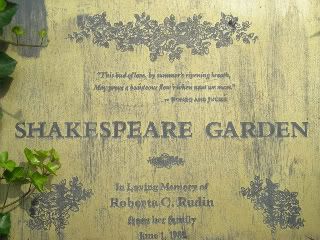
(Inscription reads: This bud of love, by summer's ripening breath,/May prove a beauteous flow'r when next we meet)
From what I've read the garden is best viewed in springtime when all of the flowers are in bloom. I had to settle for greenery. Lots and lots of greenery.
I did, however, find a plaque and some plants from Midsummer. Here's my attempt at fitting the book and the plaque into the same photo:
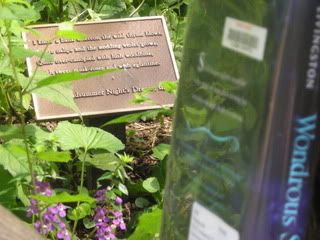
"I know a bank whereon the wild thyme blows/where oxlips and the nodding violet grows/Quite over-canopied with lush woodbine/With sweet musk-roses and with Eglantine" A Midsummer Night's Dream, ii, 1
Mission accomplished, I found a nice grassy shaded area, broke out a picnic lunch, and settled in to read Wondrous Strange, and was very proud of myself that the book all but opens in the very part of Central Park I was sitting in!
Kelley, at 17, has moved to New York City to pursue her dream of acting, and has caught her lucky break when the tempermental star of A Midsummer Night's Dream storms off the stage, forcing stagehand and understudy Kelley to step into the role of the fairy queen Titania. It's Autumn in New York, just days before Halloween - an eerie time in the city. Kelley, already stressed from being pushed suddenly into the spotlight, is further unnerved when she attracts the attention of a mysterious good looking stranger in the park. And then she finds a horse in the reservoir that proceeds to follow her home and take up residence in her apartment's tiny bathtub.
Kelley has unwittingly been wandering through Central Park when the barrier between the human and fairy worlds is at its weakest. The mysterious stranger is Sonny Flannery, one of Auberon's guards of the gate. Sonny is instantly attracted to Kelley, not only for her spunk and good looks - but rather there's an almost otherworldly element to her that Sonny can't get out of his mind - even when he's supposed to be guarding the human world from Queen Mab's minions.
It feels to me like if you've read one girl-meets-fairies story you've probably read them all - it's not a genre that holds my attention particularly well, but the slight Shakespearean element adds a little bit of depth to the story. Only a little bit, because it's not like the story itself mimics Midsummer, rather characters like Auberon (Oberon) and Puck are inserted where, really, any generic fairy king/trickster could have been.
The inclusion of some Midsummer characters did get me thinking, though - Oberon shows up in lots of places in literature - but I can't think of anything outside of the Gargoyles cartoon that features Titania (who personally I've always found more awesome - the only person with the guts to stand up to Oberon. And he could only get her back using magic!). Anyone know of a book where Titania gets to be the star?
I picked up Wondrous Strange because the annotation on the BBYA nominations page mentions A Midsummer Night's Dream. Now, despite being a huuuuuuuuuuuuuuuuuuuuuuuuuuuuge drama geek, I've never been a big fan of Shakespeare. In college I took a 2 week study abroad course on the bard because I had to take a Shakespeare class and 2 weeks in London sounded a hell of a lot better than a semester in a stuffy classroom. However, Midsummer was my first introduction to Shakespeare, way back in 5th grade when I got to be a fairy in the high school's production (being the daughter of their costumer definitely had its perks!). Then, right when the play was about to open, the cartoon Gargoyles started a Midsummer-themed arc featuring Oberon, Titania and Puck prominently.
So even though there is nothing else about Wondrous Strange that would normally appeal to me, I knew I had to pick it up. And as long as I was reading something Shakespearean-esque, why not check out the Shakespeare Garden in Central Park?
(Inscription reads: This bud of love, by summer's ripening breath,/May prove a beauteous flow'r when next we meet)
From what I've read the garden is best viewed in springtime when all of the flowers are in bloom. I had to settle for greenery. Lots and lots of greenery.
I did, however, find a plaque and some plants from Midsummer. Here's my attempt at fitting the book and the plaque into the same photo:
"I know a bank whereon the wild thyme blows/where oxlips and the nodding violet grows/Quite over-canopied with lush woodbine/With sweet musk-roses and with Eglantine" A Midsummer Night's Dream, ii, 1
Mission accomplished, I found a nice grassy shaded area, broke out a picnic lunch, and settled in to read Wondrous Strange, and was very proud of myself that the book all but opens in the very part of Central Park I was sitting in!
Kelley, at 17, has moved to New York City to pursue her dream of acting, and has caught her lucky break when the tempermental star of A Midsummer Night's Dream storms off the stage, forcing stagehand and understudy Kelley to step into the role of the fairy queen Titania. It's Autumn in New York, just days before Halloween - an eerie time in the city. Kelley, already stressed from being pushed suddenly into the spotlight, is further unnerved when she attracts the attention of a mysterious good looking stranger in the park. And then she finds a horse in the reservoir that proceeds to follow her home and take up residence in her apartment's tiny bathtub.
Kelley has unwittingly been wandering through Central Park when the barrier between the human and fairy worlds is at its weakest. The mysterious stranger is Sonny Flannery, one of Auberon's guards of the gate. Sonny is instantly attracted to Kelley, not only for her spunk and good looks - but rather there's an almost otherworldly element to her that Sonny can't get out of his mind - even when he's supposed to be guarding the human world from Queen Mab's minions.
It feels to me like if you've read one girl-meets-fairies story you've probably read them all - it's not a genre that holds my attention particularly well, but the slight Shakespearean element adds a little bit of depth to the story. Only a little bit, because it's not like the story itself mimics Midsummer, rather characters like Auberon (Oberon) and Puck are inserted where, really, any generic fairy king/trickster could have been.
The inclusion of some Midsummer characters did get me thinking, though - Oberon shows up in lots of places in literature - but I can't think of anything outside of the Gargoyles cartoon that features Titania (who personally I've always found more awesome - the only person with the guts to stand up to Oberon. And he could only get her back using magic!). Anyone know of a book where Titania gets to be the star?
Thursday, July 30, 2009
Review: If the Witness Lied by Caroline B. Cooney
Caroline B. Cooney has been writing YA suspense books for ages. Books like The Face on the Milk Carton helped define the genre in its early years and many of her books are (probably rightfully) considered classics. I know in middle school I absolutely devoured the Janie quartet (which starts with The Face on the Milk Carton) - I absolutely couldn't get enough of that poor girl's story.
So picking up Cooney's latest book, If the Witness Lied was in a way like visiting an old friend. The narrative just immediately felt like it was one of her books, even though it's been years since I've read any of them. The characters are all rather upstanding but have some crucial flaw/secret/weight on their shoulders, danger pops up immediately within the first few pages of the book, and its a tightly plotted suspense novel that I read through quickly (started it this morning on the train, read a bit during lunch and then again on the train home, and finished the last quarter of the book in about half an hour at home).
The story follows the four Fountain children - Madison, Jack, "Smithy" and Tris - who within the last three years have witnessed both their mother's and their father's deaths. Their mother died from cancer shortly after giving birth to Tris - she refused chemotherapy during her pregnancy to bring him into the world. A year before the start of the novel, their father died as well - apparently in an accident caused by Tris, earning the family a lengthy stay in the media spotlight thanks to the gristly story of a toddler who caused the deaths of two parents.
In the year since their father's death, the children have split up: Madison lives with her god parents, Smithy ran away to boarding school, while Jack nobly stuck it out and lived at home with Tris and Aunt Cheryl, their mother's stepsister who ingratiated herself into their lives shortly after their mother's death. Aunt Cheryl clearly feels no great love for the children - more than once she's suggested Tris or Jack belong in foster care and has never tried to get Madison or Smithy to move back home. Instead she is obsessed with "fixing up" the house - she's one of those women who watches nothing but home redecorating shows on TV all day. Aunt Cheryl is the witness referred to in the title, as she was the only one to witness the accident that killed the kids' father, thus it was she who placed the blame on Tris.
The day after what would have been their father's birthday, Aunt Cheryl reveals that she has arranged for a reality TV crew to document the family. Jack sees this as "selling" Tristan to TV - again. Coincidentally, the two sisters also feel a pull to come home, uniting the Fountains against the intruding enemy of Aunt Cheryl and Reality TV.
As much as Cooney was a pioneer of YA lit, in some ways this book really felt like it belonged to another era of YA literature. I kept comparing the four siblings to The Boxcar Children - the littlest brother is charming and winning, the oldest brother is the solid, responsible one and the two sisters are pretty much incompetent. Sure they can whip up toast in an effort to feel useful and keep everyone's spirits up, but when it comes to planning and action, they leave it all to Jack (even though he's two years younger than the oldest sister). Perhaps the sisters wouldn't have irked me so much if all the other women in the novel weren't also incompetent and/or evil: we're told right away that Aunt Cheryl is a beastly aunt who apparently wants to remove every little memento of the children's dead parents (she was only a step-sister to their mom, and came into the family when the mom was already an adult), and the neighbor girl is also reliant upon Jack for making plans (and is the only pseudo-motherly influence little Tris has ever known).
All of the adults are largely absent throughout the novel, and when they do appear they are ineffective cardboard cutouts. There's also a bit of preachiness - literally in the form of reflections on religion and appeals to God, and figuratively in the constant diatribes against TV in general. I'm not sure Cooney fully did her research on how reality shows are filmed, either: we meet the associate produce and editor of the show, and they're followed around by a van with a TV antennae on top. In my senior year of college my speech team was followed around by a documentary crew, and I promise there were no creepy white vans with antennae stalking us through tournaments.
This is a quick and relatively engrossing read - if you're already a fan of Cooney's there isn't anything here to put you off. However it probably won't warrant a re-read, nor do I think it's going to stand up as one of her more endearing titles.
So picking up Cooney's latest book, If the Witness Lied was in a way like visiting an old friend. The narrative just immediately felt like it was one of her books, even though it's been years since I've read any of them. The characters are all rather upstanding but have some crucial flaw/secret/weight on their shoulders, danger pops up immediately within the first few pages of the book, and its a tightly plotted suspense novel that I read through quickly (started it this morning on the train, read a bit during lunch and then again on the train home, and finished the last quarter of the book in about half an hour at home).
The story follows the four Fountain children - Madison, Jack, "Smithy" and Tris - who within the last three years have witnessed both their mother's and their father's deaths. Their mother died from cancer shortly after giving birth to Tris - she refused chemotherapy during her pregnancy to bring him into the world. A year before the start of the novel, their father died as well - apparently in an accident caused by Tris, earning the family a lengthy stay in the media spotlight thanks to the gristly story of a toddler who caused the deaths of two parents.
In the year since their father's death, the children have split up: Madison lives with her god parents, Smithy ran away to boarding school, while Jack nobly stuck it out and lived at home with Tris and Aunt Cheryl, their mother's stepsister who ingratiated herself into their lives shortly after their mother's death. Aunt Cheryl clearly feels no great love for the children - more than once she's suggested Tris or Jack belong in foster care and has never tried to get Madison or Smithy to move back home. Instead she is obsessed with "fixing up" the house - she's one of those women who watches nothing but home redecorating shows on TV all day. Aunt Cheryl is the witness referred to in the title, as she was the only one to witness the accident that killed the kids' father, thus it was she who placed the blame on Tris.
The day after what would have been their father's birthday, Aunt Cheryl reveals that she has arranged for a reality TV crew to document the family. Jack sees this as "selling" Tristan to TV - again. Coincidentally, the two sisters also feel a pull to come home, uniting the Fountains against the intruding enemy of Aunt Cheryl and Reality TV.
As much as Cooney was a pioneer of YA lit, in some ways this book really felt like it belonged to another era of YA literature. I kept comparing the four siblings to The Boxcar Children - the littlest brother is charming and winning, the oldest brother is the solid, responsible one and the two sisters are pretty much incompetent. Sure they can whip up toast in an effort to feel useful and keep everyone's spirits up, but when it comes to planning and action, they leave it all to Jack (even though he's two years younger than the oldest sister). Perhaps the sisters wouldn't have irked me so much if all the other women in the novel weren't also incompetent and/or evil: we're told right away that Aunt Cheryl is a beastly aunt who apparently wants to remove every little memento of the children's dead parents (she was only a step-sister to their mom, and came into the family when the mom was already an adult), and the neighbor girl is also reliant upon Jack for making plans (and is the only pseudo-motherly influence little Tris has ever known).
All of the adults are largely absent throughout the novel, and when they do appear they are ineffective cardboard cutouts. There's also a bit of preachiness - literally in the form of reflections on religion and appeals to God, and figuratively in the constant diatribes against TV in general. I'm not sure Cooney fully did her research on how reality shows are filmed, either: we meet the associate produce and editor of the show, and they're followed around by a van with a TV antennae on top. In my senior year of college my speech team was followed around by a documentary crew, and I promise there were no creepy white vans with antennae stalking us through tournaments.
This is a quick and relatively engrossing read - if you're already a fan of Cooney's there isn't anything here to put you off. However it probably won't warrant a re-read, nor do I think it's going to stand up as one of her more endearing titles.
Subscribe to:
Posts (Atom)
